

Hospitals are under real pressure. Patient volumes are rising, payer rules are becoming more complex, and denial scrutiny is increasing. At the same time, staffing shortages and higher operating costs are limiting how quickly organizations can adapt.
The workforce gap adds urgency. The Association of American Medical Colleges projects a shortage of up to 86,000 physicians by 2036 if current trends continue. Fewer clinicians are managing rising patient volumes while administrative complexity continues to increase.
When operations slow down, revenue follows. Incomplete documentation delays coding. Coding errors lead to denials. Denials extend days in A/R and tighten already narrow margins.
AI for hospital operations is becoming important today. When integrated into documentation, coding, and claim validation workflows, it reduces preventable errors, speeds up reimbursement, and improves revenue stability without adding headcount.
For hospital leaders, the choice is clear. Modernize operational workflows now and protect revenue and compliance. Delay and inefficiencies continue to compound across the revenue cycle. This article explores how AI is strengthening hospital operations where the pressure is highest.
Key Takeaways
- AI for hospital operations improves documentation accuracy, coding precision, and claim validation, reducing preventable denials and accelerating reimbursement.
- Operational slowdowns often stem from documentation gaps, coding backlogs, and fragmented systems that directly impact cash flow and compliance.
- Embedding AI into connected workflows, rather than isolated tools, strengthens throughput across the full care-to-cash cycle.
- Governance is critical. Secure integration, explainable outputs, regulatory alignment, and human oversight ensure audit readiness and compliance stability.
- Purpose-built platforms like RapidClaims operationalize AI at scale, improving coding consistency, risk adjustment accuracy, and revenue predictability without replacing existing EHR infrastructure.
Table of Contents
- What Is AI for Hospital Operations?
- Why Hospital Operations Are Slowing Revenue Cycles
- How AI Is Applied Across Hospital Operations
- Governance, Compliance, and Audit Readiness in Operational AI
- The Future of AI for Hospital Operations
- RapidClaims: AI-Powered Revenue Cycle Optimization for Hospitals
- Conclusion
- FAQs
What Is AI for Hospital Operations?
AI for hospital operations applies machine learning and natural language processing to improve documentation, coding, scheduling, and revenue cycle workflows. These systems analyze structured and unstructured data from EHRs, billing platforms, and operational systems to identify gaps, automate repetitive tasks, and support predictive decision-making.
In operational settings, AI strengthens documentation accuracy, coding precision, claim validation, and resource planning. The objective is not clinical diagnosis, but workflow efficiency and revenue protection.
To see where this delivers measurable value, it is necessary to examine the operational breakdowns that continue to slow reimbursement and increase financial risk.
Also Read: The Evolution of Medical Coding: Embracing Artificial Intelligence in Healthcare
Why Hospital Operations Are Slowing Revenue Cycles
Hospital revenue depends on how efficiently processes move from patient encounter to claim submission. Breakdowns in documentation, coding, or system coordination delay reimbursement and increase financial risk.
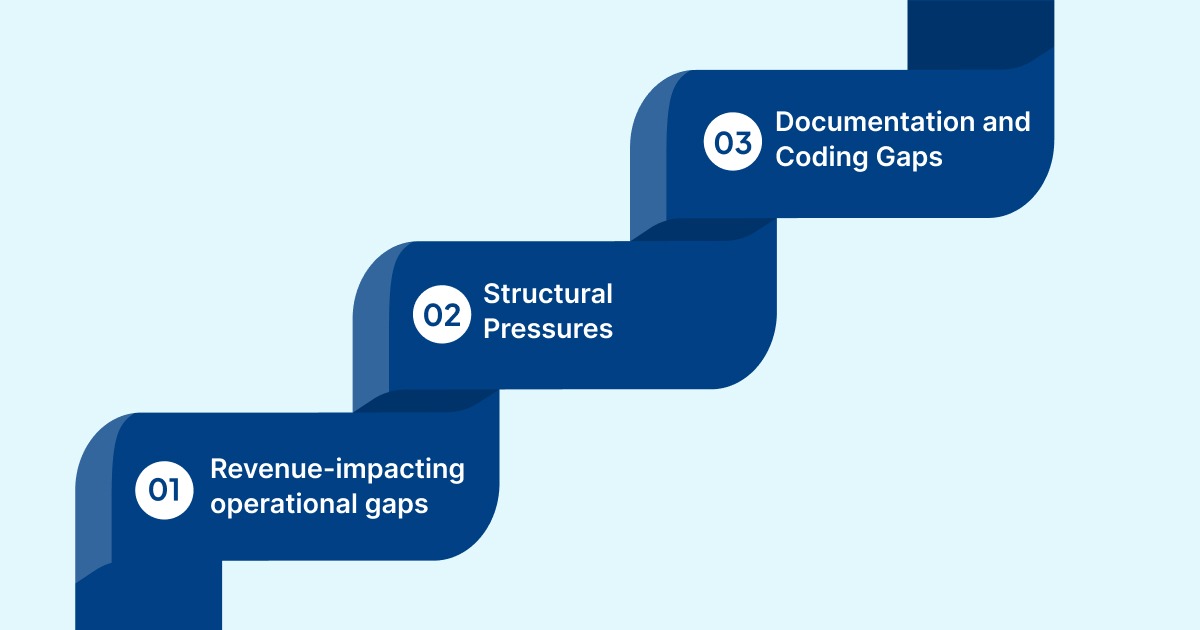
Operational Gaps with Direct Revenue Impact
Common failure points include:
- Incomplete clinical documentation
- Delayed chart finalization
- Coding backlogs
- ICD-10 and modifier errors
- NCCI edit conflicts
- Weak integration between EHR and billing systems
- Post-submission denial rework
Each delay compounds the next. Unfinished documentation postpones coding. Coding errors trigger denials. Denials extend days in A/R and increase administrative burden.
These are not isolated administrative issues. They directly affect cash flow and compliance exposure.
Structural Pressures
Operational friction is intensified by broader system constraints.
- Workforce Instability: Clinician burnout, coder shortages, rising chart volumes, and overtime dependency are reducing operational capacity while demand continues to increase.
- Financial and Capacity Constraints: Higher occupancy with fewer staffed beds, rising labor and supply costs, and narrow operating margins limit flexibility and slow operational throughput.
- Fragmented Technology Infrastructure: Siloed EHR, coding, and billing systems, combined with limited HL7/FHIR interoperability and manual reconciliation, reduce real-time visibility and increase processing delays.
When systems fail to align, manual intervention increases variability and slows throughput.
Documentation and Coding Gaps
Documentation precision directly determines reimbursement accuracy. Weak documentation leads to:
- Missed HCC capture
- Incorrect ICD-10 or CPT assignment
- Downcoding
- Increased audit exposure
Industry benchmarks show initial denial rates often range between 10% and 15%, with many denials linked to preventable documentation and coding errors.
Many hospitals deploy isolated automation tools. Few connect documentation, coding, and validation into a unified workflow.
Without coordinated systems, delays persist. Operational efficiency requires integration across the full revenue cycle. When documentation accuracy improves, coding accelerates. When coding precision improves, denials decline. When denials decline, revenue stabilizes.
Hospitals that address operational friction systematically strengthen both financial predictability and compliance control.
How AI Is Applied Across Hospital Operations
AI delivers measurable impact when it connects documentation, coding, billing, and operational workflows. Its value lies in improving accuracy, throughput, and revenue integrity across the care-to-cash process.
Documentation and Coding Accuracy
AI-powered NLP engines analyze physician notes and convert unstructured text into structured, coding-ready data before claims are generated.
These systems:
- Extract diagnoses and procedures
- Identify missing specificity
- Highlight undocumented comorbidities
- Surface HCC gaps
- Suggest ICD-10, CPT, and HCPCS codes with confidence scoring
In structured environments, deep learning models approach 90% coding accuracy. The result is fewer documentation queries, faster chart completion, and improved coding consistency without increasing staffing.
Also Read: How Computer-Assisted Coding Reduces Burnout for Medical Coders
Claim Validation and Denial Prevention
AI claim validation engines review submissions before they reach payers.
They detect:
- Modifier errors
- NCCI conflicts
- Missing documentation support
- Medical necessity gaps
- Payer-specific rule discrepancies
Pre-submission validation improves first-pass acceptance and reduces rework. In high-complexity specialties, real-time validation has significantly lowered modifier-related denials.
AI also analyzes historical denial data to identify recurring patterns and prioritize high-value appeals, shifting denial management from reactive correction to preventive control.
Risk Adjustment and Revenue Integrity
For Medicare Advantage and value-based contracts, AI improves HCC documentation and RAF accuracy.
AI systems:
- Detect undocumented chronic conditions
- Align documentation with HCC V28 updates
- Flag suspect diagnoses for review
- Maintain audit-ready traceability
Some networks have improved RAF accuracy by 8% using AI-assisted risk adjustment. AI also cross-checks documentation against billing records to detect missed charges and undercoding, reducing revenue leakage.
Predictive Capacity and Throughput Optimization
AI strengthens operational flow across admissions, discharge, and staffing.
Predictive models:
- Forecast admission and discharge patterns
- Optimize bed allocation
- Align staffing levels with projected demand
- Reduce overtime dependency
Improved throughput accelerates documentation, coding handoffs, and claim generation.
Administrative Automation and Document Processing
AI reduces manual workload in administrative workflows through structured document intelligence.
Applications include:
- Extracting data from physician notes and lab reports
- Processing prior authorizations and denial letters
- Automating insurance eligibility verification
- Supporting coding validation and compliance checks
Pharmacy, Supply Chain, and Infrastructure Optimization
AI extends beyond revenue workflows to strengthen broader operational control.
Applications include:
- Forecasting medication demand
- Monitoring supply chain variability
- Predicting equipment maintenance needs
- Automating inventory forecasting and reordering
These systems reduce downtime, prevent shortages, and improve financial predictability without expanding administrative burden.
Across these domains, AI improves operational precision when embedded into connected workflows. The impact comes from coordinated systems that reduce preventable errors, shorten processing cycles, and protect reimbursement integrity.
Governance, Compliance, and Audit Readiness in Operational AI
AI in hospital operations must function within strict regulatory and compliance boundaries. Governance is not optional. It must be built into the system architecture from the start.
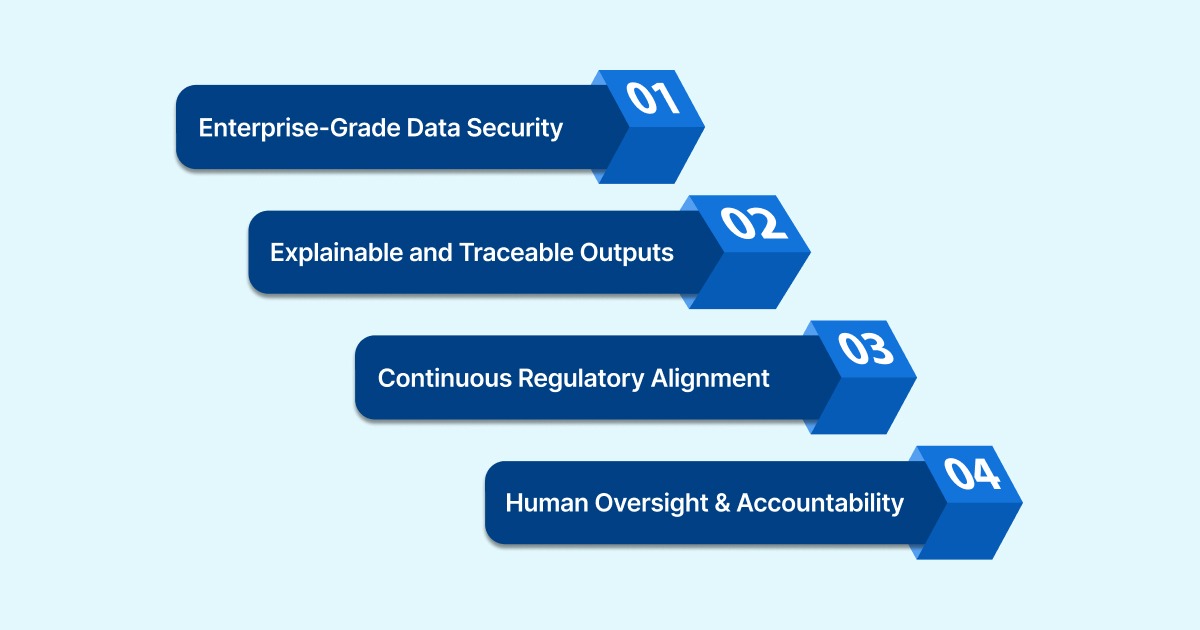
1. Enterprise-Grade Data Security: AI systems must protect PHI at every stage of processing. This requires encryption in transit and at rest, strict role-based access controls, detailed audit logs, and formal Business Associate Agreements. Security is not a feature. It is the baseline requirement for deployment inside hospital environments.
2. Explainable and Traceable Outputs: Every AI-generated coding suggestion or validation flag must be defensible. Systems should clearly link recommendations to source documentation, display confidence levels, and log any human overrides. Version tracking of rule updates is also essential to support CMS reviews and payer audits.
3. Continuous Regulatory Alignment: Coding and reimbursement standards evolve frequently. AI models must stay aligned with ICD-10 and CPT updates, HCC V28 transitions, NCCI edits, LCD and NCD policies, and payer-specific rules. Ongoing validation cycles ensure logic remains accurate as guidelines change.
4. Human Oversight and Accountability: AI improves efficiency, but final responsibility remains with clinical, coding, and compliance teams. Human review is necessary to validate edge cases, address ambiguity, and prevent bias. Strong governance ensures automation strengthens operational control rather than introducing new risk.
Operational AI delivers sustainable value only when governance, transparency, and regulatory alignment are built into every layer of deployment.
The Future of AI for Hospital Operations
AI in hospitals today is focused on specific, high-impact tasks. It supports documentation review, coding validation, imaging analysis, administrative automation, and patient communication. These systems improve speed and consistency within clearly defined workflows.
Artificial general intelligence remains conceptual. For now, healthcare organizations are investing in targeted AI that produces measurable operational and clinical results.
Near-term advancements will deepen predictive capabilities. Future models may combine longitudinal medical records, genetic data, and real-time inputs to identify risk earlier and personalize treatment decisions. In drug development, AI continues to accelerate compound screening and trial optimization.
Expansion, however, brings responsibility. Key risks include:
- Data privacy and cybersecurity threats
- Model inaccuracies
- Bias in training data
- Increasing regulatory oversight
Mitigating these risks requires structured validation before deployment, ongoing performance monitoring, transparent audit trails, and human review in high-impact decisions.
The future of AI in hospital operations depends on disciplined execution. Organizations that deploy secure, integrated, and well-governed systems will improve efficiency and financial stability while maintaining compliance and patient safety.
Hospitals need systems that connect documentation, coding, and validation without disrupting existing infrastructure. That is where purpose-built revenue cycle AI platforms make a big difference.
RapidClaims: AI-Powered Revenue Cycle Optimization for Hospitals
RapidClaims is an enterprise AI platform built to strengthen revenue cycle performance at the point where documentation drives reimbursement. It integrates into existing EHR and billing environments, enhancing workflows with automation, validation, and compliance controls rather than replacing core systems.
- RapidCode automates ICD-10, CPT, HCPCS, and HCC coding across specialties. Using machine learning and NLP, it interprets clinical documentation, generates audit-ready codes, and integrates through APIs and HL7/FHIR standards. The result is faster chart processing, fewer coding errors, and cleaner claims while maintaining coder oversight.
- RapidScrub focuses on denial prevention before submission. It applies more than 119 million payer rule edits to identify modifier issues, NCCI conflicts, documentation gaps, and payer-specific discrepancies. By resolving errors upstream, it improves first-pass acceptance and accelerates reimbursement.
- RapidCDI strengthens clinical documentation integrity and risk adjustment accuracy. It detects undocumented conditions, supports compliant HCC capture, and aligns documentation with evolving CMS requirements, improving RAF precision and reducing audit exposure.
Together, these solutions create a connected revenue workflow that:
- Increases coding throughput and consistency
- Identifies documentation gaps early
- Prevents avoidable denials
- Strengthens risk adjustment accuracy
- Maintains seamless integration with hospital systems
Hospitals can begin with targeted deployment in high-volume specialties and scale based on measurable improvements in speed, denial reduction, and revenue predictability.
Conclusion
Operational inefficiencies in documentation, coding, and denial management directly influence hospital revenue performance. As payer requirements grow more complex and workforce capacity remains limited, fragmented manual workflows increase the risk of delays, denials, and compliance exposure.
AI for hospital operations provides a structured way to address these challenges. When embedded into documentation, coding, and validation processes, it improves accuracy, reduces preventable errors, and strengthens revenue predictability. Sustainable impact depends on integration, governance, and measurable performance monitoring.
Platforms such as RapidClaims support this model by integrating AI-driven coding, risk adjustment, and claim validation into existing hospital systems. When implemented with oversight and clear KPIs, these tools help organizations improve operational efficiency while maintaining audit readiness.
Book a demo of RapidClaims to see how it can improve throughput, reduce denials, and strengthen reimbursement outcomes.
FAQs
1. What is AI for hospital operations?
AI for hospital operations uses machine learning and natural language processing to improve documentation, coding, scheduling, and claim validation workflows. It focuses on operational efficiency and revenue protection rather than direct clinical diagnosis.
2. How does AI reduce hospital claim denials?
AI reviews documentation and coding before submission, identifying missing specificity, modifier errors, and payer rule conflicts. By catching issues early, it reduces preventable denials and rework.
3. How does AI for hospital operations differ from clinical AI?
Operational AI improves workflow efficiency, documentation accuracy, and revenue cycle performance. Clinical AI supports diagnosis or treatment decisions, whereas operational AI strengthens administrative and financial processes.
4. Can AI replace medical coders in hospitals?
No. AI assists coders by automating repetitive review tasks and highlighting gaps, but human oversight remains necessary for compliance, judgment, and complex cases.
5. How does AI improve HCC risk adjustment accuracy?
AI analyzes clinical documentation to detect chronic conditions tied to HCC models and flags missing specificity. This improves RAF scoring accuracy under updated CMS guidelines, including HCC V28 transitions.
6. Does AI require major EHR modifications?
Most AI platforms integrate through APIs or HL7/FHIR connectors, allowing deployment without replacing or rewriting core EHR systems.


