

Did you know that the Medicare Fee-for-Service improper payment rate was 6.55% in Fiscal Year 2025, with an estimated $28.8 billion in improper payments?
If you manage coding revenue cycle performance or compliance, you already feel this pressure. Documentation gaps, modifier misuse, and unspecified ICD codes do not just slow claims.
These issues directly impact clean claims cash flow and expose practices to denials, recoupments, and heightened audit scrutiny. If your team is striving for accuracy under increasing regulatory pressure, you are not alone.
You need clarity, not complexity. You need systems that prevent errors before submission. This medical coding made easy guide will explore how to code accurately, prevent denials, strengthen audit readiness, and align documentation with payer expectations in 2026.
Quick Snippets
- Accurate medical coding drives clean claims, faster payments, audit protection, and revenue integrity.
- ICD-10-CM, CPT, and HCPCS Level II determine medical necessity, reimbursement, and compliance.
- Most denials stem from modifier misuse, unspecified codes, unbundling, and mismatches between diagnoses and procedures.
- A structured pre-submission checklist prevents errors before claims reach the payer.
- AI-powered automation like RapidClaims strengthens coding accuracy, reduces denials, and improves revenue cycle control.
Table of Contents
- What is Medical Coding?
- How Medical Coding Benefits You
- The 3 Code Systems That Determine Whether Your Claims Get Paid
- How the Medical Coding Process Works: Step by Step
- The Most Common Coding Errors That Lead to Claim Denials
- Denial Prevention: How to Code Correctly the First Time
- Transform Denial Prevention with RapidClaims
- Conclusion
- FAQs
What is Medical Coding?
Medical coding means reviewing clinical documentation and turning diagnoses, procedures, services, and supplies into standardized codes. The golden rule is simple: code what is documented and document what is coded. Teams use ICD-10-CM, CPT, and HCPCS Level II codes to submit claims, report quality data, and meet compliance requirements in the United States.
Coders read provider notes, operative reports, lab results, and visit documentation. They choose codes that clearly match the patient condition, the service performed, and the level of complexity documented. Every code must support medical necessity and follow payer rules and federal regulations.
Medical billing uses those codes to generate and submit claims for reimbursement. When coding fails, billing cannot correct unsupported or inaccurate data. The result is denial risk and audit exposure.
Below is a clear operational comparison.
| Area | Medical Coding | Medical Billing |
|---|---|---|
| Primary Function | Converts clinical documentation into standardized codes | Submits claims and manages reimbursement |
| Core Code Sets | ICD-10-CM, CPT, HCPCS Level II | Uses assigned codes to create claims |
| Responsibility | Ensure documentation supports code selection | Ensure claims are submitted correctly and followed through |
| Risk Exposure | Drives medical necessity, DRG assignment, modifier accuracy | Manages denials, appeals, and payment posting |
| Compliance Impact | Directly affects audit defensibility and fraud risk | Impacts timely filing and payer contract compliance |
| Revenue Impact | Determines whether the claim is payable | Determines whether the claim is paid and collected |
Now that medical coding made easy, the next question is simple. Why does coding accuracy matter so much?
How Medical Coding Benefits You
Medical coding does more than prepare a claim. It protects revenue, supports compliance, and strengthens operational control across the revenue cycle.
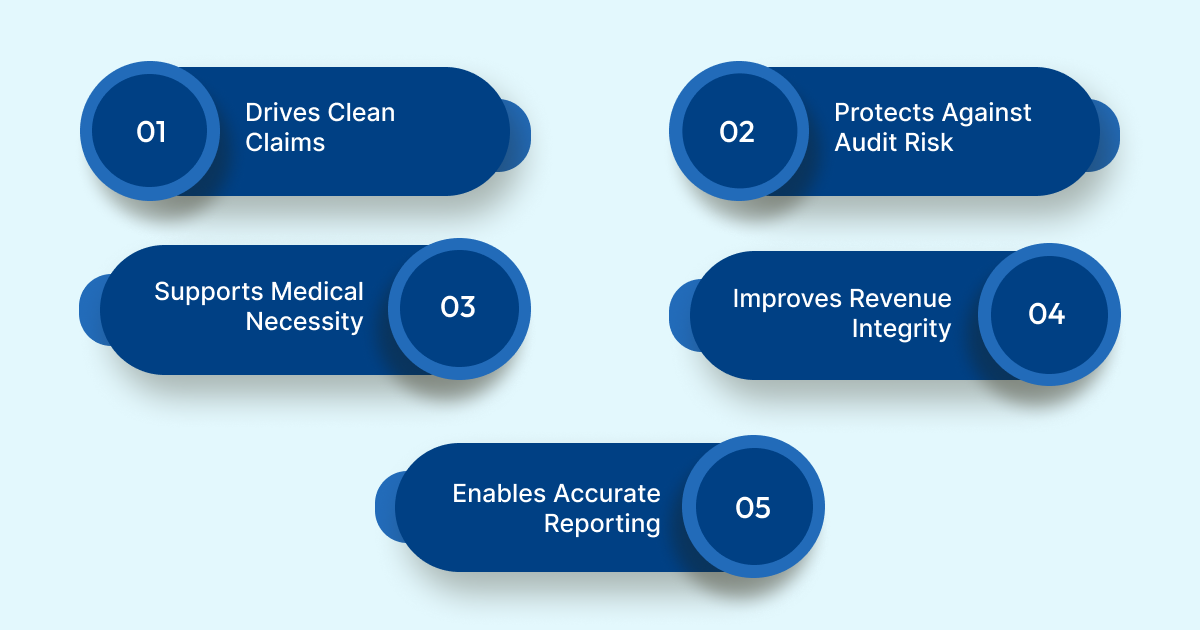
1. Drives Clean Claims and Faster Payments: Accurate coding reduces front-end rejections and medical necessity denials. When diagnosis and procedure codes align with documentation and payer policy, claims move through adjudication faster. This improves cash flow and lowers rework costs.
2. Protects Against Audit Risk: Coding directly affects audit exposure. Unsupported E/M levels, modifier misuse, and unspecified diagnoses can trigger payer review. Accurate coding strengthens documentation defensibility and reduces recoupment risk.
3. Supports Medical Necessity and Coverage Validation: Payers rely on coded data to determine whether services meet coverage rules. Specific ICD codes help validate severity and comorbidities. Clear CPT and HCPCS selection supports appropriate reimbursement.
4. Improves Revenue Integrity: Correct coding ensures that organizations capture the full scope of services provided without overbilling or underbilling. This balance protects against both revenue loss and compliance violations.
5. Enables Accurate Reporting and Risk Adjustment: Quality metrics, value-based care models, and risk adjustment programs depend on precise diagnosis capture. Coding accuracy influences performance scores and reimbursement under Medicare Advantage and other models.
However, medical coding made easy begins with understanding the code systems that drive reimbursement.
Learn more about the commonly used medical CPT/HCPCS codes.
The 3 Code Systems That Determine Whether Your Claims Get Paid
In the United States, three standardized systems determine whether a claim meets coverage rules, passes payer edits, and qualifies for payment. Understanding how ICD-10-CM, CPT, and HCPCS Level II work, and where coders typically go wrong with each, is the foundation of clean, defensible billing.
ICD-10-CM
ICD-10-CM (International Classification of Diseases, 10th Revision, Clinical Modification) is the diagnosis code set used across inpatient, outpatient, physician, and ancillary settings in the United States. It answers a core billing question: Why was the patient seen, and what condition is being treated?
- The system includes more than 70,000 alphanumeric codes organized into 21 chapters by body system and condition type.
- Codes range from three to seven characters.
- Additional characters add detail such as laterality, encounter type, and disease severity. That detail drives medical necessity review, risk adjustment, and DRG assignment.
In April 2026, CMS issued a mid-year update effective April 1, 2026.
CPT Codes: Categories I, II, and III
CPT (Current Procedural Terminology) codes, maintained by the American Medical Association (AMA), describe the procedures, services, and treatments the provider delivered.
The AMA organizes CPT codes into three categories:
- Category I: These are the primary billing codes, covering established procedures with documented clinical utility and broad payer acceptance. This is the category coders work with most frequently.
- Category II: Supplemental performance measurement codes used for quality tracking. They carry no reimbursement value and are optional. Including them does not trigger denials, but they are used by payers and CMS to track care quality metrics.
- Category III: Temporary codes for emerging technologies and experimental procedures. These codes are reviewed periodically. Importantly, not all payers recognize Category III codes for payment, and reimbursement policies vary widely. Verifying payer acceptance before billing a Category III code is essential.
Effective January 1, 2026, the updated CPT set added 270 new codes. It added AI-assisted diagnostic codes and a new Telemedicine Services subsection. that consolidates audio-visual and audio-only E/M services under a single, standardized framework for the first time.
These telehealth codes follow the same medical decision-making (MDM)-based selection logic as their in-person counterparts, simplifying documentation requirements for providers who bill both in-person and remote visits.
HCPCS Level II
HCPCS Level II (Healthcare Common Procedure Coding System) covers items and services that CPT does not.
- Primarily, durable medical equipment (DME), prosthetics, orthotics, supplies, ambulance services, and certain drug administrations are billed outside the physician's office.
- Where CPT addresses what the provider did, HCPCS Level II addresses what the provider supplied or administered.
- HCPCS Level II codes are alphanumeric, beginning with a letter (A through V) followed by four digits.
- They are maintained jointly by CMS and the HCPCS Workgroup and updated on a quarterly basis.
This means coders billing in DME, infusion therapy, or home health need to track updates throughout the year, not just annually.
In 2026, CMS expanded coverage for remote patient monitoring supplies under new HCPCS codes aligned with the telehealth expansion, adding supply and device codes that correspond to the new 98000-series E/M telehealth codes. Understanding the code sets is only part of the equation. Clean claims depend on a structured workflow.
How the Medical Coding Process Works: Step by Step
Medical coding has five core steps. Each one is a point where errors can enter the workflow and where careful practice keeps them out. The difference between a clean claim and a denied one often comes down to how precisely each step is executed.
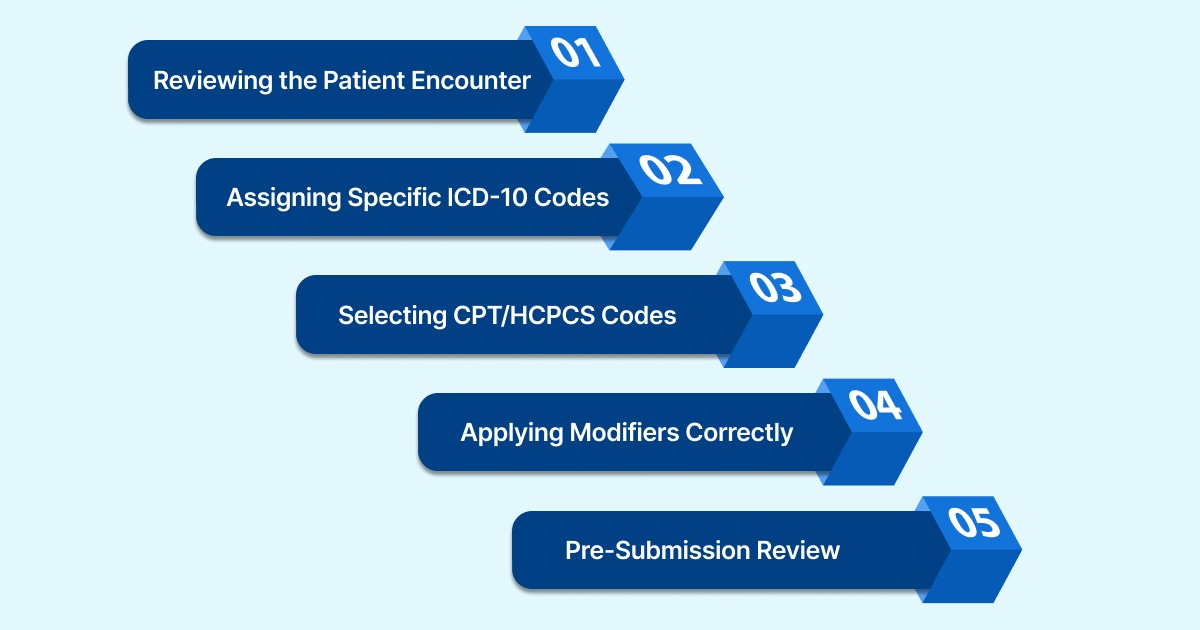
Step 1: Reviewing the Patient Encounter and Clinical Documentation
Before assigning a single code, read the complete encounter documentation. That means the physician's notes, any referenced diagnostic results, the stated reason for the visit, and everything that was actually done.
Skimming leads to missed specificity, overlooked secondary diagnoses, and incorrect CPT selection. A complete review takes minutes. A denied claim can take days to correct.
If documentation is unclear or incomplete, send a compliant query before coding. Never wait until after denial.
Step 2: Assigning ICD-10 Diagnosis Codes with Sufficient Specificity
With a clear picture of the encounter, assign diagnosis codes in the correct sequence. The principal diagnosis comes first. Secondary diagnoses that influenced treatment or consumed resources follow.
- Use the most specific ICD-10-CM code the documentation supports.
- If the provider documented a left tibial shaft fracture at the initial encounter, code it as S82.201A, not as an unspecified fracture. Specificity strengthens the medical necessity case the claim makes to the payer.
- Also apply chapter-specific ICD-10-CM guidelines. Many chapters include "code first," "use additional code," and "excludes" notes that govern sequencing. Ignoring these rules creates coding edits that trigger claim holds or outright denials.
- The April 2026 ICD-10-CM update also changed several Excludes1 notes to Excludes2 across key chapters, which affects whether two codes can be reported together on the same claim.
Review the addendum to confirm any pairs you regularly code together are still valid.
Step 3: Selecting CPT and HCPCS Procedure Codes
Procedure codes describe exactly what the provider delivered. Match each documented service to the most accurate CPT or HCPCS code.
- For E/M services, select the code level based on MDM complexity or total documented time, depending on which method the provider uses. As per CMS's 2026 guidelines, MDM is the primary selection driver.
- For surgical procedures, confirm that each component of the procedure is either included in the primary code's global period or is separately billable with documentation to support it.
- For HCPCS billing, verify that the code reflects the current 2026 quarterly update, particularly for drug administration and DME supply codes, which change more frequently than CPT.
Step 4: Applying Modifiers Correctly
Modifiers indicate that a service was altered in some way. Such as, performed bilaterally, by a different provider, or distinct from another service billed on the same date.
- Modifier 25 indicates that a significant, separately identifiable E/M service was performed on the same day as a procedure. It requires a separately identifiable E/M service beyond the procedure.
- Modifier 59 identifies a distinct procedural service that would normally be bundled under National Correct Coding Initiative (NCCI) rules, but clinical circumstances justify billing it separately. It requires clear documentation that the service was genuinely distinct under NCCI rules.
- Modifier 51 applies when multiple procedures are performed in the same session. The primary procedure bills at full value. Subsequent procedures are billed at a reduced rate. Some CPT codes are exempt from the multiple procedure reduction rule.
For 2026 telehealth CPT codes 98000 through 98015 use the correct place of service code (POS 02 for audio-visual, POS 10 for audio-only patient home) rather than a telehealth modifier. Confirm system updates before submission.
Step 5: Pre-Submission Review
Conduct a targeted final review. Confirm diagnosis and procedure alignment. Verify modifiers sequencing dates and authorization status. Run NCCI edits to detect bundling conflicts.
A structured checklist turns this step into measurable quality control. When teams follow this process consistently, first pass denial rates decline, and audit exposure decreases.
Also Read: Your 2026 Medical Coding Audit Checklist for Compliance & Clean Claims
However, even with a structured workflow, certain coding errors continue to drive denials.
The Most Common Coding Errors That Lead to Claim Denials
Most claim denials are not random. They cluster around the same errors, made by different coders, across different practices. Knowing exactly what those errors look like and how they happen is the most practical form of denial prevention available.
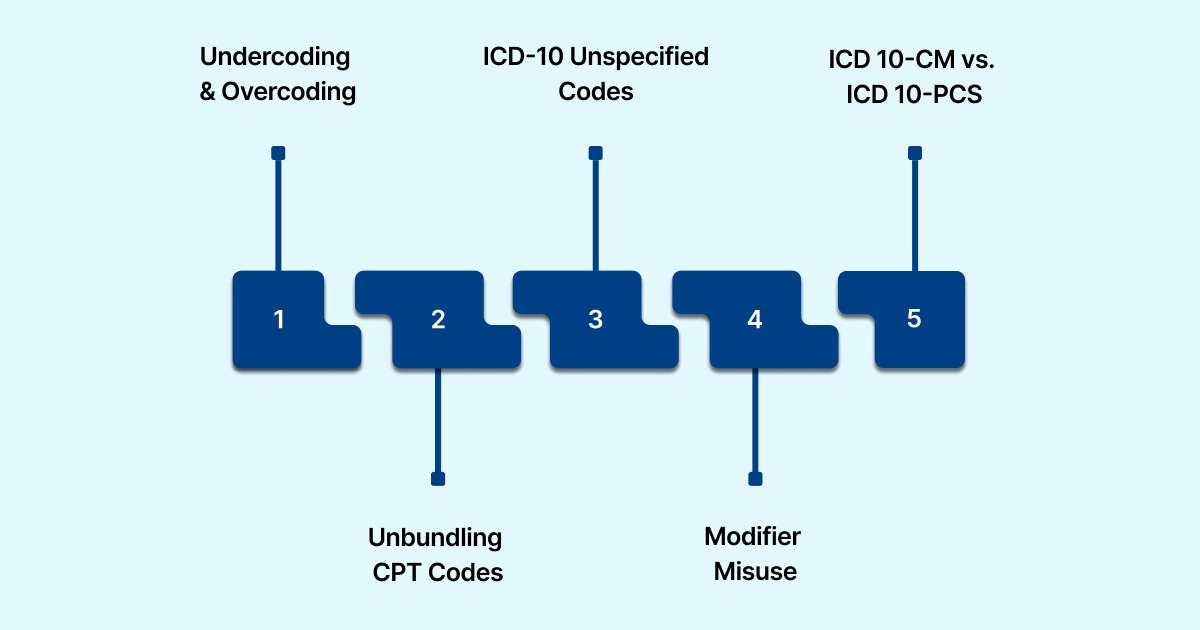
1. Undercoding and Overcoding
Overcoding means billing a higher-level or more complex service than the documentation and clinical record support. Undercoding means billing at a lower level than warranted, sometimes done defensively to avoid scrutiny, but it is still inaccurate.
Both carry real legal exposure. Overcoding that follows a consistent pattern can constitute a violation of the False Claims Act. Penalties include repayment of overpaid amounts, substantial fines, and exclusion from Medicare and Medicaid programs.
Undercoding results in systematic underpayment and signals a flawed coding process that surfaces as a compliance issue during internal or external audits.
Learn more about the impact of undercoding and overcoding in healthcare practices.
2. Unbundling CPT Codes
single comprehensive code. It inflates reimbursement artificially and is one of the primary targets of NCCI edits.
Unbundling is not always intentional. It frequently happens when coders are unfamiliar with which codes are component parts of a more comprehensive code. Regularly reviewing NCCI edit tables and cross-referencing bundling relationships for high-volume code pairs is an essential part of clean coding practice.
3. ICD-10 Unspecified Codes
Unspecified ICD-10-CM codes are valid when documentation truly lacks detail. But routine use of it, even when specificity is available, often maps to lower-weighted DRGs, which reduces reimbursement.
Consistent overuse also increases audit scrutiny, as reviewers look for patterns of poor documentation and coding controls.
4. Modifier Misuse
Modifier errors remain a top audit focus for commercial payers and government programs. For example,
- Modifier 25 is often overused. It applies only when a significant and separately identifiable E/M service goes beyond the work related to the procedure. If the note supports only the procedure itself, the modifier does not apply. Unsupported use is a common outpatient audit finding.
- Modifier 59 is frequently used to bypass NCCI bundling edits rather than document a truly distinct service. Payers actively monitor this pattern. Repeated unsupported use leads to denials, post-payment review, and recoupment.
- Modifier 51 errors usually involve omission when multiple procedures occur in the same session or incorrect use of codes exempt from multiple procedure reduction.
Always verify exemption status in the CPT descriptor before applying it.
5. ICD 10-CM vs. ICD 10-PCS
ICD-10-CM and ICD-10-PCS serve different functions. Confusing them is a basic but costly error, especially in inpatient settings.
- ICD-10-CM reports diagnoses. It applies across all care settings, including inpatient, outpatient, physician, and ancillary services. Use it to describe conditions, injuries, symptoms, and reasons for the encounter.
- ICD-10-PCS reports procedures, but only for inpatient hospital claims. It uses a seven-character structure that defines section, body system, root operation, body part, approach, device, and qualifier. Outpatient and physician procedures use CPT, not PCS.
The common error is using CPT instead of PCS for inpatient procedures or failing to assign PCS when required. This directly affects DRG assignment and reimbursement.
Read More: Common Medical Billing and Coding Errors and How to Protect Your Practice
Now, as you know, what errors could hamper your coding operations? You must be wondering how to fix them.
Denial Prevention: How to Code Correctly the First Time
The most efficient denial management strategy is to build quality control into the coding process itself, rather than treating it as a separate step that only kicks in after a claim has already been rejected.
Pre-Submission Denial Prevention Checklist
Use this checklist as a structured pre-submission review for every claim. It covers the highest-frequency denial triggers across payer types, code systems, and the 2026 code update cycles.
| Pre-Submission Check | What to Verify | If Missing or Wrong |
|---|---|---|
| Diagnosis-procedure alignment | Does the ICD-10 diagnosis code support the medical necessity of the CPT/HCPCS code billed? | Hold claim — initiate provider query before submitting |
| Code specificity | Is a more specific ICD-10-CM code available based on the documentation? | Update to the most specific code the documentation supports |
| Modifier presence and accuracy | Are required modifiers applied? Are any modifiers incorrectly applied? | Correct modifier selection before submission |
| NCCI edit check | Do any CPT/HCPCS code pairs on the claim have active NCCI Procedure-to-Procedure edits? | Review for unbundling; apply appropriate modifier or remove duplicate service |
| Medically Unlikely Edits (MUE) | Do any codes exceed the maximum units of service allowed per day for this provider type? | Verify units against documentation; split claim across dates if clinically supported |
| Prior authorization status | Is there a valid authorization number on file for services requiring prior auth? | Do not submit until authorization is confirmed and on record |
| Date of service accuracy | Does the date of service on the claim exactly match the date in the documentation? | Correct before submission. Date mismatches trigger automatic denial |
| Place of service code | Is the POS code accurate for where the service was actually delivered? | Incorrect POS triggers automatic denial across most payers |
| Provider NPI and taxonomy | Is the rendering provider's NPI and taxonomy code correct for this payer and service type? | Verify enrollment and correct before submission |
| Duplicate claim check | Has this exact claim (same patient, DOS, and code) already been submitted? | Do not resubmit without first checking original claim status in the payer portal |
| Secondary diagnoses completeness | Are all relevant secondary diagnoses captured that affected treatment or resource use? | Add missing secondary diagnoses — they affect DRG weight and reimbursement accuracy |
| 2026 code validity | Are all codes current as of the applicable 2026 update cycle (Oct 2025 annual + Apr 2026 mid-year for ICD-10; Jan 2026 for CPT)? | Replace deleted or revised codes with their 2026 equivalents before submitting |
Payer-Specific Denial Patterns to Know Before You Submit
A significant portion of denials do not come from coding errors. They come from payer-specific rules that differ from standard CMS guidelines.
Commercial payers in particular maintain their own coverage policies, modifier acceptance requirements, and prior authorization rules that do not always align with Medicare.
- Before submitting to an unfamiliar payer, or when you are seeing repeated denials from a specific payer, pull their coverage policies for the codes in question. Most commercial payers publish these on their provider portals.
- For Medicare, your MAC publishes Local Coverage Determinations (LCDs) and Local Coverage Articles (LCAs) that specify exactly what documentation is required for a code to be considered medically necessary in that jurisdiction.
- Specific patterns to watch for:
- Some payers do not accept modifier 59 and instead require the more granular -X{EPSU} modifier subset.
- Some require specific ICD-10 diagnosis codes to accompany certain procedure codes, a requirement that is not visible in the CPT code descriptor itself.
- Many payers impose frequency limitations on services like imaging, therapy, or wellness visits that are stricter than CMS guidelines.
Building a payer-specific rule reference for your highest-volume payers and updating it regularly is one of the most practical steps a coding team can take.
At this point, denial prevention stops being just a coding discipline. It becomes a systems issue. If your workflows cannot adapt in real time to payer-specific edits, coverage rules, and documentation requirements, revenue leakage is inevitable. That is where automation moves from being helpful to being strategic.
Transform Denial Prevention with RapidClaims
By now, one pattern is clear for medical coding made easy. Even strong coding teams struggle to keep pace with evolving edits, LCD requirements, and HCC updates. When systems rely on human catch-up instead of real-time validation, denials become a recurring cycle.
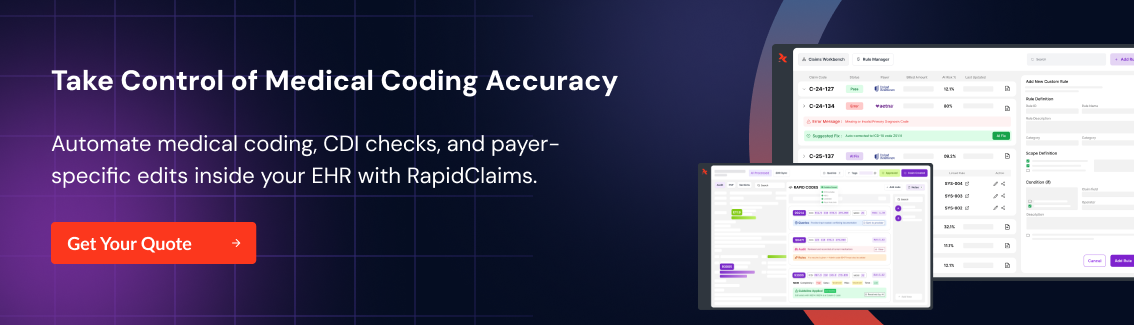
RapidClaims breaks that cycle. It uses AI-driven automation to code accurately, validate payer rules before submission, and surface documentation gaps while the encounter is still actionable.
Instead of correcting claims after denial, you prevent errors at the source. The platform integrates directly into your EHR and revenue cycle workflow, applying payer-specific intelligence in real time.
We deliver:
- Autonomous ICD-10, CPT, and E/M coding with RapidCode™, with 96%+ audited accuracy and high-volume throughput.
- AI-driven CDI optimization with RapidCDI™ to improve HCC capture, RAF accuracy, and documentation quality.
- Intelligent denial prevention with RapidScrub™, with machine-learned smart edits and real-time payer validation.
- Success-based denial recovery with RapidRecovery™, which overturns claims efficiently with contingency pricing.
- Seamless EHR and clearinghouse integrations via SMART-on-FHIR, HL7, and X12 837 interchange to fit within existing Epic, Cerner, Athena, and other workflows.
- Built-in compliance guardrails aligned with CMS, NCCI, LCD/NCD, and payer policy requirements.
- Full audit transparency with line-level rationales, traceable decision logic, and exportable audit trails.
- Enterprise-grade security with HIPAA-aligned infrastructure, role-based access controls, encryption, and SOC 2–ready safeguards.
RapidClaims replaces reactive revenue cycle management with predictive, AI-powered control that protects revenue and strengthens operational performance.
Conclusion
Medical coding determines whether your claims get paid accurately, on time, and in full. From selecting the right ICD-10 codes to applying modifiers correctly and aligning with payer-specific rules, precision at every step protects revenue.
Strong documentation review, correct sequencing, and structured pre-submission checks turn denial prevention into a repeatable process, not a reactive cleanup effort.
RapidClaims strengthens that process with AI-driven coding, CDI optimization, denial prevention, and recovery solutions that integrate directly into your existing workflows. It helps your team reduce errors, improve compliance, and accelerate reimbursement with measurable impact.
If you’re ready to reduce denials and take control of your revenue cycle, schedule a personalized demo today.
FAQs
1. What Is the Most Common Reason a Medical Claim Gets Denied?
The most common reason is a lack of medical necessity. This usually stems from diagnosis–procedure mismatches, insufficient documentation, missing modifiers, or payer-specific coverage rules that were not followed before submission.
2. What Coding Practices Are Most Likely to Trigger an Audit?
Frequent use of modifier -25 or -59 without clear documentation, high rates of unspecified ICD-10 codes, upcoding E/M levels, and billing patterns that deviate from peer benchmarks commonly trigger payer audits.
3. How Do I Know If My Coding Is Audit-Ready?
Your coding is audit-ready when documentation supports every code billed, modifiers are justified, medical necessity aligns with payer policies, and internal audits show low error rates with corrective action tracking in place.
4. What Is the Difference Between a Coding Error and Fraud?
A coding error is an unintentional mistake due to oversight or misinterpretation. Fraud involves knowingly submitting false or misleading information to obtain improper reimbursement. Intent is the key legal distinction.
5. How Often Do Medical Coding Guidelines Change?
Medical coding guidelines change at least annually, with ICD-10-CM updates in October, CPT updates in January, and quarterly HCPCS changes. CMS and commercial payers also revise policies throughout the year, requiring continuous monitoring for compliance.


