

In healthcare revenue cycle management, a contractual adjustment is the difference between what a provider charges and what a payer agrees to reimburse under a negotiated contract.
If a provider bills $1,000 and the payer’s allowed amount is $700, the remaining $300 becomes a contractual adjustment. That amount cannot be billed to the patient when the provider is in-network; it is a mandated reduction embedded in reimbursement agreements.
The concept sounds simple. The impact is not. Industry data consistently show that billing inaccuracies remain a pervasive challenge; up to 80% of U.S. medical bills contain one or more errors, which can cascade through the revenue cycle and affect reimbursement, reconciliation, and financial reporting.
Contractual adjustments shape net patient revenue, influence accounts receivable performance, affect cash flow predictability, and determine how accurately financial performance is reported. When misclassified or posted without validation, they can quietly mask underpayments, coding errors, or contract misalignment.
This blog breaks down how contractual adjustments work within claims adjudication, why they matter to revenue integrity leaders, and how structured reconciliation works.
Key Takeaways
- A contractual adjustment is the required difference between billed charges and payer-allowed amounts under a negotiated contract, and it cannot be billed to in-network patients.
- Contractual adjustments directly impact net revenue, cash flow visibility, and financial reporting accuracy across the revenue cycle.
- Misclassifying denials or underpayments as contractual adjustments can hide recoverable revenue and distort performance metrics.
- Accurate contract configuration, disciplined ERA posting, and routine reconciliation are essential to prevent silent revenue leakage.
- AI-driven contract validation and variance detection strengthen adjustment accuracy, improve audit readiness, and protect reimbursement integrity.
Table of Contents
- What Is a Contractual Adjustment?
- Why Contractual Adjustments Occur
- How Contractual Adjustments Affect Revenue and Cash Flow
- How Contractual Adjustments Appear on ERA and EOB
- How to Calculate a Contractual Adjustment
- Contractual Adjustment vs Write-Off vs Denial
- Common Errors in Contractual Adjustment Posting
- Best Practices to Manage Contractual Allowance Adjustments
- How AI Improves Contractual Adjustment Reconciliation
- How RapidClaims Strengthens Contractual Adjustment Workflows
- Final Words
- FAQs
What Is a Contractual Adjustment in Medical Billing?
A contractual adjustment, sometimes called a contractual allowance adjustment, is the required reduction between a provider’s billed charge and the payer’s allowed reimbursement under a negotiated contract or regulatory fee schedule.
When a claim is adjudicated:
- The payer determines the allowed amount
- The difference between the billed charge and the allowed amount is written off per contract
- The patient is responsible only for defined cost-sharing, such as a deductible, copay, or coinsurance
For example:
- Billed Amount: $1,200
- Allowed Amount: $700
- Contractual Adjustment: $500
That $500 cannot be billed to the patient in an in-network arrangement. It reflects a contractual obligation, not a collection failure.
On an Electronic Remittance Advice (ERA) or Explanation of Benefits (EOB), this reduction typically appears under the CO (Contractual Obligation) group code.
Contractual Adjustment Rate (CAR)
To understand the financial impact of contractual adjustments, organizations monitor the Contractual Adjustment Rate (CAR).
CAR = Contractual Adjustments ÷ Total Billed Charges
CAR measures how much of the gross charges are reduced through contractual allowances. In many organizations, especially those with significant Medicare volume, CAR may range between 60–70%, depending on payer mix and service lines.
Tracking CAR helps revenue cycle leaders assess:
- Payer mix influence
- Contract performance
- Net revenue realization trends
Now that you understand how CAR measures financial impact, let’s explore why these adjustments occur in the first place.
Why Do Contractual Adjustments Occur?
Contractual adjustments arise from the structure of provider–payer agreements. They are not arbitrary reductions; they reflect predefined reimbursement terms embedded in contracts and regulatory programs.
- Contracted Rate Agreements: When providers join payer networks, they accept negotiated fee schedules for specific CPT or HCPCS codes. If a submitted charge exceeds the contracted rate, the excess is recorded as a contractual adjustment.
- Billed vs. Allowed Amount Variance: Payers reimburse only up to the allowed amount defined in the contract or program rule. Any difference between the billed charge and the allowed amount becomes an adjustment. This variance is expected and should match contract modeling.
- Fee Schedule and Policy Updates: Payers periodically revise reimbursement methodologies, coverage policies, or regulatory fee schedules. When allowed amounts change, the resulting adjustment reflects the updated reimbursement terms.
Consistent monitoring of contract terms and payer updates is necessary to ensure adjustments align with negotiated rates and do not conceal underpayments.
Although these reductions are contractually defined, their financial and operational impact extends well beyond routine fee schedule differences.
How Contractual Adjustments Affect Revenue and Cash Flow
Contractual adjustments determine how much of your billed charges translate into actual revenue. They influence financial reporting, cash flow predictability, and operational efficiency across the revenue cycle.
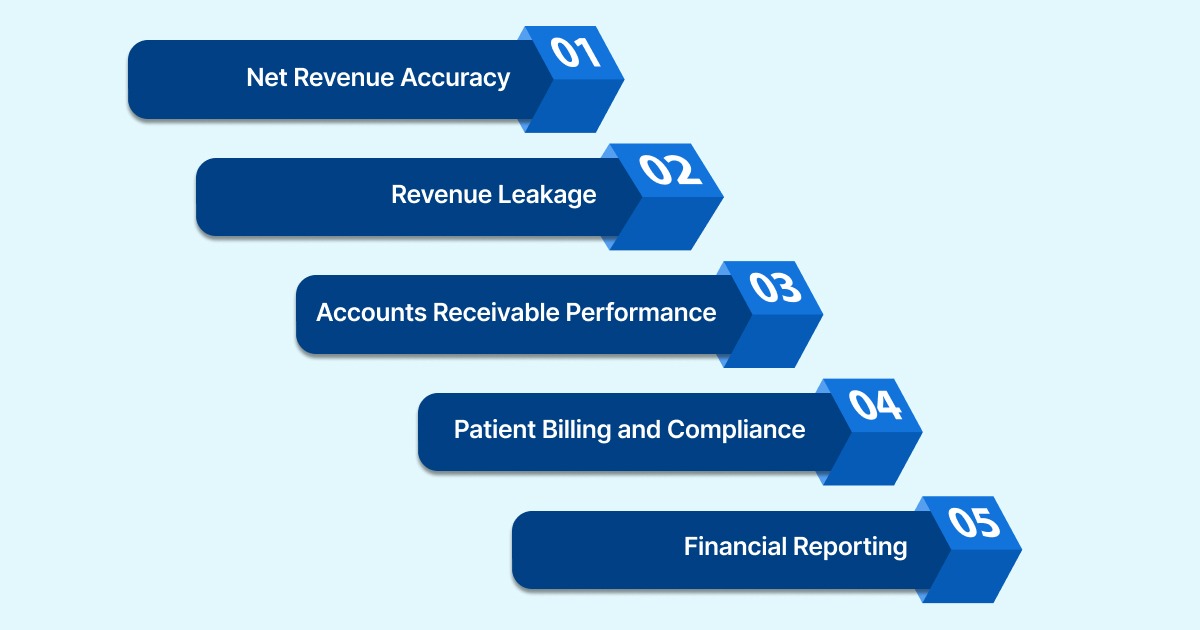
1. Net Revenue Accuracy
Net patient revenue is calculated after contractual allowances are applied. Inaccurate posting creates distorted financial visibility.
Key implications include:
- Revenue forecasts become unreliable
- Cash flow projections are overstated
- Budgeting and capital planning decisions are misaligned
- Performance reporting reflects inflated gross assumptions
Accurate adjustment recognition ensures revenue reflects true expected reimbursement.
2. Revenue Leakage and Denial Risk
Not every reduction is contractual. Misclassification can hide recoverable revenue. Common risks include:
- Bundling reductions are written off without review
- Modifier-related underpayments treated as contractual
- Medical necessity edits are misposted as allowances
- Missed appeal opportunities
Clear separation between contractual adjustments and denial-related reductions protects margin.
3. Accounts Receivable (AR) Performance
Improper adjustment posting affects downstream AR efficiency.
- Exception queues increase
- Manual reconciliation workload rises
- AR days extend unnecessarily
- Payment disputes become more frequent
Routine reconciliation of billed versus allowed amounts stabilizes posting accuracy.
4. Patient Billing and Compliance
In-network contractual adjustments cannot be transferred to patients.
- Incorrect patient balances create billing disputes
- Misclassification may trigger regulatory exposure
- Patient trust erodes when statements are inaccurate
- Cost-sharing must remain clearly defined
Revenue cycle teams must distinguish between contractual write-offs, patient responsibility, and bad debt.
5. Financial Reporting and Audit Integrity
Contractual adjustments are recorded as contra-revenue and require disciplined categorization.
- Misclassification distorts financial statements
- Payer performance analysis becomes unreliable
- Audit readiness weakens
- Reimbursement modeling loses accuracy
When monitored consistently, contractual adjustments provide clarity into contract performance rather than becoming a source of hidden variance.
To manage that impact effectively, revenue cycle teams must understand how contractual adjustments are reflected during claim adjudication.
Also Read: How Behavioral Health RCM Differs From Traditional RCM?
How Contractual Adjustments Appear on ERA and EOB
Contractual adjustments are reported on the Electronic Remittance Advice (ERA), typically delivered in the ANSI X12 835 format. The ERA contains adjudication details, including payment amounts, adjustment values, and standardized reason codes that explain how the claim was processed.
Adjustment Codes and Posting Logic
Within the ERA, payment differences are categorized using group codes supported by Claim Adjustment Reason Codes (CARCs) and Remittance Advice Remark Codes (RARCs).
- CO (Contractual Obligation): Reduction required under the payer contract
- PR (Patient Responsibility): Deductible, copay, or coinsurance amounts
- OA (Other Adjustment): Non-contractual reductions
- CR (Correction/Reversal): Adjustments correcting prior activity
Revenue cycle systems must interpret these codes correctly to separate contractual allowances from denials, corrections, and patient balances.
During posting:
- Payer payments are applied to the claim
- Contractual adjustments are recorded as contra-revenue
- Patient responsibility amounts are transferred to the patient account
Accurate posting at this stage prevents misclassification and reconciliation issues.
Line-Level vs. Claim-Level Adjustments
Adjustments may apply at different levels:
- Line level: Specific CPT or HCPCS services
- Claim level: The entire claim
Line-level reductions often point to coding errors, modifier issues, bundling edits, or contract mismatches. Claim-level adjustments typically reflect broader coverage or policy decisions.
Line-by-line reconciliation improves detection of underpayments and posting discrepancies.
Integration with EHR and Practice Management Systems
ERA data must align with internal configurations, including:
Manual posting increases the risk of mapping errors. Automated ingestion improves consistency but still requires validation controls to ensure allowed amounts match contracted reimbursement terms. Accurate calculation and posting are essential once adjustments appear on the remittance.
How to Calculate a Contractual Adjustment
The calculation itself is straightforward. The accuracy depends on clean contract data and a correct system setup.
Here’s the basic formula:
Contractual Adjustment = Billed Amount – Allowed Amount
If a provider bills $500 and the payer's allowed amount is $300, the contractual adjustment is $200. That $200 is written off under the contract and cannot be billed to the patient.
When Patient Responsibility Applies
Cost-sharing is applied to the allowed amount, not the billed charge.
Example:
- Billed Amount: $500
- Allowed Amount: $300
- Contractual Adjustment: $200
- Patient Deductible: $100
- Insurance Payment: $200
The contractual adjustment remains $200. The patient owes $100 based on plan terms, and the payer reimburses the remaining $200.
Even with correct calculation, confusion often arises when contractual adjustments are grouped with other payment reductions.
Contractual Adjustment vs Write-Off vs Denial
Payment reductions occur for different reasons, and each carries a distinct financial and operational meaning. Clear classification is necessary to preserve revenue accuracy and prevent reporting errors.
| Category | Contractual Adjustment | Denial | Write-Off (Non-Contractual) | Bad Debt | Administrative Write-Off |
|---|---|---|---|---|---|
| What It Represents | Difference between billed charge and payer’s allowed amount under contract | Claim rejected or unpaid due to processing or compliance issue | Balance removed due to internal or operational decision | Unpaid patient responsibility after collection efforts | Courtesy or hardship-based reduction |
| Why It Happens | Negotiated fee schedule or regulatory reimbursement rule | Coding errors, missing authorization, eligibility issues, medical necessity | Billing errors, missed deadlines, internal adjustments | Patient fails to pay deductible, copay, or coinsurance | Provider decision for small balances or financial hardship |
| Billable to Patient? | No (for in-network services) | Not until resolved | Typically no | Yes (initially billed) | No |
| Appealable? | No, unless posted incorrectly | Yes | No | No | No |
| Financial Impact | Expected reduction recorded as contra-revenue | Potentially recoverable revenue | Preventable revenue loss | Uncollected patient revenue | Provider-initiated revenue reduction |
A contractual adjustment reflects agreed reimbursement terms. A denial signals a correctable issue. Bad debt and administrative write-offs result from collection or operational decisions.
Accurate separation of these categories prevents misclassification, supports clean financial reporting, and strengthens audit readiness. Even with proper definitions, errors can still occur when adjustments are posted without structured validation.
Common Errors in Contractual Adjustment Posting
Most posting errors stem from outdated contract data or incorrect system configuration. When allowed amounts do not reflect current payer terms, reimbursement expectations become distorted and reconciliation gaps emerge.
Common causes include:
- Not updating fee schedules after contract renewals
- Incorrect CPT or HCPCS codes in contract tables
- Ignoring modifiers, place-of-service differentials, or tiered reimbursement rules
- Failing to account for bundled payments or outlier provisions
- Excluding ancillary services, such as imaging or therapy, from contract configurations
These issues can result in underpayments being accepted as contractual, masking revenue discrepancies.
To reduce risk, contract libraries and allowed amount tables should be reviewed and validated regularly. Routine audits help identify mismatches between expected and adjudicated payments before they affect revenue reporting or compliance standing.
Preventing adjustment errors requires structured controls across contract management, coding accuracy, and reconciliation workflows.
Also Read: Common Medical Billing and Coding Errors and How to Protect Your Practice
Best Practices to Manage Contractual Allowance Adjustments
Managing contractual allowance adjustments and the Contractual Adjustment Rate (CAR) requires coordinated oversight across contracts, coding, posting, and analytics. Without defined controls, revenue leakage and reporting errors follow.
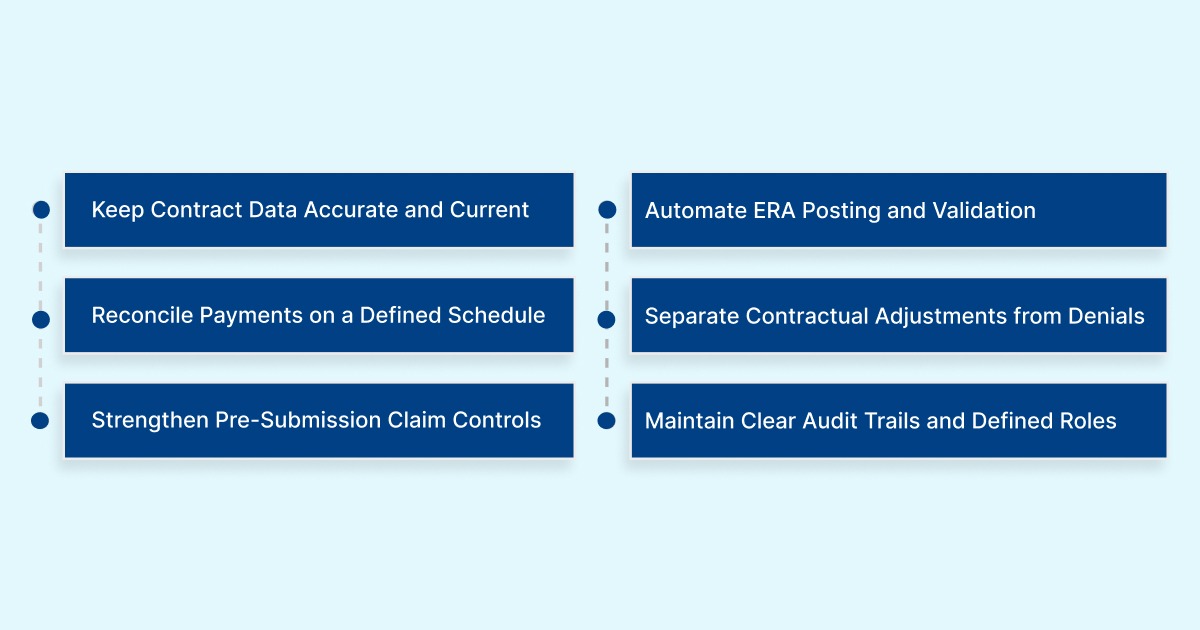
1. Keep Contract Data Accurate and Current: Update payer fee schedules immediately after renewals and validate CPT, HCPCS, modifier rules, and reimbursement methodologies. Outdated contract tables lead to incorrect allowed amounts and hidden underpayments.
2. Automate ERA Posting and Validation: Use systems that parse ERA files, apply contracted rates automatically, and flag discrepancies. Automation reduces manual posting errors and improves consistency.
3. Reconcile Payments on a Defined Schedule: Post payments daily and perform regular contract-level reconciliation. Compare expected allowed amounts to actual adjudication results to detect variances early.
4. Separate Contractual Adjustments from Denials: Ensure reductions caused by coding errors or missing documentation are not misclassified as contractual. This protects appeal opportunities and prevents revenue loss.
5. Strengthen Pre-Submission Claim Controls: Validate coding accuracy, eligibility, authorization, modifiers, and filing deadlines before submission. Cleaner claims reduce downstream adjustments and rework.
6. Maintain Clear Audit Trails and Defined Roles: Document who posts adjustments, under what rules, and how exceptions are resolved. Defined accountability supports compliance and audit readiness.
As claim volumes increase and payer rules grow more complex, many organizations are augmenting these controls with automation.
How AI Improves Contractual Adjustment Reconciliation
High claim volumes and complex payer rules make manual reconciliation inefficient and error-prone. Artificial Intelligence (AI) technology provides structured validation and real-time monitoring, enhancing adjustment accuracy and reducing revenue loss.
Automated ERA Parsing
AI platforms ingest 835 ERA files, extract adjustment data, and classify codes consistently. This reduces manual posting errors and clearly separates contractual adjustments from denials and patient responsibility amounts.
Contract-Level Validation
At the service-line level, AI compares billed charges and allowed amounts against internal contract libraries. When discrepancies appear, the system flags them for review, helping detect underpayments or outdated fee schedules.
Pattern and Variance Detection
Machine learning models analyze adjustment trends across payers, service lines, and CPT codes. They surface unusual reimbursement shifts or recurring reductions that warrant investigation.
Exception-Based Workflow
Rather than reviewing every claim, teams focus on flagged variances. AI routes these exceptions to coding or denial specialists, streamlining follow-up and reducing unnecessary workload.
Together, automated parsing, contract validation, and targeted variance detection strengthen reconciliation accuracy and financial oversight.
As contractual adjustment workflows grow more complex, many organizations move beyond static rules and manual review toward platforms that combine automation with continuous contract intelligence. This is where RapidClaims comes in.
How RapidClaims Strengthens Contractual Adjustment and RCM Workflows
RapidClaims is an AI-powered revenue cycle platform built to improve coding accuracy, contract alignment, and post-adjudication validation across the reimbursement lifecycle.
RapidCode: AI-Driven Medical Coding
RapidCode applies machine learning to assign ICD, CPT, HCPCS, and E&M codes with high accuracy and speed. Cleaner coding reduces preventable denials and minimizes incorrect reductions that could be misclassified as contractual adjustments.
RapidScrub: Pre-Submission Validation
RapidScrub reviews claims before submission to identify documentation gaps, modifier issues, or authorization risks. Addressing these issues upstream improves first-pass outcomes and reduces downstream adjustment complexity.
RapidCDI: Clinical Documentation Integrity
RapidCDI enhances documentation specificity in real time, supporting accurate coding and appropriate reimbursement, particularly in risk-adjusted environments.
Integration and Compliance Support
The platform integrates with EHR and billing systems, aligning coding, contract data, and remittance posting in a single workflow.
By combining coding accuracy, contract validation, and automated reconciliation, RapidClaims helps revenue cycle teams manage contractual adjustments with greater control and consistency.
By connecting coding, documentation, contract validation, and reconciliation into a single AI-enabled framework, RapidClaims helps revenue cycle teams maintain control over contractual adjustments while improving reimbursement accuracy and operational efficiency.
Final Words
Contractual adjustments are built into provider–payer agreements, but how they are managed determines whether they remain controlled reductions or become sources of hidden revenue loss.
When allowed amounts are posted without validation, underpayments and coding inconsistencies can go undetected. Accurate contract configuration, consistent reconciliation, and intelligent variance monitoring shift organizations from reactive correction to disciplined financial control.
RapidClaims brings coding accuracy, contract validation, and automated reconciliation together in a unified AI-driven platform designed to strengthen revenue integrity across the cycle.
If your team is ready to reduce avoidable variance and gain tighter visibility into contractual adjustment performance, book a demo with RapidClaims.
FAQs
1. How do we calculate the contractual adjustment?
Subtract the payer’s allowed amount from the billed charge. The difference between these two figures is the contractual adjustment recorded under the provider–payer agreement.
2. What is the difference between a contractual adjustment and a write-off?
A contractual adjustment is required under payer agreements and reflects negotiated reimbursement limits. A write-off outside contract terms usually results from uncollectible balances, administrative corrections, or billing errors.
3. Can contractual adjustments be reversed?
Adjustments tied to valid contract terms are not reversible. However, if an adjustment was posted incorrectly due to coding or contract configuration errors, it can be corrected and, if applicable, appealed.
4. Where do contractual adjustments appear on an ERA?
They typically appear under the CO (Contractual Obligation) group code, along with specific Claim Adjustment Reason Codes (CARCs) explaining the reduction.
5. How can healthcare teams detect incorrect contractual adjustments?
Teams should compare ERA allowed amounts with contract fee schedules and use automated reconciliation tools that flag mismatches or unexpected variance for review.
6. Do contractual adjustments affect patient billing?
For in-network services, contractual adjustments are not billable to the patient. Only defined patient responsibility amounts, such as deductible, copay, or coinsurance, may be collected.


