Learn what unbundling and upcoding are, why they trigger audits, and how to prevent costly billing errors with stronger compliance in 2026.
Published January 22, 2026Updated June 5, 2026
Healthcare fraud, waste and abuse continue to impose a heavy financial burden on the United States medical system. In 2025, billing errors remain widespread. Up to 80 percent of medical claims are estimated to contain mistakes, contributing to billions in lost revenue for providers and payers.
Among these errors, two of the most damaging and often fraudulent practices are upcoding and unbundling. Both distort the services actually performed and inflate reimbursement amounts, which increases regulatory scrutiny and audit risk.
Because both practices alter how services are coded for payment, either by overstating complexity or by breaking bundled procedures into separately billable items, they undermine financial integrity and disrupt accurate reimbursement.
Understanding the difference between unbundling and upcoding is essential for coding teams, billing specialists, compliance leaders and auditors. The next sections explain these practices in clear detail and outline how organizations can prevent them in 2026 and beyond.
Key Takeaways
Unbundling and upcoding are among the most financially damaging billing errors, contributing to billions in improper payments as audit scrutiny intensifies in 2025 and 2026.
Unbundling splits services that should be billed as a single bundled code, while upcoding inflates service complexity beyond what documentation supports. Both lead to overpayment and high compliance risk.
Payers now use AI-driven audit tools that identify bundling violations, documentation mismatches, and abnormal coding patterns in real time, increasing the likelihood of denials and recoupments.
Documentation quality is the strongest defense against both unbundling and upcoding, requiring clear, complete, and specific clinical details that align with CPT, ICD, and NCCI rules.
Preventing unbundling requires updated bundling logic, clinician education, and automated scrubbers capable of catching invalid code pairs before submission.
Preventing upcoding depends on strict E/M leveling, diagnosis specificity, and audits that flag high-risk providers or sudden spikes in complex codes.
Audit risk continues to rise as federal and commercial payers expand improper payment recovery programs, making compliance a top priority for 2026.
Automation offers the fastest path to error reduction, helping teams catch unsupported codes, detect bundling conflicts, and validate documentation accuracy before claims go out.
RapidClaims supports organizations with AI-powered coding, documentation integrity, and denial-prevention tools that reduce unbundling and upcoding risk while strengthening compliance and claim accuracy.
Table of Contents:
What Is Unbundling in Medical Billing
What Is Upcoding in Medical Billing
Key Differences Between Unbundling and Upcoding
Why Unbundling and Upcoding Are High-Priority Targets for 2026 Audits
How to Prevent Unbundling in 2026
How to Prevent Upcoding in 2026
Conclusion
FAQs
What Is Unbundling in Medical Billing
Unbundling occurs when services that should be billed together under a single comprehensive code are instead separated into individual component codes. This results in a higher total charge than allowed and is considered a coding error by CMS and commercial payers.
How Unbundling Happens
Unbundling typically occurs when:
Component procedures are billed separately instead of using a bundled CPT or HCPCS code
The coder overlooks National Correct Coding Initiative edits
Documentation is interpreted incorrectly or lacks clarity
Providers are unaware that the comprehensive code already includes related services
Examples of Unbundling
Billing incision and closure separately when both are already included in a surgical code
Billing imaging guidance (like ultrasound) separately when it is bundled into the primary procedure
Separately coding evaluation services when they are included in the procedure performed on the same day
Risk of payer investigations for repeated patterns
Negative compliance flags in internal and external reviews
What Is Upcoding in Medical Billing
Upcoding refers to assigning a higher level or more complex code than what is supported by the clinical documentation. Unlike unbundling which splits services, upcoding inflates the intensity, complexity, or cost of the service itself.
How Upcoding Occurs
Upcoding typically happens when:
A higher level E and M code is chosen even though documentation supports a lower level
More complex procedure codes are selected than what was actually performed
Diagnosis codes with higher severity are assigned without clinical justification
Automated systems or templates default to higher levels without proper review
Examples of Upcoding
Billing a level 4 office visit when documentation supports a level 2
Coding major surgery when only a minor procedure was performed
Selecting a higher complexity diagnosis code without corresponding clinical evidence
Why Upcoding Is a Serious Issue
Upcoding can lead to:
Heavy financial penalties during audits
Accusations of fraud when patterns repeat
Payer scrutiny that affects future authorizations and reimbursement
Damaged compliance standing for both clinicians and billing teams
Once unbundling and upcoding are understood individually, it becomes essential to differentiate how they impact billing, compliance, and reimbursement. Although both are considered improper coding practices, they differ in intent, mechanism, and audit risk.
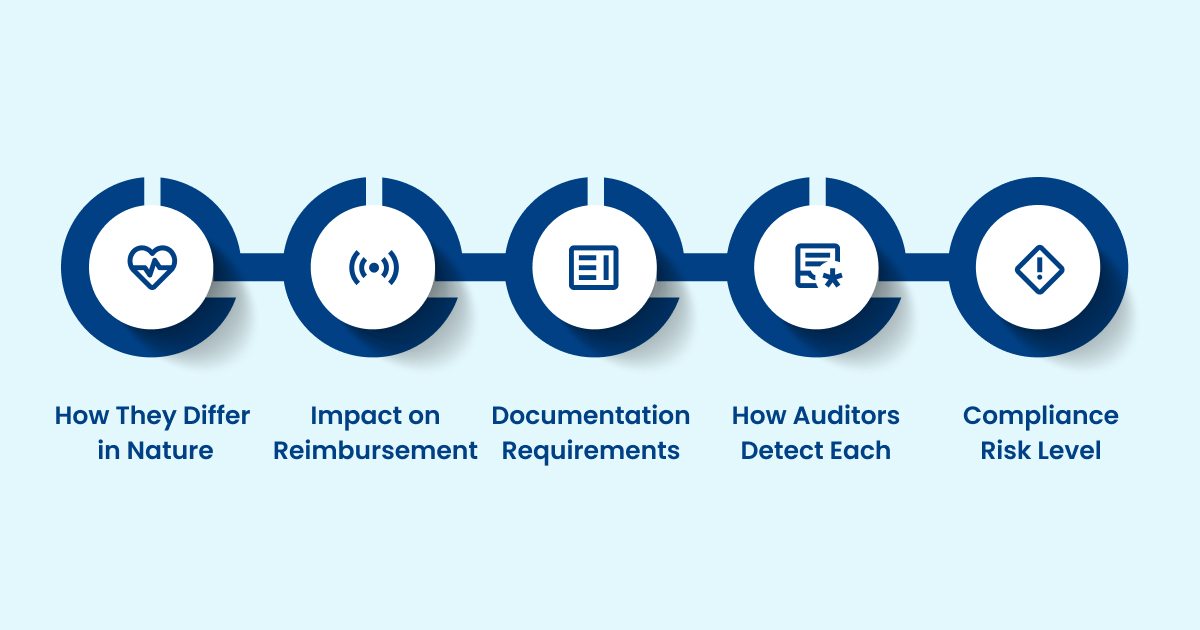
How They Differ in Nature
Unbundling involves splitting services that should be billed as a single comprehensive code.
Upcoding involves selecting a code that overstates the complexity or level of the service performed.
Impact on Reimbursement
Unbundling leads to inflated charges by billing multiple codes instead of one bundled code.
Upcoding leads to inflated charges by choosing codes that pay more than what documentation supports.
Documentation Requirements
Unbundling is often tied to CPT rules, National Correct Coding Initiative edits, and existing procedure bundles.
Upcoding directly depends on the level of detail and accuracy in the clinical note.
How Auditors Detect Each
Unbundling is spotted through code pair edits, NCCI rules, and frequency analysis.
Upcoding is detected by comparing documentation against selected CPT or diagnosis codes.
Compliance Risk Level
Both carry high audit risk, but upcoding is more frequently associated with allegations of intent because it often implies exaggeration of service complexity.
Why Unbundling and Upcoding Are High-Priority Targets for 2026 Audits
Regulators and payers are placing increased emphasis on coding integrity in 2026, and unbundling and upcoding remain two of the most scrutinized billing behaviors. The heightened focus is driven by new audit technologies, expanded federal initiatives, and payer programs designed to curb improper payments.
1. Growth of AI-Driven Audit Systems
Medicare Administrative Contractors and commercial payers are now using machine learning models that can flag suspicious billing patterns in seconds. These systems detect:
Abrupt spikes in coding levels
Unusual frequency of code pair violations
Providers regularly bypassing bundling rules
Because these tools operate in real time, payers are catching improper patterns far faster than in previous years.
2. Increased Federal Oversight of Improper Payments
The federal government continues to prioritize reducing erroneous reimbursements. Improper payment estimates for Medicare and Medicaid remain high, which has led agencies to expand:
Excessive use of unbundled imaging and procedural codes
Providers with outlier billing compared to regional benchmarks
These reviews can delay payments significantly even when errors are unintentional.
4. Greater Cross-System Data Sharing
Health plans now share billing behavior data with analytics vendors, government contractors, and risk-mitigation organizations. As a result:
Providers can be flagged across multiple payers
Historical billing patterns remain visible for years
Single mistakes can escalate into multi-payer scrutiny
This multiplies the impact of unbundling or upcoding errors.
5. Higher Financial Penalties and Recovery Actions
Auditors are prioritizing cases that produce the largest financial returns. Since both unbundling and upcoding increase reimbursement amounts, they often result in:
Full claim denials
Recoupment demands
Re-review of prior claims from the same provider
Potential fraud review when patterns repeat
The financial risk grows exponentially when improper patterns remain unaddressed over time.
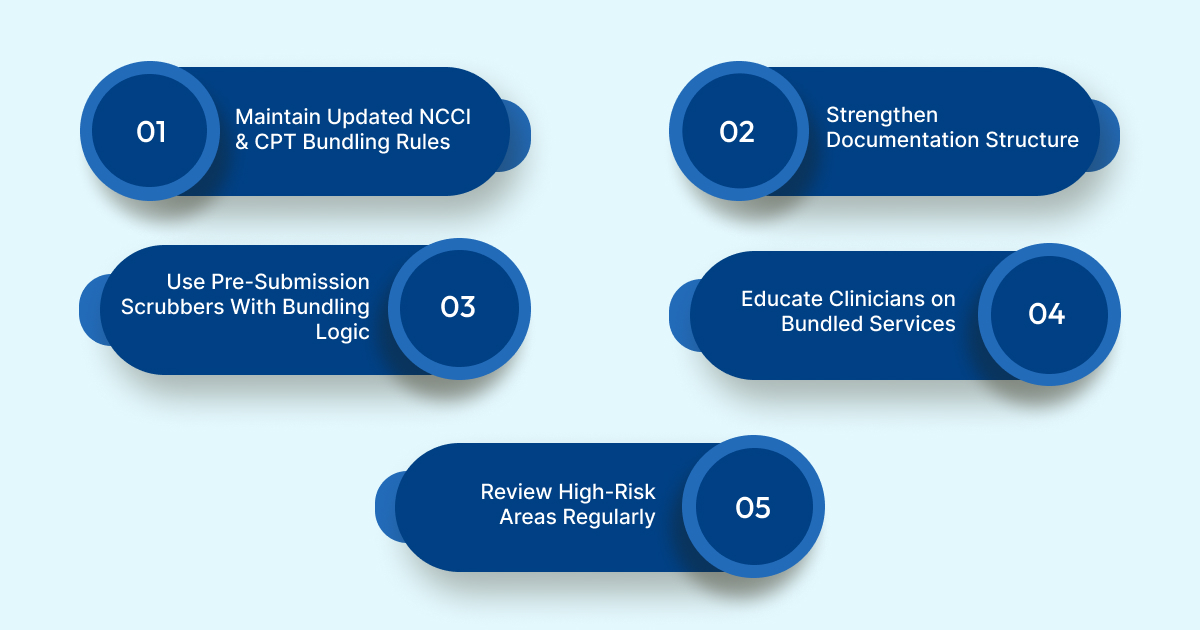
How to Prevent Unbundling in 2026
Preventing unbundling requires clear workflows, up-to-date coding knowledge, and systematic checks that ensure bundled rules are applied correctly. Because bundling regulations continue to evolve, organizations must combine education, automation, and documentation clarity to minimize risk.
1. Maintain Updated NCCI and CPT Bundling Rules
Bundling edits are updated quarterly. Coding teams should ensure:
All systems reflect the latest National Correct Coding Initiative edits
Old code pair logic is removed from templates and cheat sheets
2. Strengthen Documentation Structure
Clear documentation helps coders determine whether services are integral to the primary procedure. Improve clarity by:
Using structured templates for procedure notes
Ensuring required elements for comprehensive codes are consistently captured
3. Use Pre-Submission Scrubbers With Bundling Logic
Automated tools reduce improper split-billing by identifying:
Code pairs that violate bundling rules
Codes missing required comprehensive counterparts
Imaging or surgical services that should not be billed separately
4. Educate Clinicians on Bundled Services
Many unbundling errors originate at the provider level. Short training sessions can clarify:
Which services are always included in the primary procedure
When add-on codes are appropriate
Documentation needed to justify billing exceptions
5. Review High-Risk Areas Regularly
Certain categories are more susceptible to unbundling, such as:
Imaging
Minor surgical procedures
Post-operative services
Conducting focused audits in these areas helps detect recurring issues early.
Organizations using RapidClaims report a 98 percent clean-claim rate, 170 percent coder productivity lift, and up to 40 percent denial reduction. Request a personalized demo to evaluate the potential impact for your team.
How to Prevent Upcoding in 2026
Upcoding prevention focuses on documentation accuracy, coding discipline, and alignment between clinical complexity and code selection. Since upcoding triggers heavy penalties, organizations need consistent verification steps.
1. Align Coding Levels With Documentation Depth
Upcoding often occurs when documentation does not support the selected CPT or diagnosis code. Prevention requires:
Ensuring each code level matches the recorded medical decision-making
Using templates that capture necessary clinical elements
Avoiding unnecessary details added solely for coding purposes
2. Implement E/M Leveling Tools
Evaluation and management codes are among the most frequently upcoded. Use leveling tools to:
Verify visit complexity
Check time-based coding validity
Confirm that history, exam, and MDM requirements are met
3. Audit Providers With Outlier Patterns
Analytics should flag providers who consistently bill higher-than-average codes. Outlier analysis helps detect:
Excessive level 4 and 5 office visits
Sudden spikes in high-complexity codes
Patterns inconsistent with peer benchmarks
4. Improve Diagnosis Coding Integrity
Upcoding can involve diagnoses as well as procedures. Safeguards include:
Requiring clinical evidence for high-severity ICD codes
Reviewing chronic condition documentation
Ensuring specificity aligns with clinical findings
5. Use AI or Manual Crosschecks Before Claims Go Out
Advanced review systems help prevent mismatches between documentation and codes by identifying:
Unsupported E/M levels
Indicators of inflated complexity
Missing documentation that affects coding accuracy
RapidClaims helps teams prevent unbundling and upcoding through automated coding support, smart edit validation, and real-time documentation checks. Request a demo to see these capabilities in action.
Conclusion
Unbundling and upcoding remain two of the most consequential coding errors in healthcare, each carrying significant financial and compliance risks. As audit scrutiny intensifies and payer rules evolve, organizations must maintain consistent documentation, accurate coding discipline, and proactive oversight to protect revenue and avoid penalties. Strong internal controls, well-trained staff, structured auditing, and clear coding workflows are essential to keeping claims compliant and ensuring that reimbursement accurately reflects the care delivered.
Modern revenue cycle teams increasingly rely on automation to detect coding inconsistencies early, prevent bundling violations, validate documentation, and flag unsupported code selections. Platforms that combine AI driven coding, documentation integrity checks, and real time claim scrubbing offer a substantial advantage by reducing manual review and improving claim quality before submission.
RapidClaims supports organizations in reducing unbundling and upcoding risk through automated coding assistance, predictive denial prevention, documentation validation, and audit ready transparency. These capabilities help teams improve accuracy, strengthen compliance, and ensure each claim reflects the correct level of service.
See how RapidClaims reduces coding errors, improves documentation accuracy, and helps prevent unbundling and upcoding across your entire revenue cycle. Upload 500 sample charts for a tailored ROI model or request a demo to get started.
FAQs
Q: What is the meaning of unbundling in medical billing?
A: Unbundling means billing separate procedure codes for services that should be reported under a single comprehensive or bundled code. This often violates CPT rules and NCCI edits, and it typically results in overpayment or claim denial.
Q: What is the meaning of upcoding in healthcare?
A: Upcoding occurs when a provider selects a code that represents a higher complexity or more expensive service than what is supported by the medical documentation. This inflates reimbursement and is a major audit trigger.
Q: How are unbundling and upcoding different?
A: Unbundling splits a bundled service into multiple separate codes, while upcoding inflates the level or intensity of the service provided. Both increase payment but occur through different mechanisms.
Q: Is unbundling considered fraud?
A: If unbundling is intentional and repeated, it can be classified as fraud. Even unintentional unbundling can lead to recoupment, penalties, and heightened audit scrutiny.
Q: Why is upcoding a serious compliance risk?
A: Upcoding is directly tied to misrepresenting service complexity. Payers treat repeated upcoding as a potential attempt to inflate revenue, which can lead to high financial penalties and, in serious cases, legal action.
Get the next analysis in your inbox
The Revenue Cycle Briefing — operator-grade research, every other Wednesday. 12,400+ subscribers.