Simplifying E&M Codes: 2026 Guidelines, Cheat Sheet & Common Pitfalls
Accurate E&M coding ensures proper reimbursement and compliance. Learn to avoid common mistakes and optimize coding efficiency for better financial results.
Ayeesha Siddiqua
Lead Coder · RapidClaims
Published March 6, 2026Updated August 10, 2026
Inaccurate coding can lead to claim denials, delayed reimbursements, and increased administrative costs, a reality that many healthcare organizations face. With the complexity of medical billing and frequent updates to guidelines, it's easy for mistakes to happen.
E&M codes play a critical role in this process, as they determine the reimbursement rates for evaluation and management services. However, nearly 15% of all claimssubmitted to payers for reimbursement are initially denied, often due to errors in coding or incomplete documentation.
To avoid these issues, it's essential to understand the intricacies of E&M coding. In this article, you'll explore why accurate E&M coding is so important, common pitfalls, and how to ensure you capture every potential code for optimal reimbursement.
Quick look
E&M coding determines healthcare reimbursement based on service complexity and patient visits.
Accurate E&M coding ensures correct reimbursement and compliance, avoiding underbilling or overbilling.
Commonly missed codes like 99211 and 99215 can lead to lost revenue if not documented properly.
Proper documentation is crucial for justifying codes, particularly history, examination, and medical decision-making (MDM).
Staying updated on E&M coding guidelines and using AI-powered tools can streamline workflows and improve accuracy.
Table of Contents
What Are E&M Codes and Why Are They Crucial for Accurate Billing?
Key E&M Coding Guidelines You Need to Follow for Compliance
Commonly Missed E&M Codes and How to Avoid Missing Them
Ensuring Compliance with E&M Code Reporting: Key Tips
How RapidClaims Improves E&M Coding Efficiency and Accuracy?
Wrapping Up
FAQs
What Are E&M Codes and Why Are They Crucial for Accurate Billing?
E&M codes are used to classify and document the complexity of healthcare services provided during patient visits, considering factors such as history, examination, and medical decision-making.
These codes are directly tied to reimbursement rates and compliance with industry regulations.
Why E&M Codes Are Crucial for Accurate Billing:
Correct Reimbursement: E&M codes like 99213 (low complexity) versus 99215 (high complexity) determine reimbursement rates based on visit complexity.
Avoiding Financial Loss: Incorrect coding, such as using 99211 (brief visit) instead of 99212 (moderate complexity), can result in underbilling and lost revenue.
Compliance with Regulations: Following CMS and AMA guidelines ensures accurate coding and reduces audit risks, especially with modifiers like -25 for separate procedures.
Optimizing Claims Processing: Properly coded claims like 99233 (hospital inpatient) avoid delays and rejections due to documentation issues.
Audit Protection: Detailed coding and accurate documentation of Medical Decision Making (MDM) support codes like 99215, ensuring you're audit-ready.
With a clear understanding of why accurate E&M coding is critical, let's move on to the coding guidelines you need to follow for compliance.
Key E&M Coding Guidelines You Need to Follow for Compliance
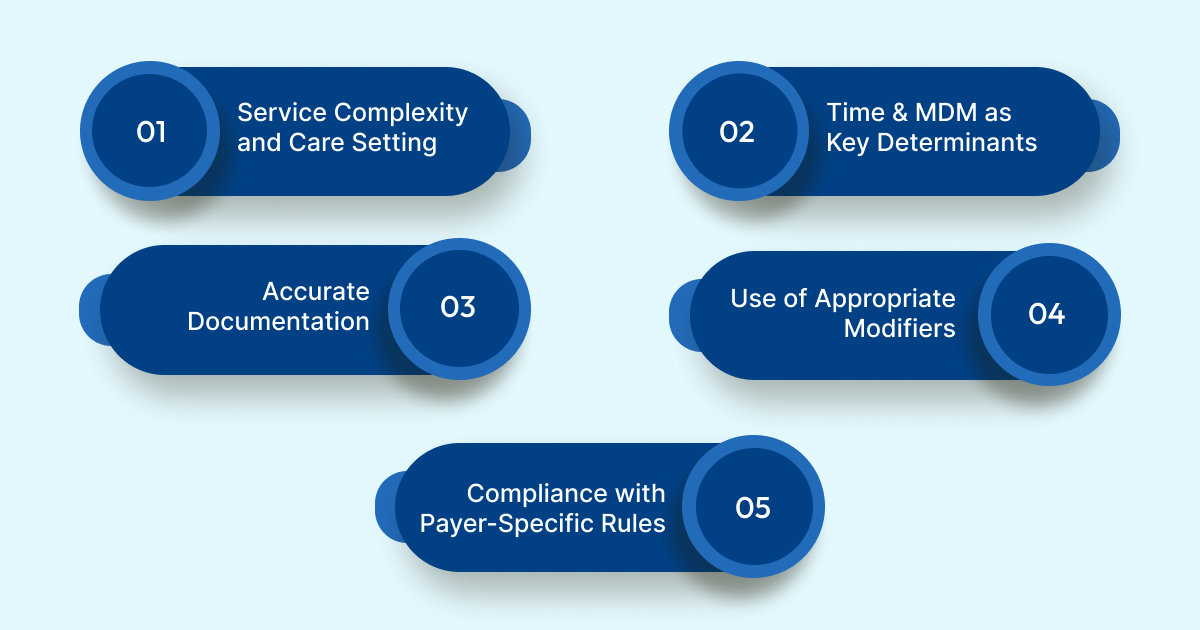
Adhering to E&M coding guidelines is crucial for ensuring proper reimbursement and staying compliant with industry regulations. These guidelines, set by the CMS and AMA, help healthcare providers determine the appropriate code based on service complexity and documentation.
1. Service Complexity and Care Setting
The appropriate E&M code depends on the complexity of the patient visit and the care setting (e.g., office vs. hospital).
For example, a 99215 (high complexity) is applicable for detailed consultations in outpatient settings, while a 99223 is used for inpatient visits requiring high complexity decision-making.
2. Time and Medical Decision Making (MDM) as Key Determinants
MDM or the time spent with the patient can be used to justify the level of service provided.
For instance, if a physician spends 40 minutes with a patient in a comprehensive consultation, 99215 can be used, as time becomes a key factor in determining the code.
3. Accurate Documentation
Detailed documentation supporting each element of E&M codes is critical, including history, examination, and MDM.
For example, a thorough history of the patient's symptoms and a detailed physical exam are necessary to support the use of 99214 (moderate complexity) in an outpatient visit.
4. Use of Appropriate Modifiers
Modifiers such as -25 (separate significant service) are essential to report when a procedure is done in addition to the E&M service, preventing coding errors and ensuring proper billing.
For instance, a patient receiving a 99213 visit (office consultation) with a minor procedure (e.g., wound closure) requires modifier -25 to report both services separately.
5. Compliance with Payer-Specific Rules
While CMS guidelines are standard, different payers may have additional coding requirements or rules.
Staying informed about payer-specific rules ensures that E&M codes are compliant with individual insurance company standards.
By understanding and applying these E&M coding guidelines, you can avoid common pitfalls and ensure compliance.
Commonly Missed E&M Codes and How to Avoid Missing Them
Certain E&M codes are frequently overlooked, leading to missed revenue opportunities. These mistakes can be caused by insufficient documentation, misunderstandings of code requirements, or rushing through the coding process.
1. 99211 - Office or Other Outpatient Services, Minimal Complexity
This code is often missed because it's typically used for a brief, low-complexity visit, such as a nurse's check or a routine follow-up.
Ensure all patient interactions, even those that seem minor, are documented thoroughly, including the reason for the visit and any minimal services provided.
2. 99215 - Office or Other Outpatient Services, High Complexity
Commonly missed due to misjudging the complexity level of the visit. A 99215 requires extensive documentation of the history, examination, and Medical Decision Making (MDM).
To avoid missing this, carefully assess the time spent with the patient and document the high-complexity decision-making involved in the visit.
3. 99223 - Initial Hospital Care, High Complexity
This code is often skipped when hospital visits with high complexity are not properly documented. It is typically underused because coders sometimes apply a lower code based on the level of service rather than documentation.
Ensure complete MDM documentation, especially for inpatient care involving multiple assessments or decisions.
4. 99203 - Office or Other Outpatient Services, Moderate Complexity
Frequently missed for intermediate visits where the patient’s condition is stable but requires more than just a quick evaluation.
Properly document examinations and decision-making processes that support a moderate level of care, ensuring the complexity is justified.
5. 99283 - Emergency Department Visit, Low Complexity
This code can be missed when the emergency department visit is deemed routine, but still requires proper documentation of the assessment performed.
Ensure that documentation includes medical history, exam findings, and decision-making to substantiate the code.
Correctly capturing E&M codes can be challenging, but how can healthcare providers ensure accuracy in every instance?
RapidClaims helps streamline the coding process with its RapidCode, using AI to identify missed codes and ensure thorough documentation. These tools optimize workflows, reduce claim denials, and maximize reimbursement potential.
Now that you understand the importance of accurate coding, let’s look into key tips for ensuring compliance with E&M code reporting.
Ensuring Compliance with E&M Code Reporting: Key Tips
Ensuring compliance with E&M code reporting is essential to avoid audits and penalties while optimizing reimbursement.
Here is the checklist for ensuring compliance with E&M code reporting:
Regularly review updates from CMS and AMA to ensure adherence to the latest coding standards and changes in E&M codes.
Apply appropriate modifiers like -25 for separate significant procedures to prevent bundling errors.
When using time-based codes, ensure that the total time spent with the patient is documented clearly and accurately, with breakdowns of time spent on each activity.
Clearly document the level of MDM involved in each patient visit to justify the correct complexity level for the code used.
Implement internal audits to review claims for compliance before submission, focusing on high-risk codes and areas prone to errors.
With these tips in place, RapidClaims can further streamline your E&M coding process by improving both efficiency and accuracy, ensuring compliance is maintained with minimal effort.
How RapidClaims Improves E&M Coding Efficiency and Accuracy?
RapidClaims is an AI-powered platform that automates medical coding and streamlines workflows to enhance E&M code accuracy.
With a >98% clean claim rate and 100% audit compliance, it helps healthcare providers boost productivity by 1.7x while saving 2 hours per coder daily. This results in improved coding efficiency and faster reimbursement.
Uses AI to identify and resolve claim issues before submission, reducing denials by 40%.
Speeds up A/R recovery by 5 days and reduces cost to collect by 70%.
By combining these advanced tools, RapidClaims ensures efficient and accurate E&M coding. It helps healthcare providers optimize their revenue cycle while maintaining compliance and minimizing denials.
Wrapping Up
Accurate E&M coding is key to proper reimbursement and compliance. By understanding the guidelines, avoiding common mistakes, and optimizing documentation, providers can improve their revenue cycle and reduce claim denials.
RapidClaims automates E&M coding with AI-powered tools like RapidCode, RapidCDI, and RapidScrub, ensuring accuracy, compliance, and faster reimbursements while reducing operational costs.
Ready to optimize your E&M coding and revenue cycle? Schedule a Free Demo today and see how RapidClaims can transform your coding efficiency!
FAQs
1. How do I handle E&M coding for a patient with multiple conditions?
Choose the appropriate code based on the complexity of decision-making for each condition. Document the contribution of each condition to the service provided.
2. What specific documentation is required to justify a high-complexity E&M code?
Document multiple diagnoses, detailed decision-making, and extensive tests. Ensure that the patient's history and examination support the level of complexity.
3. How do I differentiate between a new and established patient for E&M coding?
New patients require a full history and physical exam. Established patients may have a focused history and can reference prior visit records.
4. Why is it important to document both history and physical exams in E&M coding?
History and physical exams justify the level of service provided. Missing either can result in lower-level codes and incorrect reimbursements.
5. How can I improve coding accuracy for complex patient encounters without increasing workload?
Use AI-powered tools to automate routine coding tasks, allowing coders to focus on complex cases and improve accuracy.
Get the next analysis in your inbox
The Revenue Cycle Briefing — operator-grade research, every other Wednesday. 12,400+ subscribers.
About the author
Ayeesha Siddiqua
Lead Coder · RapidClaims
Ayeesha Siddiqua is a highly experienced medical coding professional with 22 years of expertise in E/M Outpatient, Radiology, and Interventional Radiology (IVR), ensuring coding accuracy, regulatory compliance, and optimized reimbursements at RapidClaims.