

The CO-11 denial code is one of the common and most preventable sources of revenue loss in healthcare billing. It signals a breakdown between clinical documentation, coded data, and payer medical necessity rules, and when it goes unaddressed, the impact compounds quickly. Each CO-11 denial delays cash flow, increases rework, and raises compliance risk across the revenue cycle.
For revenue cycle teams, this means longer A/R days and mounting operational pressure. For coding and billing leaders, repeated CO-11 patterns are a warning sign of systemic gaps in documentation quality and diagnosis–procedure linkage, not isolated errors. The urgency is real. According to the American Hospital Association, 89% of healthcare organizations have seen an increase in payment denials, with more than half reporting a significant rise year over year.
While denials can’t be eliminated entirely, they can be reduced with the right controls. Here, we’ll explain what the CO-11 denial code means, why it occurs, and how to resolve it efficiently.
Key Takeaways
- The CO-11 denial code signals a diagnosis–procedure mismatch caused by documentation gaps, coding errors, or unmet payer medical necessity rules.
- Repeated CO-11 denials slow reimbursements and increase rework, often pointing to systemic workflow issues rather than isolated mistakes.
- Most CO-11 denials are preventable with accurate documentation, correct diagnosis linkage, and payer-aware validation before submission.
- Real-time, automated checks embedded in coding workflows are the most effective way to reduce CO-11 denials at scale and protect revenue.
Table of Contents
- What Does the CO-11 Denial Code Mean?
- Impact of CO-11 Denials on Healthcare Providers
- A Real-World Example of a CO-11 Denial Code
- 6 Common Causes of the CO-11 Denial Code
- How to Identify CO-11 Denial Codes on Claims
- How to Triage and Prioritize CO-11 Denials
- How to Resolve CO-11 Denial Codes
- Strategies to Prevent the CO-11 Denial Code
- How RapidClaims Help Reduce CO-11 Denials
- Conclusion
- FAQs
What Does the CO-11 Denial Code Mean?
The CO-11 denial code is issued when a payer determines that the diagnosis on a claim does not justify the medical necessity of the billed procedure or service. Simply put, the diagnosis–procedure relationship does not meet the payer’s clinical or policy requirements.
From the payer’s perspective, a CO-11 denial typically means one or more of the following conditions were not met:
- The ICD-10 diagnosis code does not support the billed CPT or HCPCS procedure
- The diagnosis pointer is missing, incorrect, or improperly linked
- The clinical documentation does not establish medical necessity under coverage rules
To make this determination, payers rely on automated edits and policy-driven logic, including:
- ICD-10 to CPT linkage requirements
- Local and National Coverage Determinations (LCDs and NCDs)
- Procedure-specific diagnosis limitations
- Specialty, place-of-service, and modifier rules
When the diagnosis does not clearly explain why the procedure was performed within these frameworks, the claim is denied under CO-11. Let’s understand how CO-11 denials appear on remittance advice and what signals to look for.
How the CO-11 Denial Code Appears on Remittance Advice
CO-11 denials appear on the ERA/835 remittance advice as a claim adjustment reason code under the Contractual Obligation category. They are commonly accompanied by language such as “Diagnosis inconsistent with procedure.”
Although the description is brief, the cause behind the denial can vary widely, from a simple diagnosis linkage issue to a payer-specific medical necessity policy conflict. Recognizing CO-11 on the remittance is critical, but its real significance lies in what follows: delayed reimbursement, added rework, and increased strain on the revenue cycle.
Also Read: Common Denial Codes in Medical Billing and Coding
Impact of CO-11 Denials on Healthcare Providers
CO-11 denials do more than stop a single claim from being paid. When they occur repeatedly, they create ripple effects across operations, finances, and patient relationships, making them one of the most disruptive denial types for healthcare organizations.
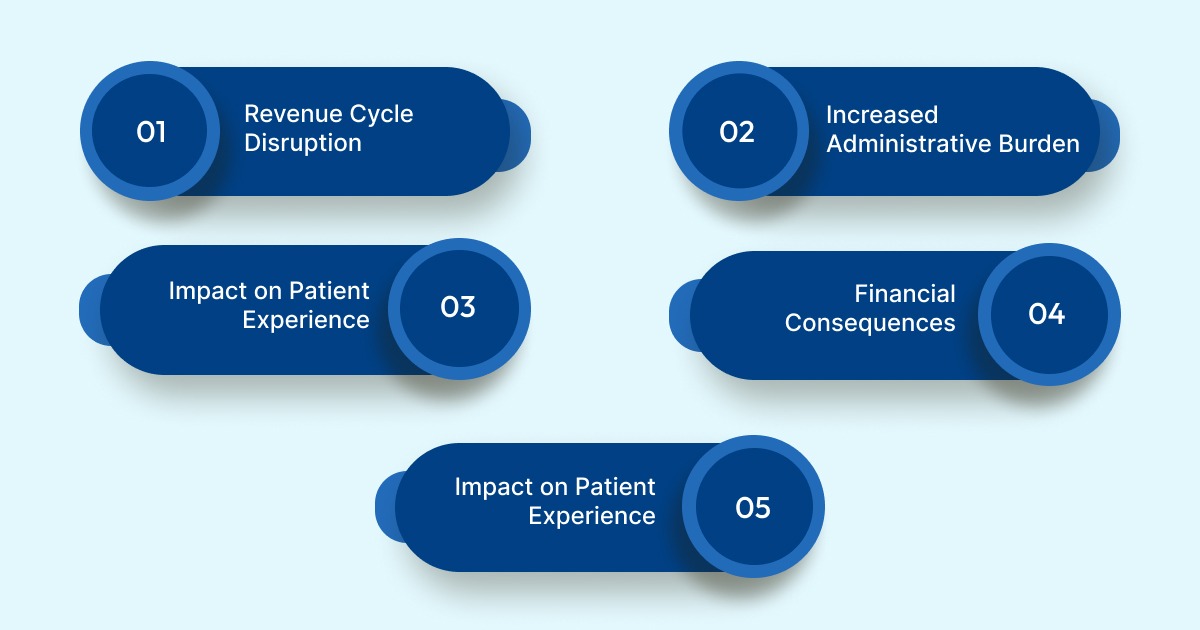
1. Revenue Cycle Disruption
CO-11 denials interrupt the normal flow of reimbursements and introduce volatility into the revenue cycle. As denial rates climb across the industry, cash flow becomes harder to predict and manage.
Because the root cause of CO-11 often sits upstream, in documentation, coding, or claim creation, the same issues tend to resurface, increasing days in accounts receivable and slowing overall collections.
2. Increased Administrative Burden
Each CO-11 denial requires investigation, correction, and frequently an appeal. This manual rework pulls billing and coding teams away from higher-value activities and adds significant operational cost. Over time, denial management becomes a recurring drain on productivity, reducing efficiency across the revenue cycle function.
3. Impact on Patient Experience
CO-11 denials can also affect patients directly. Delayed or denied claims often lead to billing confusion, unexpected balances, and prolonged financial uncertainty. In some cases, this uncertainty discourages patients from pursuing follow-up care.
Over time, repeated billing issues can erode patient trust and negatively influence a provider’s reputation, especially in an environment where patient feedback is highly visible online.
4. Financial Consequences
The financial impact of CO-11 denials is substantial. Healthcare providers lose an estimated $262 billion annually to denied claims, with CO-11 being a frequent contributor. Repeated denials lead to delayed or lost revenue, higher cost to collect, and increased audit exposure when patterns persist.
These pressures are especially challenging for smaller practices and organizations operating on thin margins, where cash flow disruptions can limit investment in staff, technology, and patient services.
5. Impact on Patient Experience
CO-11 denials also affect patients. Delayed or rejected claims often result in billing confusion, unexpected balances, and prolonged financial uncertainty. In some cases, this discourages patients from pursuing follow-up care. Over time, repeated billing issues can erode trust and negatively affect a provider’s reputation.
Because CO-11 denials are typically symptoms of upstream workflow gaps rather than isolated errors, addressing them reactively is rarely enough. Understanding their full impact on the revenue cycle is a critical step toward preventing them and building a more stable, compliant reimbursement process.
Also Read: Top 20 Denial Codes in U.S. Medical Billing (2026 Guide)
A Real-World Example of a CO-11 Denial Code
A healthcare provider submits a claim for a diagnostic imaging service using a diagnosis code for general fatigue. The payer denies the claim under CO-11, citing that the diagnosis does not support the medical necessity of the imaging.
How the denial was resolved:
- The provider reviews the patient’s medical record and confirms the imaging was ordered due to suspected cardiac concerns.
- The claim is updated with a more specific diagnosis that accurately reflects the clinical reason for the test.
- Supporting documentation is attached, and the claim is resubmitted.
Once the diagnosis/procedure relationship is clearly established, the payer approves the claim and issues reimbursement.
As this example shows, CO-11 denials rarely happen without warning. In most cases, they stem from specific and repeatable issues across documentation, coding, and payer policy interpretation.
6 Common Causes of the CO-11 Denial Code
CO-11 denials are often mistaken for simple coding errors. In reality, they usually reflect broader breakdowns across documentation, diagnosis selection, code linkage, or payer-specific medical necessity rules. These issues are predictable, repeatable, and largely preventable when addressed at the right point in the workflow.
Below are the most common causes of CO-11 denials:
1. Incomplete or Insufficient Clinical Documentation
Documentation gaps are one of the leading drivers of CO-11 denials. When clinical notes fail to clearly establish medical necessity, the diagnosis may not support the billed procedure, even if the codes appear correct.
Common issues include:
- Missing or unclear clinical rationale for the procedure
- Lack of specificity in provider notes
- Weak linkage between symptoms, assessment, and treatment plan
- Limited detail in operative or progress notes
Example: A provider bills for knee arthroscopy using a diagnosis of knee pain. The medical record lacks imaging results, exam findings, or evidence of failed conservative treatment. The payer denies the claim under CO-11 because the documentation does not justify the procedure.
2. Diagnosis and Procedure Code Mismatch
CO-11 denials frequently occur when the ICD-10 diagnosis does not adequately support the billed CPT or HCPCS procedure. These mismatches are often triggered by:
- Use of overly broad or nonspecific diagnosis codes
- Outdated ICD-10 or CPT codes after annual updates
- Incorrect laterality, encounter type, or severity coding
- Missing or misapplied modifiers
Automated payer edits commonly flag these inconsistencies before payment.
Example: A claim is submitted for bronchoscopy using a diagnosis code for cough (R05). Because the diagnosis is too general to support an invasive respiratory procedure, the payer denies the claim with CO-11.
3. Diagnosis Pointer and Linkage Errors
In some cases, the correct diagnosis is present on the claim but is not properly linked to the procedure line. These errors are common in high-volume or integrated environments and may occur when:
- Diagnosis pointers drop during EHR-to-billing transfers
- Incorrect diagnosis sequencing is selected
- Multiple diagnoses exist, but the wrong one is linked to the procedure
Even small linkage errors can trigger a CO-11 denial.
Example: A claim includes diagnoses for diabetes and diabetic neuropathy, but a nerve conduction study is linked to the general diabetes code instead of the neuropathy diagnosis. The payer flags the mismatch and issues a CO-11 denial.
4. Medical Necessity Not Established
A claim may still be denied under CO-11 even when diagnosis and procedure codes technically align. This happens when the payer determines that the service was not medically necessary based on its coverage criteria.
This commonly occurs when:
- Severity or frequency thresholds are not met
- Required clinical indicators are missing
- LCD or NCD coverage criteria are not satisfied
Example: A claim for sinus surgery is submitted with a diagnosis of acute sinusitis. The documentation does not show chronic or recurrent disease, leading the payer to determine that surgery was not medically necessary and deny the claim under CO-11.
5. Payer-Specific Coverage and Policy Rules
Medical necessity rules vary by payer. A diagnosis–procedure pairing approved by one payer may be denied by another due to:
- Local Coverage Determinations (LCDs)
- National Coverage Determinations (NCDs)
- Specialty-specific diagnosis limitations
- Site-of-service or modifier-based restrictions
Failing to account for payer-specific logic significantly increases CO-11 risk.
Example: A diagnostic test is covered by one payer when billed with a general musculoskeletal diagnosis but denied by another payer that requires a more specific diagnosis under its LCD, resulting in a CO-11 denial.
6. Improper Unbundling, Upcoding, or Downcoding
Billing practices that distort clinical intent can also lead to CO-11 denials:
- Unbundling: Billing components separately instead of using a comprehensive code
- Upcoding: Reporting a higher-level service than the diagnosis supports
- Downcoding: Reporting a lower-level service that does not align with the documented diagnosis
Each of these breaks the diagnosis–procedure relationship in payer adjudication logic.
Examples:
- Unbundling components of a bundled procedure leads to a CO-11 denial.
- Billing a higher-level surgical procedure when the diagnosis supports a less complex service triggers denial.
- Reporting a complex service at a lower level causes misalignment and rejection.
Once you know what’s causing them, you can stop them from quietly draining time and revenue. The next step is learning how to identify CO-11 denials quickly, so you can fix the issue early, before it turns into rework, delays, and lost reimbursement.
How to Identify CO-11 Denial Codes on Claims
Identifying a CO-11 denial begins with reviewing the payer’s response after claim submission. Payers communicate denial details through the Explanation of Benefits (EOB) or Remittance Advice (RA), which explain why a claim or specific claim line was rejected.
Within these documents, adjustment and remark codes provide important context for a CO-11 denial, including:
- CARC 11: Diagnosis is inconsistent with the procedure billed
- RARC N519: Invalid combination of diagnosis, procedure, or modifiers
- CARC 16: Missing, incomplete, or incorrect claim information
To pinpoint the issue, review the denial narrative and isolate the affected claim line. Compare the ICD-10 diagnosis code with the associated CPT or HCPCS procedure code to identify mismatches, linkage errors, or missing modifiers.
Additional insight may be available in the 835 Healthcare Policy Identification segment (Loop 2110, Service Payment Information REF), which can reference payer-specific policies or coverage rules that contributed to the denial.
Accurate and early identification of CO-11 denials allows revenue cycle teams to take targeted corrective action, whether that means correcting codes, fixing diagnosis pointers, or supplying documentation to support medical necessity.
Also Read: Common Medical Billing and Coding Errors and How to Protect Your Practice
Now, let’s determine which denials require immediate action and how to prioritize them for efficient resolution.
How to Triage and Prioritize CO-11 Denials
Not every CO-11 denial deserves the same level of effort. Effective triage helps revenue cycle teams decide what to work first, what to route for correction, and what to deprioritize, based on financial impact and recovery likelihood.
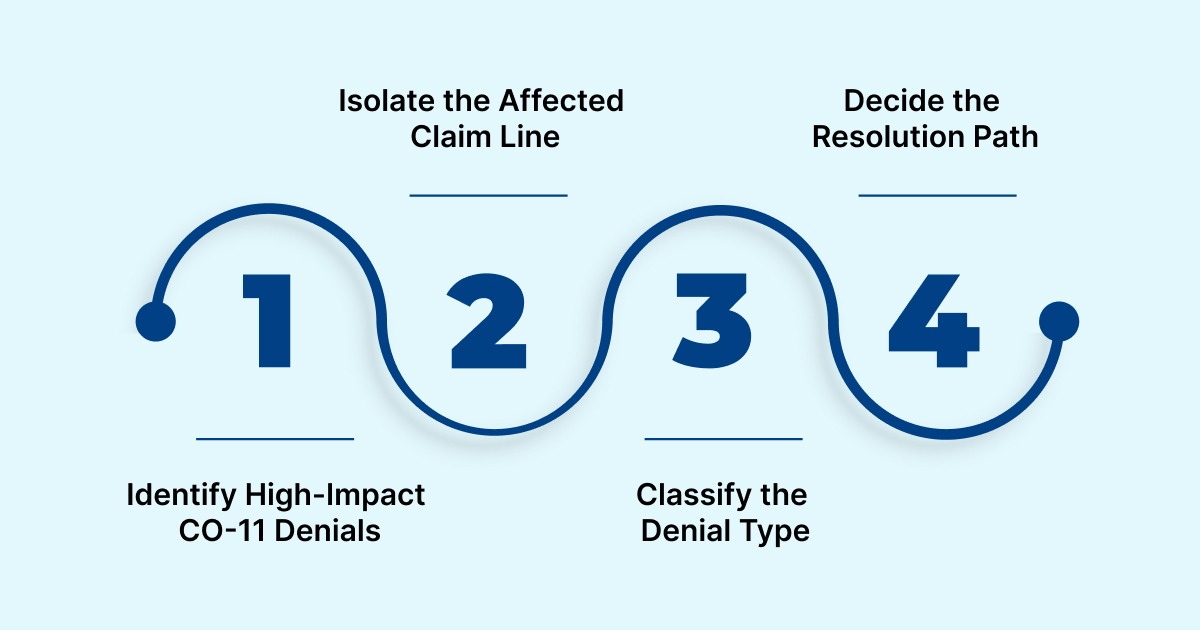
1. Identify High-Impact CO-11 Denials
Start by prioritizing denials where recovery will meaningfully affect revenue or operational efficiency. Focus on:
- High-dollar claims with significant reimbursement value
- Repeat CO-11 denials tied to the same CPT code, provider, or specialty
- High-volume procedures generating recurring denial patterns
- Claims approaching timely filing or appeal deadlines
This ensures limited RCM resources are directed toward denials that matter most.
2. Isolate the Affected Claim Line
Next, review the Remittance Advice (RA/835) to identify exactly which claim line triggered CO-11. Confirm at a high level:
- The denied CPT or HCPCS code
- The linked ICD-10 diagnosis code(s)
- Diagnosis pointer sequencing
- Modifier and place-of-service indicators
At this stage, the goal is scoping, not correcting. You are identifying where the issue lives, not resolving it yet.
3. Classify the Denial Type
Before taking action, classify the denial into one of three buckets:
- Likely correctable (coding, linkage, modifier-related)
- Documentation-dependent (may require provider input)
- Policy-driven (payer interpretation or coverage limitation)
This classification prevents unnecessary appeals and reduces wasted rework.
4. Decide the Resolution Path
Answer three routing questions:
- Can this be corrected and resubmitted without an appeal?
- Does it require provider clarification before action?
- Is payer policy the likely blocker, making an appeal necessary?
Once decided, route the denial to the appropriate workflow, coding correction, provider query, or appeal queue. At this point, triage is complete. The focus now shifts from prioritization to execution.
Also Read: Key Updates in New CPT Code Set for 2026
How to Resolve CO-11 Denial Codes
Once a CO-11 denial has been triaged and routed, the goal is clear: fix the issue, recover reimbursement, and prevent recurrence.
Step 1: Review the Denial and Claim Details
Begin with a detailed review of the EOB or RA/835 to confirm:
- The denied CPT or HCPCS code
- The linked ICD-10 diagnosis code(s)
- Diagnosis pointer sequencing
- Modifier usage and place of service
If available, review the 835 Healthcare Policy Identification segment (Loop 2110) to understand any payer policy or rule that influenced the denial.
Step 2: Validate Coding and Diagnosis–Procedure Linkage
Verify that the claim accurately reflects the clinical scenario:
- Confirm diagnosis specificity supports the billed procedure
- Ensure the CPT or HCPCS code matches the service performed
- Validate correct diagnosis pointer linkage and sequencing
- Check for missing, incorrect, or misapplied modifiers
- Identify outdated or deprecated codes
Many CO-11 denials are resolved at this stage through precise coding corrections.
Step 3: Evaluate Clinical Documentation for Medical Necessity
Next, assess whether the medical record clearly supports the service. Look for:
- Explicit clinical rationale for the procedure
- Symptoms, severity, and duration supporting treatment
- Diagnostic findings, imaging, or test results
- Alignment between diagnosis, treatment plan, and service performed
If documentation is insufficient, initiate a targeted provider query focused only on the missing elements needed to establish medical necessity.
Step 4: Align With the Provider When Needed
When provider input is required, avoid full chart rewrites. Instead:
- Request clarification specific to medical necessity
- Confirm diagnosis accuracy and intent
- Ensure documentation aligns with payer expectations
This minimizes delays while preserving documentation integrity.
Step 5: Correct and Resubmit or File an Appeal
Choose the appropriate action based on findings:
- Correct and resubmit when issues involve coding errors, diagnosis specificity, linkage, or modifiers
- Submit an appeal when documentation supports the service but payer interpretation or policy application caused the denial
Include a concise medical necessity explanation and attach all supporting documentation.
Step 6: Track Resolution and Monitor Patterns
After submission:
- Monitor claim status and payer responses
- Track time to resolution and appeal success rates
- Identify repeat CO-11 denials by procedure, provider, or specialty
Recurring patterns indicate upstream documentation or workflow gaps that must be addressed to prevent future denials.
Strategies to Prevent the CO-11 Denial Code
Preventing CO-11 denials is far more effective than correcting them after claims are rejected. Organizations that consistently reduce these denials focus on eliminating diagnosis–procedure mismatches before claims reach the payer.
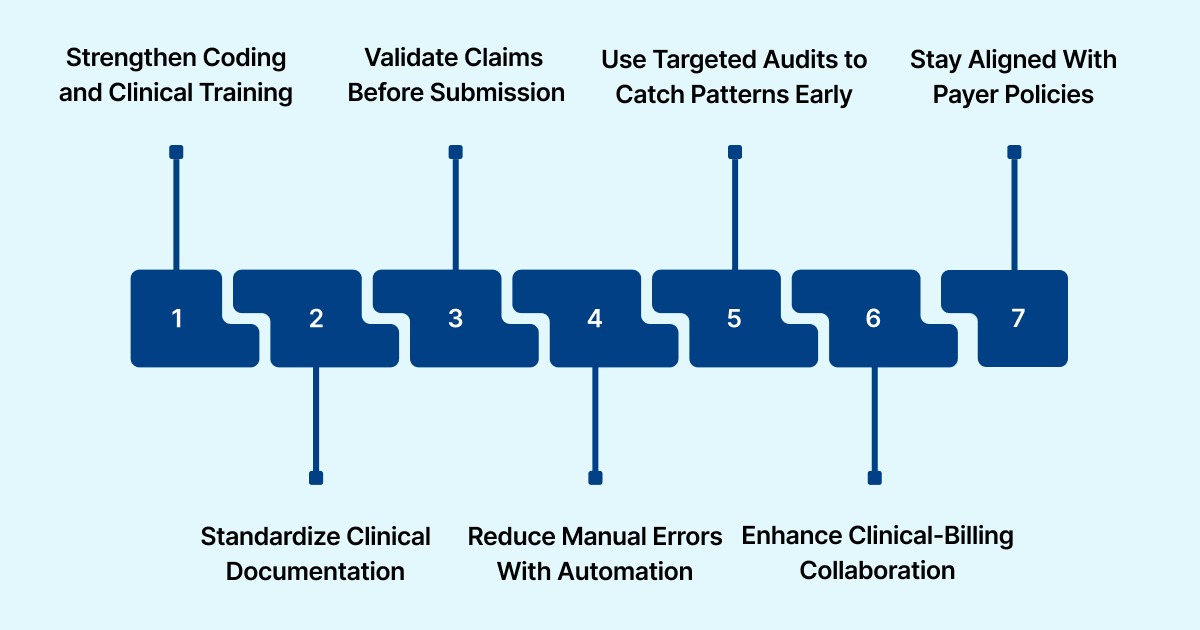
- Strengthen Coding and Clinical Training
Accurate claims start with informed teams. Coding and billing staff must stay current with ICD-10, CPT, and payer-specific updates, while clinical teams need clear guidance on documenting medical necessity. Shared training across departments helps keep diagnoses, procedures, and documentation aligned.
- Standardize Clinical Documentation
Medical necessity must be clear in the clinical record. Documentation should capture the patient’s condition, severity, duration, and the rationale for the procedure performed. Standard templates and structured prompts reduce variability and improve consistency, especially for services with high denial risk.
- Validate Claims Before Submission
Pre-submission validation is one of the most effective ways to prevent CO-11 denials. Verifying diagnosis–procedure compatibility, diagnosis pointers, and modifier usage before submission prevents avoidable errors and reduces downstream rework.
- Reduce Manual Errors With Automation
Manual coding processes increase the likelihood of oversight. Automated coding and validation tools can identify mismatches and documentation gaps in real time, improving first-pass accuracy and lowering reliance on post-denial fixes.
- Use Targeted Audits to Catch Patterns Early
Focused internal audits help identify recurring diagnosis–procedure alignment issues. Reviewing high-denial procedures, affected specialties, and recent payer policy changes allows teams to correct systemic gaps before they impact reimbursement.
- Improve Collaboration Between Clinical and Billing Teams
Clear communication between clinical and billing teams helps prevent disconnects that lead to CO-11 denials. Regular reviews of denial trends and documentation expectations ensure both teams work from the same understanding.
- Stay Aligned With Payer Policies
Medical necessity requirements vary by payer and change frequently. Ongoing monitoring of LCDs, NCDs, and payer-specific coverage rules is essential to prevent denials caused by outdated assumptions.
Even with strong documentation, training, and audits in place, manual controls often struggle to scale as claim volumes grow and payer rules become more complex. Consistently preventing CO-11 denials requires real-time validation embedded directly into the coding workflow. This is where RapidClaims plays a critical role.
How RapidClaims Help Reduce CO-11 Denials
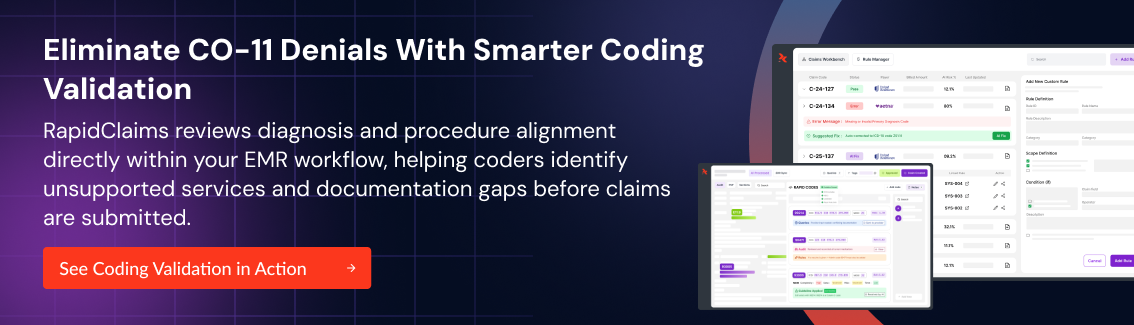
RapidClaims is an AI-driven medical coding automation platform designed to identify and prevent diagnosis–procedure mismatches before claims are submitted. By embedding medical necessity validation and payer rule checks into daily coding workflows, RapidClaims helps teams reduce avoidable denials without increasing manual effort.
RapidCode: Diagnosis–Procedure Validation at the Source
RapidCode analyzes clinical documentation in real time to ensure diagnoses support the billed procedures. It:
- Detects diagnosis–procedure mismatches before submission
- Recommends ICD-10 and CPT codes aligned with clinical context
- Flags missing or weak medical necessity indicators
This upstream validation improves first-pass claim accuracy and reduces downstream rework.
RapidScrub: Pre-Submission Claim Review
RapidScrub focuses on pre-submission claim quality by scanning claims against payer logic and policy requirements. It helps teams:
- Identify and correct coding mismatches, modifier issues, and missing pointers
- Apply payer-specific edits and checks before submission
- Highlight claims where documentation may not fully support the billed service
By reviewing claims before they leave the system, RapidScrub reduces the likelihood of CO-11 denials and other preventable rejections.
Integrated, Workflow-First Design
RapidClaims integrates with existing EHR and RCM systems, allowing validation to occur within established coding and billing workflows. Issues are surfaced where work already happens, without adding extra steps or operational friction.
Instead of reacting to CO-11 denials after they disrupt cash flow, RapidClaims helps revenue cycle teams prevent them before claims reach the payer.
Conclusion
CO-11 denial codes point to deeper breakdowns in diagnosis–procedure alignment, documentation quality, and payer policy adherence. Resolving these denials claim by claim may recover revenue in the short term, but it does little to stop repeat CO-11 denial codes from reappearing.
Preventing CO-11 denial codes at scale requires real-time validation built directly into coding and claim review workflows. With AI-powered solutions like RapidCode and RapidScrub, RapidClaims helps teams identify medical necessity gaps early, improve first-pass claim accuracy, and submit audit-ready claims without adding operational complexity.
Discover how RapidClaims helps teams prevent CO-11 denials earlier in the coding and claim review process. Book a demo now!
FAQs
1. What does denial code CO-11 mean?
CO-11 indicates that the diagnosis submitted on a claim does not support the billed procedure under payer medical necessity rules. It reflects a diagnosis–procedure mismatch.
2. What triggers a CO-11 denial code?
A CO-11 denial is triggered when the payer determines that the ICD-10 diagnosis does not justify the CPT or HCPCS procedure, or when linkage or documentation is insufficient.
3. Can CO-11 denials be appealed?
Yes. CO-11 denials can be appealed when documentation clearly supports medical necessity or when payer interpretation is incorrect. Otherwise, corrected claims are often more effective.
4. Is CO-11 always a coding error?
No. While coding errors can cause CO-11 denials, they may also result from documentation gaps, diagnosis linkage issues, or payer-specific coverage rules.
5. How does the CO-11 denial code impact the revenue cycle?
Repeated CO-11 denials delay reimbursements, increase rework, and disrupt cash flow. Over time, they reduce clean claim rates and increase administrative costs.
6. Do payer rules affect CO-11 outcomes?
Yes. Medical necessity requirements vary by payer, plan type, and region. A diagnosis–procedure pairing accepted by one payer may be denied by another.


