.jpg)

Revenue cycle management for physician practices has become harder to execute as complexity continues to rise. Coding guidelines change frequently, payer scrutiny is tighter, documentation expectations are higher, and staffing remains constrained. In this environment, even small errors can delay reimbursement, increase denials, and disrupt cash flow.
According to the American Medical Association, 32% of outpatient commercial claims and 11% of Medicare claims remain unpaid 90 days after submission. For physician practices operating with thin margins, these delays directly affect financial stability and operational focus.
RCM is no longer a back-office function. It has become a core operational capability that determines how reliably practices get paid. This blog explains RCM for physician practices, where revenue leakage occurs, and how AI-driven medical coding and automation are improving outcomes across the revenue cycle.
Key Takeaways
- RCM for physician practices is no longer a back-office task. Coding accuracy, documentation quality, and early error detection now directly affect cash flow, denial rates, and compliance risk.
- Most revenue leakage is preventable. Errors at registration, documentation, coding, and payer validation compound downstream as denials, delayed payments, and write-offs.
- Traditional RCM workflows are reactive and hard to scale. Manual coding, fragmented systems, and inconsistent rule application increase variability and audit exposure.
- AI-driven RCM shifts the model from recovery to prevention. Automated coding, documentation gap detection, and pre-submission payer validation reduce denials and speed reimbursement.
- Successful RCM modernization is incremental. Practices that assess readiness, pilot automation, and monitor KPIs achieve sustainable improvements.
Table of Contents
- What Is RCM for Physician Practices?
- RCM Challenges Physician Practices Face Today
- Where Revenue Leakage Happens in Physician Practice RCM
- The Key Stages of Revenue Cycle Management in Physician Practices
- Why Traditional RCM Falls Short for Physician Practices
- How AI Improves Coding Accuracy and Prevents Denials
- What Physician Practices Gain from Modern RCM
- How to Implement Modern RCM Workflows
- How RapidClaims Supports AI-Driven RCM for Physician Practices
- Key Trends Shaping RCM for Physician Practices
- Conclusion
- FAQs
What Is RCM for Physician Practices?
Revenue cycle management (RCM) is the end-to-end process of converting clinical services into collected revenue. For physician practices, it spans:
- Patient scheduling and registration
- Insurance eligibility and authorization
- Clinical documentation and charge capture
- Medical coding and claim submission
- Payment posting, denial management, and AR follow-up
RCM is not a single system or role. It is a coordinated workflow across front-office staff, clinicians, coders, and billing teams. When these functions are not aligned, errors increase, denials rise, and revenue becomes harder to predict.
Physician practices typically operate with lean teams and tight margins. As claim volumes grow and payer oversight intensifies, manual RCM workflows struggle to scale. This makes accuracy, consistency, and early error detection essential to maintaining financial stability.
Also Read: Revenue Cycle Management in Healthcare: A 2025-2026 Guide
RCM Challenges That Physician Practices Face Today
Physician practices now operate in a reimbursement environment defined by higher scrutiny, tighter margins, and growing administrative burden. Revenue cycle performance depends on precision at every step, yet the system itself has become more complex.
Several external pressures are driving this shift:
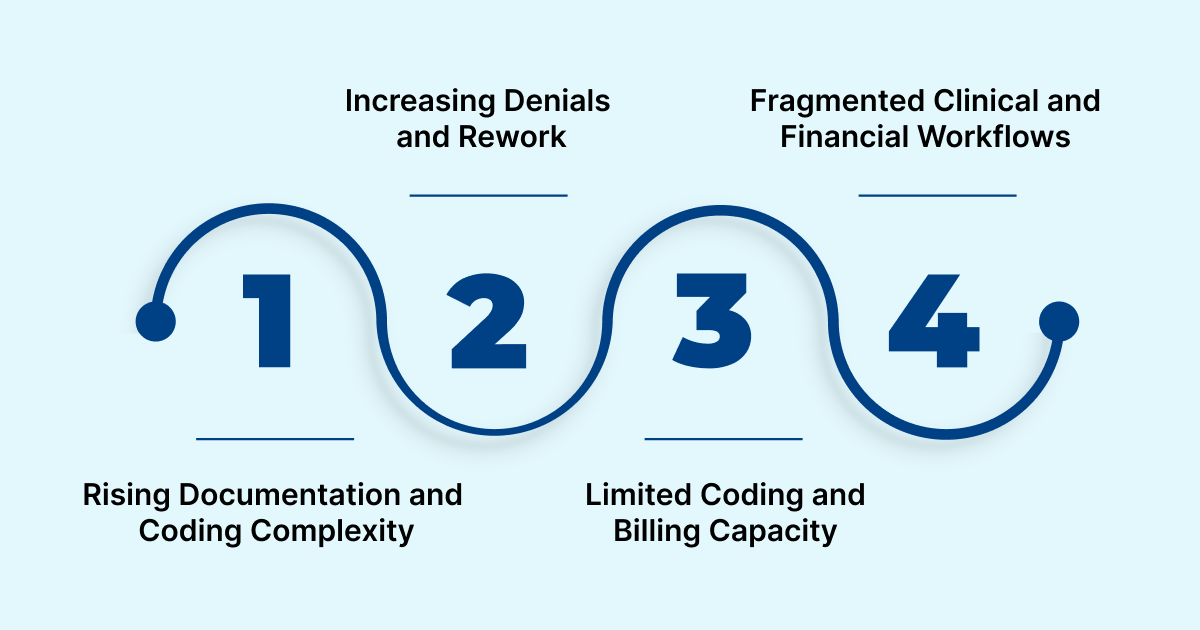
- Rising Documentation and Coding Complexity
Coding standards such as ICD-10, CPT, E&M, and HCC continue to evolve. Payers increasingly require detailed clinical specificity to justify reimbursement. Providers must document more thoroughly, and coders must apply increasingly nuanced rules. Small documentation gaps can lead to undercoding, overcoding, or denial.
- Increasing Payer Scrutiny and Denials
Denials are no longer limited to eligibility errors. Medical necessity disputes, modifier misuse, insufficient documentation, and payer-specific edits are common. Appeals are time-consuming and recovery rates vary, increasing the cost to collect.
- Staffing Constraints and Volume Pressure
Many physician practices operate with lean billing and coding teams. As patient volumes rise and payer requirements shift, backlogs form quickly. Delays in coding and submission extend days in accounts receivable and reduce cash flow predictability.
- Fragmented Clinical and Financial Workflows
Clinical documentation resides in the EHR, while coding, billing, and reporting systems often operate separately. Limited integration makes it harder to detect errors early, shifting correction efforts downstream.
Taken together, these pressures create an environment where revenue depends on speed, accuracy, and coordination. However, the workflows most practices rely on were not designed for this level of complexity.
Where Physician Practices Lose Revenue in the Revenue Cycle
Revenue leakage in physician practices is rarely caused by a single breakdown. It occurs at predictable pressure points across the revenue cycle. When left unaddressed, these gaps compound into denials, delayed reimbursement, underpayments, and write-offs.
The primary leakage points include:
1. Front-End Eligibility and Authorization Gaps: Incorrect insurance verification, inactive coverage, or missing prior authorizations lead to avoidable denials. These errors invalidate otherwise accurate claims and are often difficult to recover once submitted.
2. Documentation Gaps That Limit Coding Accuracy: Incomplete or insufficiently specific documentation results in undercoding, missed diagnoses, unsupported services, or audit exposure. Even small omissions reduce reimbursement or increase denial risk.
3. Coding Variability and Modifier Errors: Manual coding introduces variability in E&M level selection, modifier usage, and code combinations. Inconsistent rule application increases denials and compliance risk.
4. Payer-Specific Rule Misalignment: Failure to apply NCCI edits, LCD/NCD requirements, and payer-specific billing rules before submission leads to technical denials that could have been prevented.
5. Denial Rework and Delayed Appeals: Without structured root-cause analysis, denial patterns repeat. Missed appeal deadlines and high manual effort reduce recovery rates and increase write-offs.
6. Underpayments and Reconciliation Blind Spots: When payments are not reconciled accurately, underpayments go unnoticed. Limited AR visibility prevents practices from identifying systemic payer issues.
Individually, these gaps may seem manageable. Collectively, they reduce clean-claim rates, extend days in accounts receivable, increase audit exposure, and destabilize cash flow. These breakdowns typically surface at specific stages of the revenue cycle, making it essential to examine RCM step by step to understand where revenue is created or lost
The Key Stages of Revenue Cycle Management in Physician Practices
Revenue cycle management is a connected workflow where each stage depends on the one before it. Breakdowns rarely cause immediate issues. Instead, they surface later as denials, delayed payments, or revenue that is never recovered.
1. Patient Registration, Eligibility, and Authorization
This stage establishes the foundation of the revenue cycle. It includes appointment scheduling, patient demographic capture, insurance verification, and prior authorization when required.
All downstream RCM activities rely on the accuracy of this information. Even small front-end errors can invalidate an otherwise correct claim and are often difficult to appeal.
Common failure points
- Incomplete or incorrect patient information
- Inactive or mismatched insurance coverage
- Missing or expired prior authorizations
2. Clinical Documentation and Charge Capture
During the patient visit, providers document diagnoses, procedures, and medical decision-making. Charge capture ensures all billable services are recorded. Documentation quality directly affects coding accuracy and compliance. When notes do not support the level of service billed, claims may be down coded, denied, or flagged for audit.
Common failure points
- Missing diagnoses or incomplete assessments
- Insufficient specificity for ICD-10 or E&M levels
- Services rendered but not captured for billing
3. Medical Coding, Billing, and Validation
Medical coding converts clinical documentation into standardized codes such as ICD-10, CPT, HCPCS, and HCC. Claims are then validated against payer rules before submission. This is the most technically complex stage of RCM, as coders must apply evolving guidelines alongside payer-specific edits.
Common failure points
- Coding errors from outdated guidance or manual variability
- Missed modifiers or incorrect code combinations
- Inconsistent coding patterns that increase audit risk
4. Claim Preparation and Submission
At this stage, claims are finalized, scrubbed for compliance, and submitted to payers, typically through a clearinghouse. Even when coding is accurate, incomplete or non-compliant claims can be rejected. Pre-submission validation is critical to preventing avoidable delays.
Common failure points
- Minor data inconsistencies triggering claim rejections
- Missing supporting documentation
- Delayed claim transmission
5. Payment Posting, Reconciliation, and Patient Balances
Once payments are received, they must be accurately posted and reconciled against submitted claims. This process provides visibility into underpayments, contractual adjustments, and remaining patient balances. Without accurate reconciliation, practices lose insight into true revenue performance.
Common failure points
- Underpayments that go unnoticed
- Distorted accounts receivable aging
- Delayed or inaccurate patient billing
6. Denial Management and A/R Follow-Up
Denied or underpaid claims are reviewed, corrected, and appealed. Denial management determines whether lost revenue is recovered or written off and helps identify upstream issues that need correction.
Common failure points
- Repeated denial patterns without root-cause analysis
- Missed appeal deadlines
- High manual effort with limited recovery
Viewed across the full lifecycle, it becomes clear how small errors compound over time. Traditional RCM workflows tend to address problems only after they appear downstream, making prevention significantly more difficult and costly.
Also Read: Top Vendors for Revenue Cycle Management in Healthcare
Why Traditional RCM Falls Short for Physician Practices
Traditional revenue cycle management models were built for simpler billing environments. They rely heavily on manual review, retrospective correction, and disconnected systems. As complexity has increased, the structural limitations of this model have become more visible.
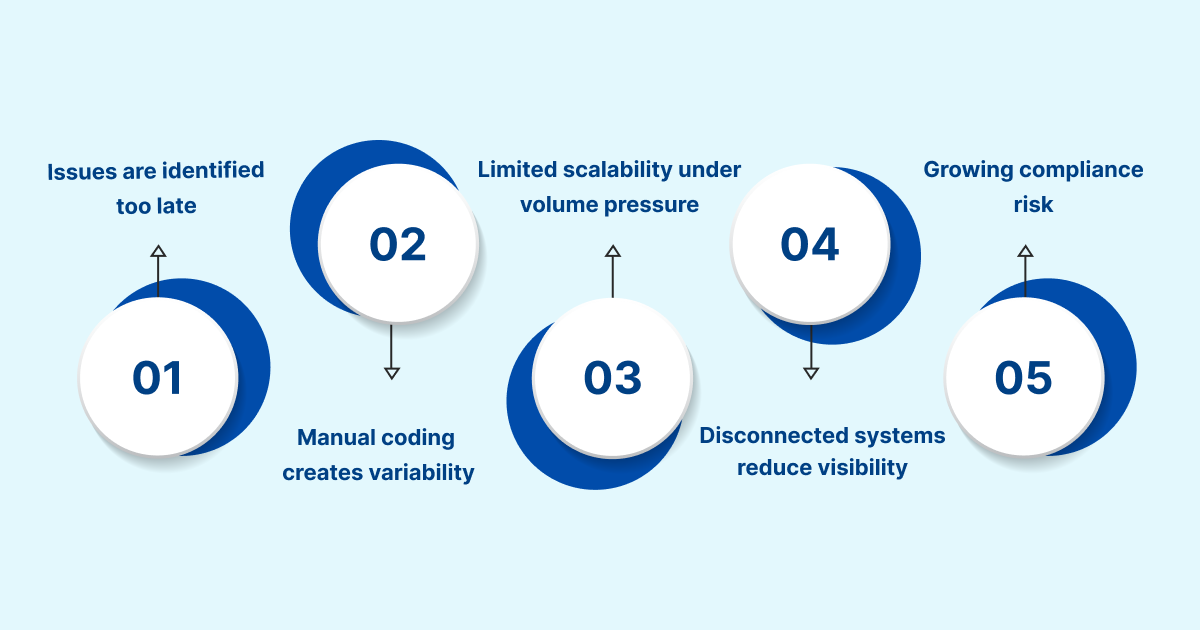
The limitations of traditional RCM stem from its reactive and fragmented nature:
- Issues are Identified Too Late: In traditional workflows, most issues are discovered only after a claim is denied or rejected. By the time documentation gaps or coding errors surface, rework is required and reimbursement is delayed.
- Manual Coding Creates Variability: Coding accuracy depends on individual experience, workload, and interpretation of evolving guidance. This introduces variability across providers and specialties, increasing denial risk and audit exposure.
- Limited Scalability Under Volume Pressure: Manual processes do not scale efficiently when chart volumes increase. Adding headcount raises costs, while failing to scale extends AR timelines and increases backlog pressure.
- Disconnected Validation: Payer-specific edits, NCCI rules, and LCD/NCD requirements are often applied inconsistently. Without embedded validation prior to submission, preventable technical denials occur.
- Incomplete Revenue Visibility: Because systems are fragmented, practices struggle to identify denial trends, underpayments, or root causes early. Revenue leakage is addressed after impact rather than prevented upfront.
Traditional RCM was designed to recover revenue after problems occur. Modern physician practices require workflows that prevent revenue loss before claims ever reach payers. This is where technology begins to change outcomes.
How AI Improves Coding Accuracy and Prevents Denials
Revenue cycle management is moving from reactive denial correction to proactive error prevention. AI supports this shift by identifying coding, documentation, and compliance issues early in the workflow, when they are easiest and least costly to fix.
a) AI-Driven Medical Coding: AI-driven coding uses natural language processing to interpret clinical documentation and assign ICD-10, CPT, HCPCS, and HCC codes based on clinical context. By applying consistent logic across all charts, AI reduces missed services, coding variation, and processing delays.
b) Early Detection of Documentation Gaps: AI reviews clinical notes before claim submission to flag missing diagnoses, unsupported procedures, or insufficient specificity. Addressing these gaps while documentation is still current prevents avoidable denials and reduces downstream rework.
c) Built-In Payer Rule Validation: AI-assisted workflows validate claims against payer-specific requirements, including NCCI edits and LCD/NCD rules, before submission. This improves first-pass acceptance rates and reduces denials caused by technical non-compliance.
d) Improved HCC Risk Adjustment Accuracy: For practices participating in Medicare Advantage or value-based care programs, AI-driven risk adjustment tools analyze clinical evidence to identify underreported conditions. This supports more accurate RAF score capture and appropriate reimbursement.
e) Audit Readiness and Explainability: AI-driven RCM workflows maintain structured audit trails that link assigned codes to supporting documentation and decision logic. This transparency supports compliance reviews and reduces audit risk.
Platforms like RapidClaims combine autonomous coding with explainable outputs, allowing physician practices to improve accuracy and consistency without sacrificing oversight. When applied consistently, these capabilities deliver measurable gains in denial reduction, throughput, and revenue visibility.
What Physician Practices Gain from Modern RCM
Modernizing revenue cycle management delivers measurable improvements across financial performance, operational efficiency, and compliance. When implemented correctly, these gains compound over time, allowing practices to scale without increasing administrative burden.
Key Benefits
Practices that adopt modern, technology-enabled RCM typically see:
- Higher clean-claim rates through pre-submission validation and stronger documentation alignment
- Lower denial rates driven by improved coding accuracy and payer rule compliance
- Faster chart processing and reduced coding backlogs
- Shorter days in accounts receivable, improving cash flow predictability
- Increased coder productivity without adding headcount
- Improved audit readiness supported by structured, traceable documentation
Together, these outcomes strengthen both financial stability and operational control.
RCM Use Cases Across Physician Practice Models
While the benefits are consistent, how they are realized varies by practice type.
- Small and Single-Specialty Practices: Automation reduces reliance on limited coding resources, speeds chart turnaround, and stabilizes monthly cash flow without increasing costs.
- Multi-Specialty Physician Groups: AI-driven RCM standardizes documentation and coding quality across specialties while supporting specialty-specific rules. Centralized reporting improves governance and compliance visibility.
- Medical Billing Organizations Supporting Practices: Billing partners use automation to scale efficiently, increase throughput, and maintain consistent quality across multiple clients and payer mixes.
Across all models, the common advantages are earlier error detection, clearer visibility into revenue performance, and the ability to grow without proportional increases in staffing or administrative effort.
Seeing what’s possible naturally leads to the next question: how do physician practices move from theory to execution without disrupting day-to-day operations?
Also Read: Top 10 Revenue Cycle Management Companies in the USA (2026)
How to Implement Modern RCM Workflows
Modernizing RCM works best when it is deliberate and incremental. The goal is to improve accuracy and throughput without disrupting existing clinical or billing operations.
1. Assess Workflow Readiness: Start by reviewing claim volumes, specialty mix, top denial drivers, AR aging, and EHR integrations. Establishing a clear baseline ensures automation is applied where it will have the greatest impact.
2. Pilot Automation and Measure Impact: A focused pilot allows practices to compare performance before and after automation. Core metrics typically include clean-claim rate, denial rate, days in AR, and coder productivity.
3. Align Teams Around Exception-Based Workflows: Automation is most effective when coders and billing teams focus on complex or exception cases. Clear ownership improves accountability and reduces rework.
4. Standardize Documentation and Coding Practices: Consistent documentation standards and coding workflows reduce variability and support accuracy as payer and regulatory requirements evolve.
5. Monitor performance and optimize continuously: Post-implementation, practices should regularly review KPIs to identify issues early and sustain improvements over time.
Automation reinforces each step by enforcing consistency and catching errors before submission. Platforms like RapidClaims support this approach by strengthening coding accuracy, reducing denials, and maintaining audit-ready workflows without disrupting existing systems.
How RapidClaims Supports AI-Driven RCM for Physician Practices
Physician practices modernizing RCM need platforms built specifically for healthcare complexity, not generic automation tools. RapidClaims is designed to embed AI directly into medical coding and claims workflows while maintaining strict compliance standards.
With SMART-on-FHIR and native EHR integrations, RapidClaims operates within existing clinical and billing systems, minimizing disruption while continuously adapting to payer requirements. Its modular approach allows practices to apply automation where it delivers the most impact:
- RapidCode provides autonomous medical coding with consistent, auditable accuracy across high-volume charts.
- RapidCDI strengthens clinical documentation and risk adjustment capture, supporting more accurate RAF scores.
- RapidScrub validates claims against payer rules before submission, reducing preventable denials.
Together, these capabilities improve audit readiness, reduce repetitive documentation effort, and protect margins by identifying issues early in the revenue cycle rather than after reimbursement is delayed.
Conclusion
RCM for physician practices can no longer depend on manual, reactive workflows. Coding accuracy, documentation quality, and early issue detection now directly affect reimbursement speed, denial rates, and compliance exposure. As claim volumes increase and payer scrutiny intensifies, practices need RCM processes that prevent errors before they reach payers.
AI-powered platforms such as RapidClaims enable this shift by automating high-volume, error-prone tasks including medical coding, documentation validation, and payer rule checks. The result is more accurate claims, fewer denials, faster reimbursement cycles, and audit-ready workflows that integrate with existing EHR systems.
Reach out to RapidClaims to see how AI-driven medical coding can reduce denials, improve accuracy, and stabilize revenue across your RCM workflows.
FAQs
1. What are the first 3 steps of RCM?
The first steps are patient scheduling and registration, insurance eligibility verification, and prior authorization when required. Errors at this stage often lead to avoidable denials later in the cycle.
2. What is the RCM process in medical billing?
The RCM process covers documentation, medical coding, claim submission, payment posting, denial management, and accounts receivable follow-up to ensure services are reimbursed accurately and on time.
3. What does revenue cycle management include for physician practices?
RCM includes patient intake, eligibility checks, clinical documentation, coding, claim submission, denial management, and AR follow-up to convert care delivery into collected revenue.
4. Can AI support specialty-specific coding?
Yes. AI systems can apply specialty-specific coding rules, payer requirements, and documentation patterns while maintaining consistency across providers.
5. Why do physician practices struggle with RCM?
Common challenges include evolving payer rules, fragmented workflows, limited staffing, and increasing documentation and coding complexity.
6. Which RCM stage has the biggest financial impact?
Coding accuracy and denial management typically drive the largest revenue gains, as errors here most often lead to denials and delayed payments.
7. Does automation improve RCM outcomes?
Yes. Automation improves consistency, reduces manual effort, shortens processing timelines, and helps practices adapt to changing payer requirements.


