
Insurance and healthcare organizations face growing pressure as claim complexity and evolving payer rules put revenue at risk. Yet many struggles stem from a familiar source: preventable claim denials. Denials erode cash flow, inflate administrative time, and increase operational burden.
Traditional tools like rule-based edits or manual reviews often cannot keep pace with today’s claim volumes and shifting payer logic. The result? Errors reach the insurer first and trigger denials that could have been prevented.
According to a 2025 industry survey, 41 % of providers now face denial rates of 10 % or higher.
This article unpacks how predictive denial analytics enables organizations to spot and prevent high-risk claims before submission. You’ll learn how it works, where the highest-value use-cases exist, how to measure impact, and how specialized platforms help operationalize the approach with minimal technical overhead.
Key Takeaways
- Predictive analytics in insurance claims identifies errors before submission, preventing costly denials that delay cash flow.
- ML models catch issues rule-based edits miss; including documentation gaps, coding inconsistencies, and payer-specific risk signals.
- Organizations gain early visibility into emerging payer behavior patterns, helping teams adjust before denials spike.
- Risk scoring shows which claims will likely be denied and why, enabling targeted corrections during coding and review.
- Denial prevention reduces appeals, improves first-pass yield, shortens payment cycles, and lowers administrative burden.
- The strongest ROI comes from fewer high-dollar denials, better documentation alignment, and reduced rework across service lines.
Table of Contents:
- The Financial Impact of Claim Denials in Insurance and Healthcare
- What Predictive Denial Analytics Means for Insurance Claim Accuracy
- High-Value Use Cases for Predictive Analytics in Insurance Claims
- How Predictive Analytics Scores Insurance Claims and Flags Denial Risk
- Measuring ROI From Predictive Analytics in Insurance Claims
- Challenges in Using Predictive Analytics for Insurance Claims and How to Solve Them
- How RapidClaims Enhances Predictive Analytics for Insurance Claims
- The Future of Predictive Analytics in Insurance Claims and Denial Prevention
- Conclusion
- FAQs
The Financial Impact of Claim Denials in Insurance and Healthcare
Denials remain a major source of financial loss across insurance and healthcare revenue cycle operations. Even a small rise in denial rates can disrupt revenue and increase workload.

Why denials are so costly
- Lost or delayed reimbursement that slows cash flow
- Extra labor for audits, rework, and appeals
- Higher administrative spending that reduces margins
- Longer payment cycles that complicate forecasting
Common preventable causes
- Missing or incomplete documentation
- Coding errors or inconsistencies
- Eligibility and authorization issues
- Misalignment with payer rules or medical necessity criteria
Operational impact on teams
- Staff diverted from strategic work to handle appeals
- More errors due to repetitive, high-volume processing
- Revenue planning challenges as denial patterns shift
As claim volumes rise and payer rules grow more complex, traditional review methods fall short. These pressures make proactive denial prevention essential for stable reimbursement and smoother operations.
What Predictive Denial Analytics Means for Insurance Claim Accuracy
Predictive denial analytics uses machine learning to assess the likelihood that a claim will be denied before it is submitted. Unlike broader analytics used for underwriting or pricing, this approach focuses specifically on the patterns, payer behaviors, and documentation signals that influence denial outcomes.
The model analyzes thousands of claim attributes together, including historical denial trends, payer behavior shifts, clinical context, documentation quality, and coding accuracy. From this, it produces a risk score that shows which claims need attention and why.
What makes this approach effective
- Identifies risk indicators that rule-based edits cannot detect
- Adapts as payer expectations and documentation standards change
- Evaluates relationships between diagnoses, procedures, and clinical notes
- Pinpoints root causes rather than isolated symptoms
Types of insights produced
- Claims likely to face medical necessity scrutiny based on payer history
- Procedure and diagnosis pairings that repeatedly trigger reviews
- Documentation gaps linked to poor appeal outcomes
- Coding patterns that often result in partial rather than full reimbursement
By surfacing these insights during claim creation or review, predictive denial analytics helps organizations prevent denials instead of reacting to them. This leads to more accurate submissions and steadier revenue flow.
High-Value Use Cases for Predictive Analytics in Insurance Claims
Predictive denial analytics delivers value when it isolates the precise technical, clinical, and payer-behavior drivers that influence adjudication outcomes. Below is a deeper, more specialized view of where this intelligence changes results in a measurable way.
1. Detecting Submission Errors That Traditional Edits Cannot See
Predictive models evaluate the clinical logic inside a claim, not just the coding format.
Examples of high-impact detections:
- Clinical narratives that do not meet the payer’s internal medical necessity thresholds for a given CPT code
- Physician note structures that historically correlate with documentation insufficiency for specific DRGs
- Attachments or imaging that payers routinely request for certain diagnosis clusters but are often omitted
These insights help teams correct claims at the documentation level rather than at the code level, which is where most preventable denials originate.
2. Uncovering Emerging Payer Behavior Patterns
Predictive analytics identifies payer shifts earlier than traditional analytics or staff observation.
Examples of subtle but important shifts:
- A payer increasing denials for a specific surgical code only when paired with a certain anesthesia or assistant-at-surgery code
- Rising rejection rates for telehealth encounters involving specific chronic condition codes due to evolving coverage policies
- New documentation expectations for high-cost imaging where payers demand stronger clinical indications
These insights reveal unpublished payer tendencies that materially affect reimbursement.
3. Ranking Appeals by Probability of Reversal
Predictive models analyze appeal history across providers, payers, and clinical specialties.
Factors that influence overturn likelihood:
- Whether the provider’s documentation style aligns with historically successful appeal packets
- Specific ICD–CPT combinations that have high overturn rates only when accompanied by certain clinical phrases
- Payer-level patterns where first-level appeals rarely succeed, but second-level reviews show strong recovery when certain evidence types are included
This allows teams to focus on denial categories that genuinely move the needle instead of spending time on low-yield appeals.
4. Exposing Operational Weak Spots That Create Recurring Denials
Predictive analytics often reveals organizational patterns that manual audits do not surface.
Examples of systemic contributors:
- A subset of physicians whose documentation consistency reduces claim defensibility for high-cost procedures
- Scheduling workflows that regularly create incorrect visit types, triggering authorization denials in specific service lines
- Coders who overuse or underuse certain modifiers in ways that misalign with payer adjudication behavior
These insights let leaders address root causes at the department or workflow level rather than correcting claims one by one.
Explore how predictive denial analytics can strengthen your claim accuracy and reduce preventable rework. Request a workflow assessment with the RapidClaims team.
How Predictive Analytics Scores Insurance Claims and Flags Denial Risk
Predictive denial analytics converts historical claim behavior into real time guidance that helps teams correct issues before submission. The process is built on a few essential components.
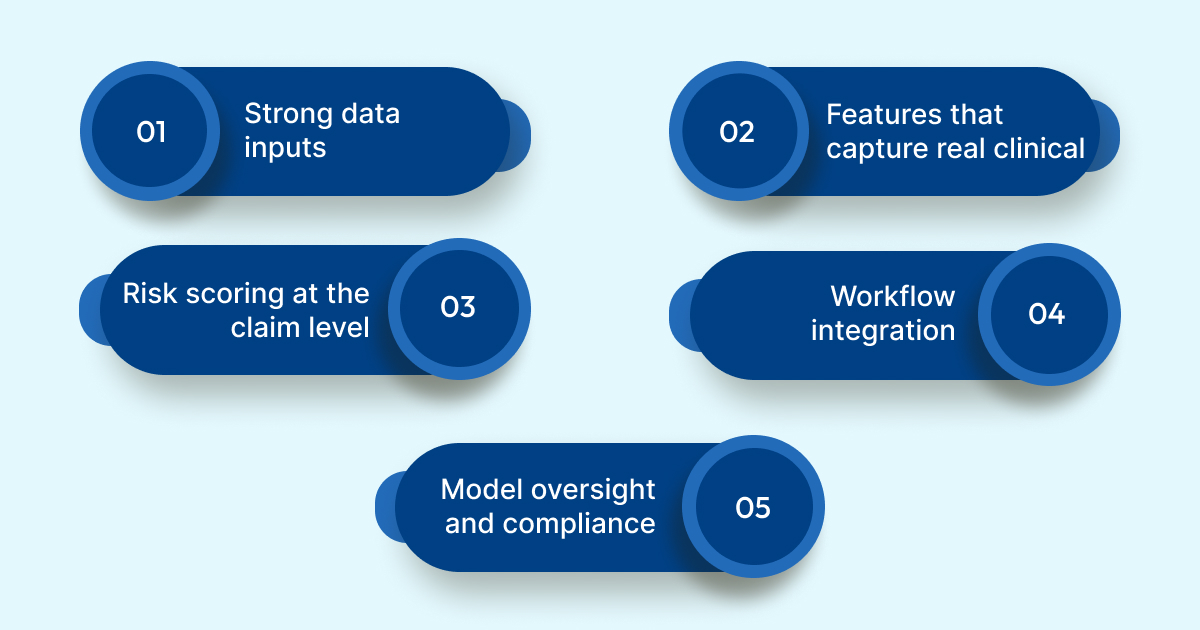
1. Strong data inputs
Models perform best when they use data that reflects actual payer responses. Useful inputs include:
- Past denials tied directly to specific claim elements
- Clinical notes linked to diagnoses and procedures
- Provider level patterns that affect review outcomes
- Time based trends showing how payer decisions shift
Clean, connected data ensures the model learns from real interactions.
2. Features that capture real clinical and operational context
The model evaluates relationships, not isolated fields. Examples include:
- Consistency between documentation and procedure choices
- Completeness scores for clinical notes
- Provider specific coding tendencies
- Payer behaviors tied to certain diagnoses
These features help the model detect risk signals that are difficult to catch manually.
3. Risk scoring at the claim level
Each claim receives a score that reflects its likelihood of denial and the reasons behind that risk.
The score points to specific issues such as:
- Missing phrases required for medical necessity
- Code combinations that recently produced denials
- Documentation sections that do not match historical approval patterns
4. Workflow integration
Predictive insights only matter if they reach users at the right moment. High value integrations include:
- Alerts during coding or charge review
- Automatic routing of high risk claims to senior staff
- Pre submission checklists based on the model’s findings
5. Model oversight and compliance
Payer rules evolve, so accuracy must be monitored and updated. Oversight includes:
- Tracking shifts in payer behavior
- Refreshing models with new denial outcomes
- Maintaining documentation that explains why a claim was flagged
This framework gives teams real time intelligence that reduces preventable denials and supports more efficient claim submission.
Measuring ROI From Predictive Analytics in Insurance Claims
The value of predictive denial analytics becomes clear when organizations track the operational and financial outcomes tied directly to corrected claims.
Key measurable results
- Lower denial volume by reducing submission errors that consistently trigger payer review
- Higher first pass yield from improved alignment between documentation and payer requirements
- Reduced appeal workload by preventing claims that historically fail overturn attempts
- Faster payment cycles because fewer claims require resubmission or additional records
How organizations quantify gains
- Compare baseline denial categories with post implementation patterns
- Track changes in denial severity, not just counts, to measure improvement in high dollar areas
- Monitor shifts in staff workload distribution as fewer claims move to appeals
- Evaluate reimbursement consistency across providers and service lines to identify areas most impacted by predictive corrections
These metrics reflect real operational change and create a clear picture of how predictive denial analytics strengthens both revenue performance and staff efficiency.
Challenges in Using Predictive Analytics for Insurance Claims and How to Solve Them
Predictive denial analytics delivers strong value, but teams face practical hurdles that must be addressed early to ensure consistent results.
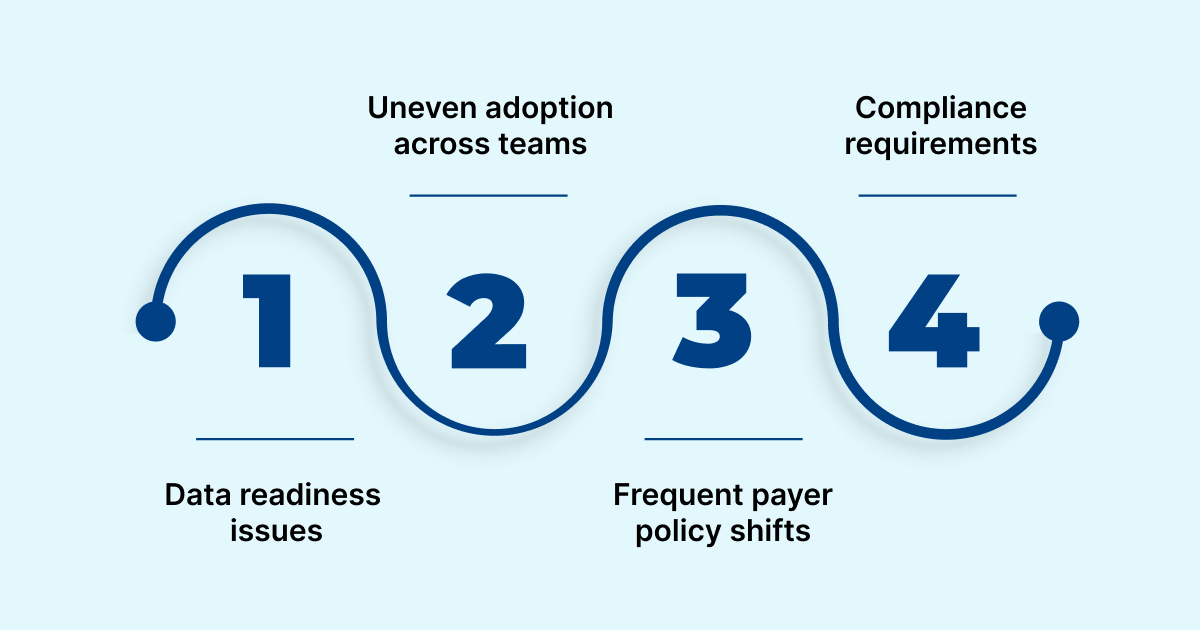
1. Data readiness issues
Many organizations discover gaps when linking clinical notes, claim elements, and historical denial reasons.
Solution: establish a single source of truth that connects documentation, coding, and payer responses so the model learns from complete cases.
2. Uneven adoption across teams
Reviewers and coders may hesitate to trust automated risk signals if explanations are unclear.
Solution: provide claim level reasoning that shows exactly which patterns triggered the risk score so staff understand and verify each alert.
3. Frequent payer policy shifts
Payer behaviors change quickly, which can reduce model accuracy if not updated.
Solution: retrain models on recent denial outcomes and introduce monitoring that flags when prediction accuracy starts to decline.
4. Compliance requirements
Some analytics systems struggle to show how a prediction was generated, creating issues during audits.
Solution: maintain transparent audit trails and store model decisions with supporting evidence for every flagged claim.
This combination of solutions helps teams preserve accuracy, maintain trust, and keep predictive denial analytics aligned with real payer behavior.
Ready to identify your highest-impact denial-prevention opportunities? Connect with RapidClaims for a data-driven review of your current workflows.
How RapidClaims Enhances Predictive Analytics for Insurance Claims
RapidClaims strengthens predictive denial analytics by focusing on the exact points in the workflow where operational risk translates into financial loss.
- Targeted detection of high impact issues: RapidClaims identifies patterns that commonly lead to costly denials, including documentation gaps tied to specific procedures, payer level behavior changes, and provider habits that influence approval probability.
- Real time guidance inside coding and charge capture: Instead of sending users to a separate review system, RapidClaims delivers claim level risk signals during coding, clinical documentation review, and submission checks. This helps teams correct issues while information is still available and context is clear.
- Payer aware intelligence: The platform continuously learns from new responses across payers and regions. This makes it possible to surface early signals when a payer begins tightening criteria for certain diagnosis or procedure combinations.
- Operational improvements beyond the claim: RapidClaims highlights upstream patterns such as recurring gaps in specialty documentation or variation in coder interpretation. These insights help leaders correct root causes and prevent future denials across entire departments.
This approach allows organizations to reduce preventable denials, strengthen compliance, and create a more predictable reimbursement environment. Request a demo now!
The Future of Predictive Analytics in Insurance Claims and Denial Prevention
Predictive denial analytics is moving toward faster, more adaptive intelligence that responds to changes in payer behavior and clinical practice in near real time.
- Real time learning from payer responses: Models will shift from periodic retraining to continuous updates based on new denial outcomes, allowing organizations to react to payer policy changes before they affect large claim volumes.
- Context aware clinical validation: Next generation systems will evaluate clinical language with greater precision, identifying subtle documentation patterns that influence approval decisions for complex procedures and high acuity cases.
- Collaboration across insurers and providers: Shared analytics frameworks will help both sides identify preventable denial drivers, reducing administrative friction and improving reimbursement accuracy across the industry.
- Automation that targets specific risk drivers: Future platforms will not only flag issues but also generate suggested corrections tailored to the exact payer, specialty, and clinical scenario.
These advancements will make denial prevention more precise, more adaptive, and more central to financial performance for both insurers and healthcare organizations.
Conclusion
Predictive denial analytics gives organizations a clearer line of sight into the claims most likely to fail and the specific reasons behind that risk. This shift from reacting to denials toward preventing them strengthens reimbursement accuracy and reduces operational strain.
As these tools mature, denial prevention will become a standard part of financial strategy rather than an after-the-fact correction process.
If you want to identify where your largest preventable denial opportunities exist, connect with RapidClaims for an assessment.
FAQs
Q: What is predictive denial analytics?
A: It is the use of machine-learning and data-driven models that evaluate incoming claims (including clinical details, coding, payer history and provider behavior) to estimate the likelihood of a claim being denied before submission.
Q: How does predictive analytics help reduce claim denials?
A: By flagging high-risk claims early, identifying coding or documentation gaps, and highlighting payer-specific patterns, teams can correct issues pre-submission, improving first-pass yield and reducing administrative appeals.
Q: What type of data is needed to build an effective denial-prediction model?
A: Key inputs include: historical claim outcomes with denials, procedure and diagnosis codes (e.g., ICD, CPT), provider and facility characteristics, payer behavior or rules, prior authorization records, and documentation/completeness indicators.
Q: Can predictive denial analytics eliminate all claim denials?
A: No. While the technology can significantly reduce preventable denials by detecting known risk patterns, some denials stem from new or complex payer policy changes, marginal cases requiring clinical judgement, or errors outside the historic model training set.
Q: How do you measure the return on investment (ROI) from predictive denial analytics?
A: Metrics include: reduction in denial rate, increase in clean-claim rate, reduction in appeal volume, shortened days in accounts receivable (A/R), improvements in reimbursement consistency by provider or service line, and lower administrative cost per claim.


