

A/R billing & follow-up is where revenue is either secured or silently lost. Every patient encounter creates a reimbursement opportunity, yet industry data shows that nearly 17% medical claims are initially denied, increasing the burden on revenue cycle teams to recover what was rightfully earned. Without disciplined oversight, claims stall, denials compound, and cash flow becomes unpredictable.
For healthcare operations leaders, A/R performance is a direct indicator of financial control. Days in A/R, denial rates, net collection rate, and write-offs reflect how effectively claims are tracked, corrected, and resolved. When follow-up is reactive, revenue leakage follows. When it is structured, measurable, and supported by intelligent automation, reimbursement accelerates and operational risk declines.
This article explores how A/R follow-up drives revenue cycle performance, where breakdowns typically occur, and how structured workflows convert outstanding balances into predictable revenue.
Key Takeaways
- A/R billing and follow-up directly determine how quickly earned revenue turns into collected revenue, impacting cash flow and financial stability.
- Most aging balances stem from preventable issues such as coding errors, documentation gaps, eligibility problems, and missed filing deadlines.
- Structured A/R workflows, including clear prioritization and denial analysis, improve recovery rates and reduce avoidable write-offs.
- Poor follow-up increases days in A/R, operational strain, and revenue leakage, especially when high-value claims are not escalated in time.
- Automation and AI-driven coding validation reduce downstream rework, lower denial volume, and ease A/R burden by preventing errors before submission.
Table of Contents
- What Is A/R Billing & Follow-Up in Medical Billing?
- Types of Accounts Receivable in Healthcare
- Why A/R Billing & Follow-Up Is Critical to Revenue Cycle Performance
- The Financial Impact of Poor A/R Follow-Up
- Common Causes of Delayed or Denied Medical Claims
- Operational Barriers That Disrupt A/R Performance
- Step-by-Step A/R Follow-Up Process in Medical Billing
- Best Practices for Effective A/R Billing & Follow-Up
- How Automation and AI Improve A/R Follow-Up Efficiency
- RapidClaims: AI-Powered A/R and Coding Automation
- Conclusion
- FAQs
What Is A/R Billing & Follow Up in Medical Billing?
Accounts Receivable (A/R) refers to payments owed for services already delivered but not yet reimbursed. After a claim is submitted, the balance remains in A/R until it is paid, adjusted according to contract terms, or written off. This includes amounts owed by both insurers and patients.
The workflow is straightforward:
- Care is provided
- A claim is submitted
- The payer processes the claim
- Remaining patient responsibility is billed
- Payments are posted
- Unresolved balances enter follow-up
Breakdowns at any point, such as coding errors, missing documentation, eligibility issues, or payer delays, cause claims to age. As aging increases, recovery likelihood decreases.
A/R follow-up ensures those claims are actively managed. It involves reviewing aging reports, resolving denials, correcting errors, validating reimbursements against contracted rates, and escalating appeals within required timelines. In many organizations, analytics teams identify root causes while follow-up teams drive resolution.
Together, these efforts move outstanding balances toward payment and protect revenue performance across the cycle. However, not all receivables behave the same, and each category requires a different management approach.
Types of Accounts Receivable in Healthcare
Accounts receivable in healthcare fall into two primary categories, each requiring a distinct management approach.
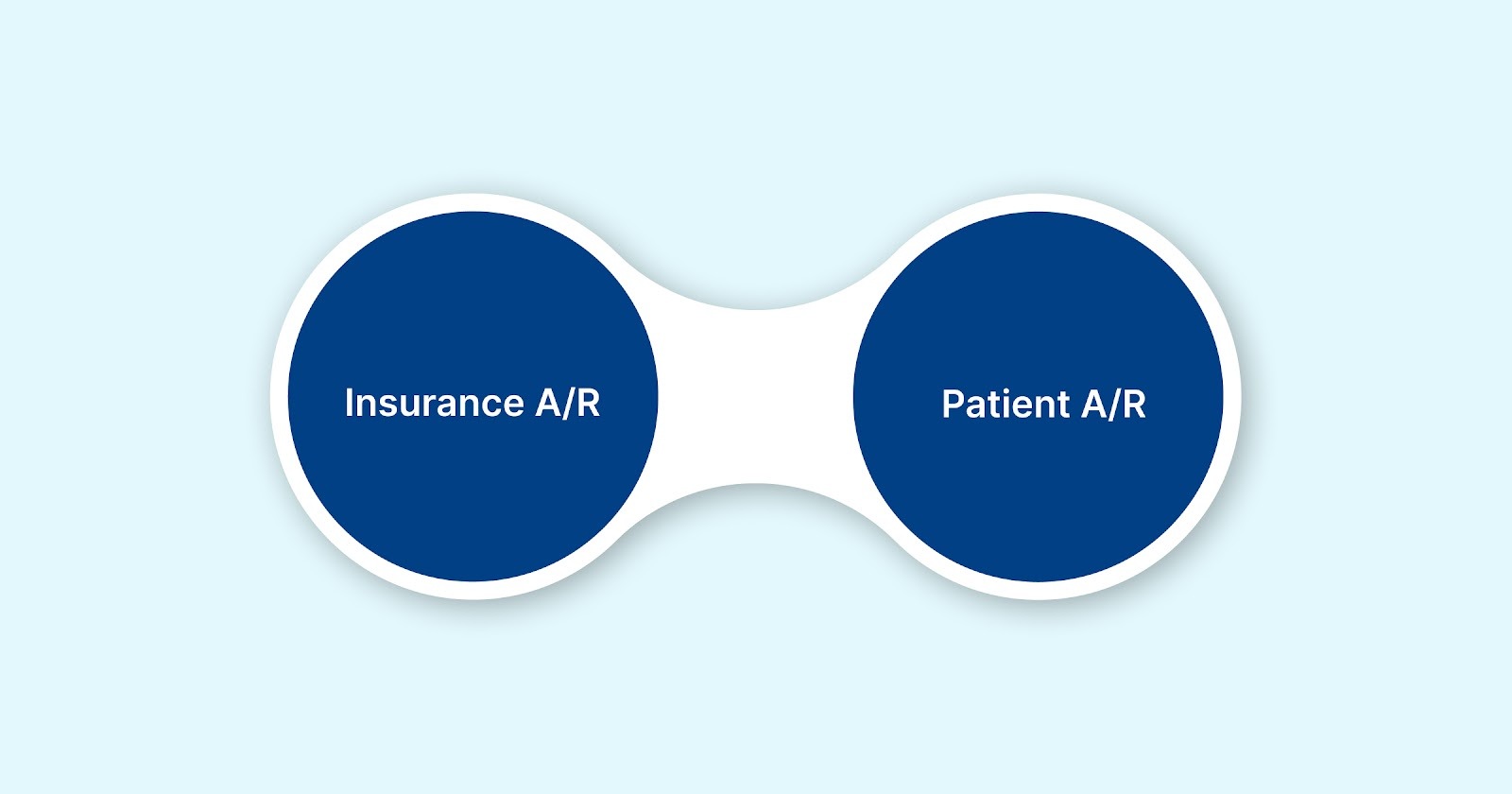
1. Insurance A/R
This includes outstanding payments from Medicare, Medicaid, and commercial payers. Managing insurance A/R typically involves:
- Verifying claim status
- Correcting denials and submitting appeals
- Reviewing reimbursements against contracted rates
Timely action is critical to prevent claims from aging beyond filing or appeal limits.
2. Patient A/R
This includes deductibles, copayments, and coinsurance owed after payer adjudication. Effective management requires:
- Accurate patient billing
- Clear communication of financial responsibility
- Structured follow-up to secure payment
Both insurance and patient A/R directly affect cash flow. The way these balances are tracked and resolved determines how efficiently revenue moves from earned to collected.
Why A/R Billing & Follow Up Is Critical to Revenue Cycle Performance
Accounts Receivable directly reflects how efficiently revenue moves from service delivery to payment. When follow-up is inconsistent, claims age, denials remain unresolved, underpayments go unnoticed, and cash flow weakens. Over time, this erodes financial stability and increases operational strain.
Disciplined A/R follow-up keeps reimbursement on track from submission through final resolution. Its impact extends across liquidity, operational control, and compliance oversight.
- Protects Cash Flow and Financial Stability: Predictable reimbursement supports staffing, infrastructure, and patient care operations. Structured follow-up shortens reimbursement timelines, lowers days in A/R, and strengthens financial forecasting.
- Ensures Claims Progress Through Adjudication: Claims may be delayed, partially paid, or placed in pending status. Active monitoring confirms receipt, tracks processing, and escalates issues before filing or appeal deadlines expire.
- Improves Denial and Underpayment Recovery: Denials and payment discrepancies require timely correction. Reviewing denial codes, validating documentation, and reconciling remittances against contracted rates protects reimbursement rights and prevents avoidable write-offs.
- Reduces Revenue Leakage and Bad Debt: Unattended balances eventually convert to financial loss. Monitoring aging reports and applying defined escalation protocols improves recovery rates and net collection performance.
- Maintains Compliance Readiness: Documented follow-up activity, accurate payment reconciliation, and structured appeal tracking support payer contract compliance and external audit requirements.
When A/R follow-up is systematic and accountable, revenue remains controlled and measurable. Without it, financial risk escalates quickly across key performance indicators.
The Financial Impact of Poor A/R Follow-Up
When A/R follow-up lacks structure, financial performance deteriorates quickly. Claims remain unworked, denials go unresolved, and underpayments are missed. As balances age, recovery rates decline, and cash flow tightens.
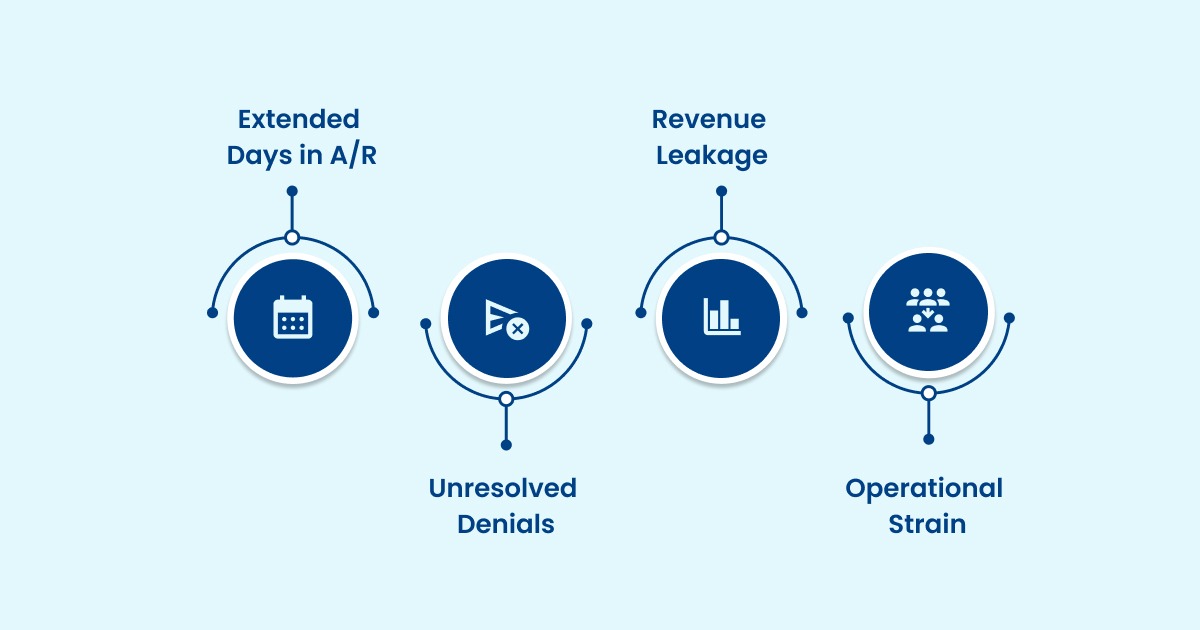
- Extended Days in A/R: Rising days in A/R indicate delays in claim resolution. Once receivables move beyond 60, 90, or 120 days, the likelihood of full recovery decreases and administrative effort increases.
- Unresolved Denials and Underpayments: Denied claims that are not corrected or appealed within filing limits translate into preventable revenue loss. Similarly, underpayments persist when remittances are not reviewed against contracted rates.
- Revenue Leakage: Claims left uncorrected or unprioritized result in lost reimbursement. Without structured triage, high-value accounts may remain unattended while lower-impact claims consume resources.
- Operational Strain: Manual tracking and repetitive payer outreach increase workload and inefficiency. As aging inventories grow, teams shift from proactive improvement to reactive correction, raising labor costs and reducing overall productivity.
In most cases, prolonged aging reflects operational gaps that were not addressed early. Without disciplined follow-up, financial risk compounds across the revenue cycle.
Also Read: How Does AI Reduce Denials and Boost Efficiency in Medical Billing?
Common Causes of Delayed or Denied Medical Claims
Most A/R delays originate from identifiable breakdowns in claim accuracy or payer requirements.
- Coding Inaccuracies: Incorrect CPT, ICD-10, or HCC assignments
- Incomplete Documentation: Insufficient clinical detail to support medical necessity
- Eligibility or Coverage Issues: Lapsed insurance or coordination-of-benefits errors
- Authorization Gaps: Missing or invalid prior authorizations
- Payer Adjudication Errors: Incorrect application of contracted reimbursement rates
Each category requires a targeted correction strategy. Treating all denials uniformly slows resolution and reduces recovery efficiency.
Many of these breakdowns originate upstream during coding and documentation capture. AI-driven validation tools such as RapidCode and RapidScrub help detect code mismatches, compliance risks, and documentation gaps before claims are submitted, reducing downstream A/R burden.
While individual claim errors explain part of the problem, operational structure often determines how quickly those errors are resolved.
Also Read: Choosing the Right Encoder for Medical Coding
Operational Barriers That Disrupt A/R Performance
Beyond claim-level issues, systemic weaknesses can prolong aging and increase rework.
1) Payer Rule Variability and Filing Limits: Each payer enforces distinct documentation standards, reimbursement policies, and appeal deadlines. Missing a timely filing window can permanently eliminate a recovery opportunity.
2) Manual Workflows and Weak Prioritization: In many organizations, A/R management relies on manual sorting, disconnected tracking tools, and inconsistent triage logic. Without prioritization based on financial impact and recovery likelihood, high-value claims may remain unresolved.
3) Fragmented Systems and Limited Visibility: Disconnected EHR, clearinghouse, and billing platforms restrict insight into denial trends. When data is not centralized and analyzed, organizations respond to symptoms rather than correcting root causes.
Addressing these barriers requires more than reactive correction. It requires a structured framework that drives claims toward resolution with clear accountability and prioritization.
Step-by-Step A/R Follow-Up Process in Medical Billing
A/R follow-up follows a structured progression designed to move outstanding claims toward resolution and payment. While workflows vary by organization, the process consistently centers on three core stages: evaluation, prioritization, and resolution.
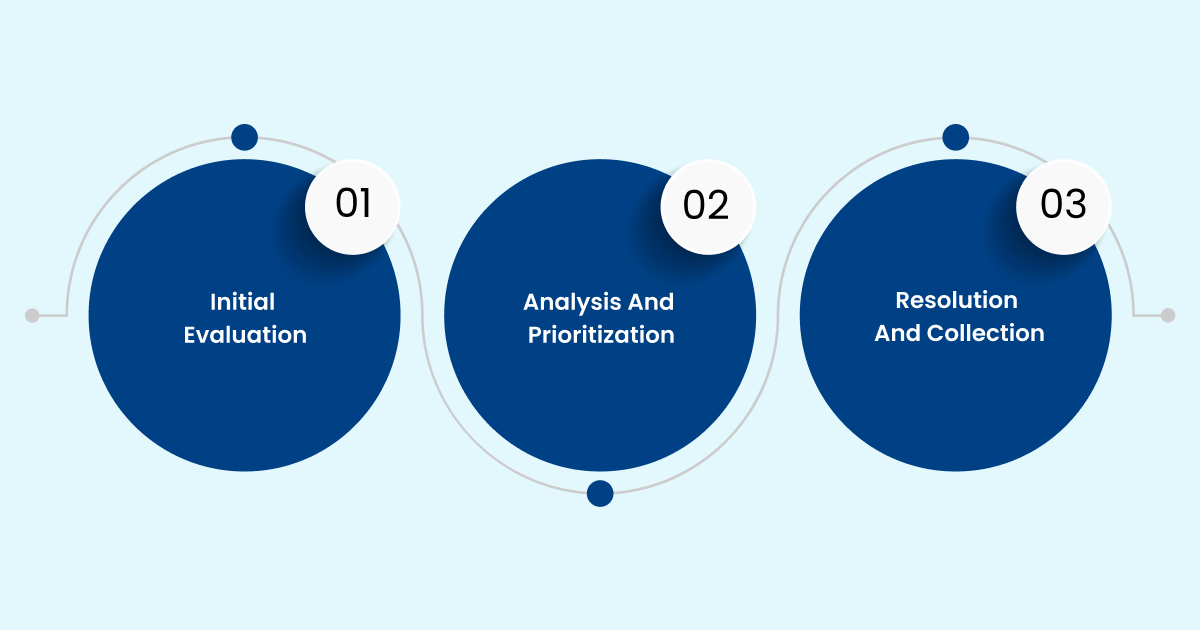
Stage 1: Initial Evaluation
The first step is reviewing the A/R aging report to identify accounts that require action. During this phase, teams:
- Categorize balances by aging bucket
- Confirm claim status (pending, denied, partially paid, or adjusted)
- Validate reimbursement against contracted rates
- Review filing and appeal deadlines
- Separate non-actionable balances from recoverable claims
This stage establishes clarity on which claims should move forward and which require adjustment.
Stage 2: Analysis and Prioritization
Once claims are identified, the focus shifts to determining why payment has not been secured. Teams typically:
- Review denial codes for documentation or coding discrepancies
- Confirm underpayments against payer contracts
- Identify claims approaching timely filing limits
- Evaluate recovery probability and financial value
- Prioritize high-impact or time-sensitive accounts
Structured prioritization ensures resources are directed toward claims with the greatest revenue impact.
Stage 3: Resolution and Collection
The final stage centers on corrective action and reimbursement recovery. Teams:
- Verify coding accuracy and supporting documentation
- Confirm payer processing details
- Correct and resubmit claims or initiate appeals
- Post payments accurately upon adjudication
- Generate patient statements for remaining balances
- Continue follow-up until the account reaches resolution
Although these phases may overlap, defined accountability at each step prevents claims from stagnating in aging categories and drives consistent revenue realization. A defined process provides control. Sustained performance, however, depends on disciplined execution and measurable standards.
Best Practices for Effective A/R Billing & Follow Up
Strong A/R performance depends on consistent oversight and disciplined execution. Clear processes reduce denials, speed reimbursement, and improve financial predictability.
Effective A/R management includes:
- Routine Review of Aging Reports: Regular evaluation of aging buckets highlights slow-paying payers, high-risk accounts, and developing denial trends. Early intervention prevents balance from progressing into extended aging.
- Tracking Core A/R Metrics: Monitoring indicators such as days in A/R, denial rates, and net collection ratios provides measurable insight into performance. These metrics guide prioritization and reveal operational gaps.
- Structured Denial Analysis and Ongoing Training: Denied claims require timely review and correction. Keeping teams current on coding updates, payer policies, and appeal procedures reduces recurring errors and improves recovery rates.
- Automated Tracking and Workflow Controls: Tools that monitor claim status, assign follow-up tasks, and flag deadlines reduce missed actions and manual inefficiencies. Defined workflows ensure consistent claim movement toward resolution.
- Clear Patient Communication: Transparent billing statements and structured payment options improve resolution of patient-responsible balances while minimizing disputes.
When integrated into daily operations, these practices create a controlled A/R environment with measurable outcomes and stronger cash flow stability. Even well-designed processes face limitations when managed manually. This is where technology begins to reshape A/R performance.
How Automation and AI Improve A/R Follow-Up Efficiency
Manual follow-up depends on repetitive review, status checks, and payer outreach. Automation reduces this burden by structuring data, prioritizing action, and improving visibility across the revenue cycle.
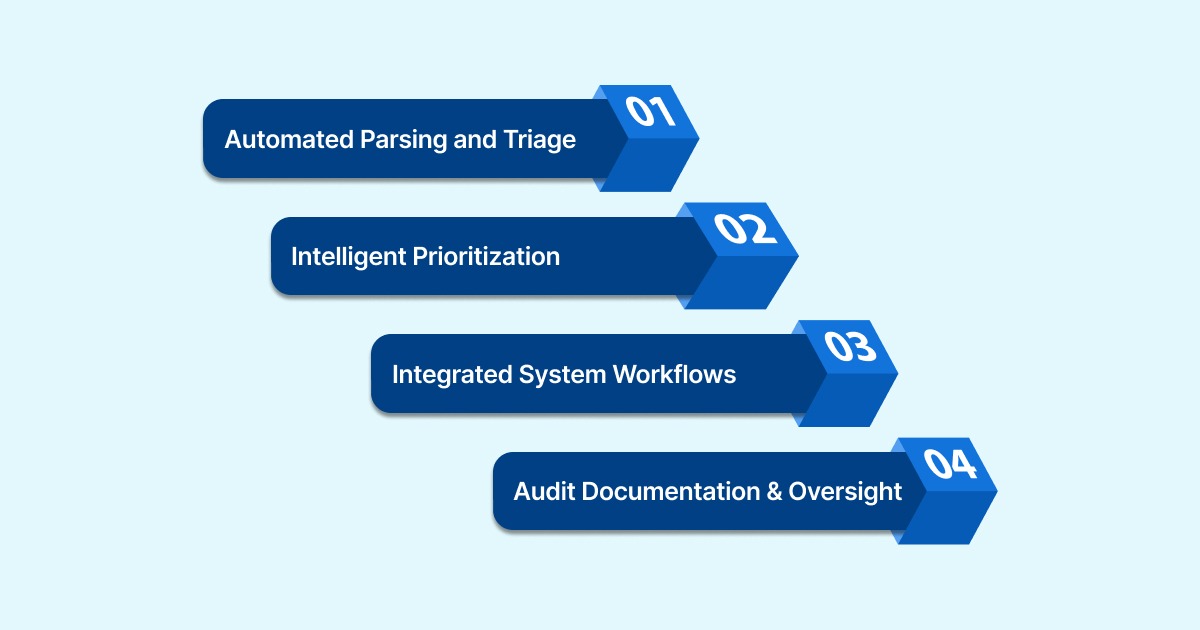
- Automated Parsing and Triage
Systems can ingest ERA and EOB files to detect denials, underpayments, and suspended claims automatically. Claims are categorized by reason code and routed into defined follow-up queues, increasing throughput without expanding staff.
- Intelligent Prioritization
AI models analyze payer behavior, aging trends, and historical outcomes to surface high-value claims and recommend next steps. This allows teams to focus on accounts with the greatest recovery potential.
- Integrated System Workflows
When EHR, practice management, and billing platforms are connected, coding updates, documentation gaps, and payer responses are visible in real time. This reduces manual reconciliation and prevents information silos.
- Audit Documentation and Oversight
Automated systems log follow-up actions, appeal submissions, and payment adjustments. These records support compliance reviews and strengthen audit readiness.
The most effective way to reduce A/R pressure is to prevent avoidable denials at the source. Technology that improves coding precision and claim validation upstream has a measurable impact on follow-up workload downstream. RapidClaims is one such platform.
Also Read: Unleashing the Power of AI in Medical Coding: Revolutionizing Revenue Cycle Management
RapidClaims: AI-Powered A/R and Coding Automation
As reimbursement complexity increases, strengthening both coding precision and claim validation becomes essential to reducing downstream A/R burden. RapidClaims provides an AI-driven platform designed to improve claim quality before submission and support structured follow-up after adjudication.
Its product suite addresses critical points across the revenue cycle:
RapidCode
A fully autonomous coding engine that assigns ICD-10, CPT, E/M, HCC, and related codes directly from clinical documentation. By generating submission-ready codes aligned with payer requirements, RapidCode reduces preventable denials and improves first-pass acceptance.
RapidScrub
An AI-powered claim validation tool that reviews claims prior to submission. It applies payer-specific logic to detect coding inconsistencies, documentation gaps, and compliance risks, minimizing avoidable rejections and follow-up workload.
RapidCDI
A clinical documentation integrity solution that helps providers capture the specificity required for accurate coding. Stronger documentation supports medical necessity, reduces ambiguity, and strengthens reimbursement outcomes across both initial submission and appeal processes.
Together, these solutions provide:
- Real-time coding and compliance validation
- Early detection of documentation deficiencies
- Scalable processing for high claim volumes
- Analytics that identify denial trends and revenue risk
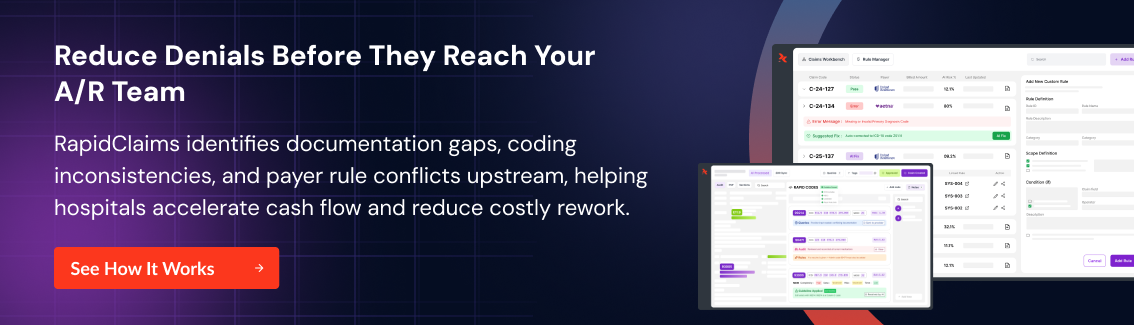
By integrating AI across coding, scrubbing, and documentation workflows, RapidClaims reduces administrative rework, improves reimbursement accuracy, and supports stronger financial performance across the revenue cycle.
Final Thoughts
A/R billing & follow-up plays a direct role in how quickly healthcare organizations get paid. It reflects the accuracy of coding, the strength of documentation, and how well claims are tracked through to resolution. When follow-up is inconsistent, denials increase, balances age, and revenue becomes harder to recover.
A structured approach improves visibility, shortens payment cycles, and reduces avoidable write-offs. When paired with automation that validates claims and flags risks early, teams can focus less on rework and more on improving overall performance.
If prolonged days in A/R or recurring denials are slowing your revenue cycle, book a demo to see how RapidClaims can help streamline your A/R follow-up and strengthen reimbursement outcomes.
FAQs
1. What is A/R follow-up in medical billing?
A/R follow-up is the process of tracking and resolving unpaid, denied, or underpaid claims after submission. It ensures balances move through adjudication, correction, appeal, and final payment within payer timelines.
2. What is the difference between A/R follow-up and denial management?
A/R follow-up covers all outstanding balances, including pending and partially paid claims. Denial management is a subset focused specifically on analyzing, correcting, and appealing formally denied claims.
3. How soon should a claim be followed up on after submission?
Best practice is to review claim status within 21 to 30 days of submission. Early review prevents claims from aging into higher-risk buckets.
4. What is the first step in A/R follow-up?
The first step is reviewing payment postings and ERA/EOB reports to identify denials, underpayments, or missing adjudications. This establishes which accounts require action.
5. When should a claim be written off versus reworked?
Claims should be reworked or appealed while filing and appeal limits remain open. Write-offs are considered only after recovery options have been exhausted under payer guidelines.
6. Why is integration with EHR and billing systems important?
Integrated systems provide real-time visibility into documentation, coding, and payer responses. This reduces manual gaps and speeds issue resolution.


