
Medical coding remains a major point of friction in the revenue cycle. For healthcare professionals, the complexity of clinical notes and ever-changing payer rules often results in costly human errors. In fact, claim denial rates rose from 10.2% to 11% in 2022, according to a Crowe LLP report. This concerning trend underscores a critical need for solutions that guarantee coding accuracy and compliance.
This is why AI medical coding software is no longer optional, but essential. These intelligent platforms utilize advanced technology to read clinical documentation and assign codes with unmatched precision, directly mitigating the risks posed by rising denial rates and manual inefficiency.
This guide will explain how modern AI coding software works and review the five top solutions available today. We'll show you how adopting the right AI platform can boost your accuracy, cut operational costs, and secure your revenue integrity.
Key Takeaways
- Autonomous AI is Essential: AI coding software utilizes Machine Learning (ML) and NLP to assign codes autonomously based on clinical context, going far beyond the keyword-matching of older Computer-Assisted Coding (CAC).
- Benefits are Financial and Operational: The software directly reduces rising claim denial rates, accelerates cash flow by clearing backlogs, and lowers administrative overhead costs.
- Compliance Requires Transparency: Look for platforms that guarantee continuous, automatic compliance updates and provide a fully documented, auditable trail for every coding decision.
- Key Features are Integration and Scalability: A top-tier solution must offer effortless, two-way integration with your existing EHR and the ability to scale processing volume without proportional increases in budget.
- Frees Up Human Experts: AI handles high-volume, repetitive coding, allowing your expert human coders to dedicate their time and judgment to the most complex, high-value, or ambiguous patient charts.
Table of Contents
- What Is AI Medical Coding Software?
- Benefits of AI Medical Coding Software
- Key Features to Look for in AI Medical Coding Software
- 5 Best AI Medical Coding Software Solutions
- Conclusion
- FAQs
What Is AI Medical Coding Software?
AI medical coding software is an advanced, specialized application that goes beyond traditional Computer-Assisted Coding (CAC). It is a system built specifically to automate the complex process of turning clinical text into standardized billing and diagnostic codes.
CAC vs. AI Medical Coding Software
Unlike older software that simply highlighted potential keywords for a human to select, modern AI is autonomous. The difference lies in how each system processes information:
| Feature | CAC (Computer-Assisted Coding) | AI Medical Coding Software |
|---|---|---|
| Logic Model | Rules-Based: Relies on pre-programmed dictionary rules and keyword matching. | Learning-Based: Uses Machine Learning (ML) and Large Language Models (LLMs) to understand context. |
| Input | Structured data and simple text where keywords are easily highlighted. | Unstructured, nuanced text (free-text physician notes, operative reports). |
| Action | Suggests a code based on a keyword match; requires human confirmation. | Autonomously assigns the most appropriate code based on clinical context and learned accuracy. |
Also Read: Differences Between Autonomous Coding and Computer-Assisted Coding
Core Technology and Workflow
The intelligence of the software relies on two core technologies working in sequence:

1. Clinical Data Ingestion and NLP: The software securely connects to your EHR to pull unstructured documentation (notes, operative reports, etc.). It then uses Natural Language Processing (NLP) to "read" and extract all relevant diagnoses, procedures, and services from the text.
2. Machine Learning (ML) Code Assignment: The AI's ML models cross-reference this clinical data against millions of historical claims, payer rules, and code libraries. It learns from past decisions to understand nuanced medical terminology, apply correct sequencing, and assign the most accurate ICD-10, CPT, and E&M codes.
3. Human-in-the-Loop Validation: The system flags cases with low confidence or extreme complexity, such as unusual modifier combinations or ambiguous diagnoses, and routes them directly to a human coder for review and final approval.
This workflow eliminates manual data entry for routine cases, enabling the software to deliver audit-ready codes rapidly.
Also Read: Common Types and Usage of Medical Coding Examples
Benefits of AI Medical Coding Software
For revenue cycle managers and compliance officers, adopting AI coding software is a direct investment in financial security and operational speed. These tools are designed to solve your most persistent workflow and accuracy challenges:
- Increased Accuracy and Speed: You can trust the AI to process the high-volume, routine charts faster than any human, maintaining a much higher, consistent accuracy rate. This allows your department to clear coding backlogs and get claims submitted days sooner.
- Reduced Claim Denials: The software acts as a proactive defense by automatically identifying common errors like missing modifiers or inconsistent diagnoses before the claim is ever sent to the payer. This directly improves your clean claim rate and stabilizes your cash flow.
- Lower Operational Costs: By handling the repetitive data entry and basic coding tasks, AI significantly reduces the need for constant overtime or rapid team expansion to manage volume spikes. This allows your team to handle more charts without raising administrative overhead.
- Enhanced Compliance and Audit-Readiness: AI is constantly updated with the latest payer rules and regulatory changes, minimizing the risk of non-compliant coding. Every code assignment is fully documented, providing a clear, auditable trail needed to defend against payer reviews.
- Support for Human Coders: AI takes over the tedious work, freeing your expert human coders to focus their valuable judgment on complex, ambiguous, or high-value cases. This increases job satisfaction and maximizes the return on your team's professional expertise.
These operational and financial advantages clearly demonstrate that AI is a definitive upgrade to traditional coding methods.
Key Features to Look for in AI Medical Coding Software
When evaluating a platform, focus on how well its technology addresses your fundamental concerns: accuracy, integration, and financial control. These are the non-negotiable capabilities every top-tier solution must offer:
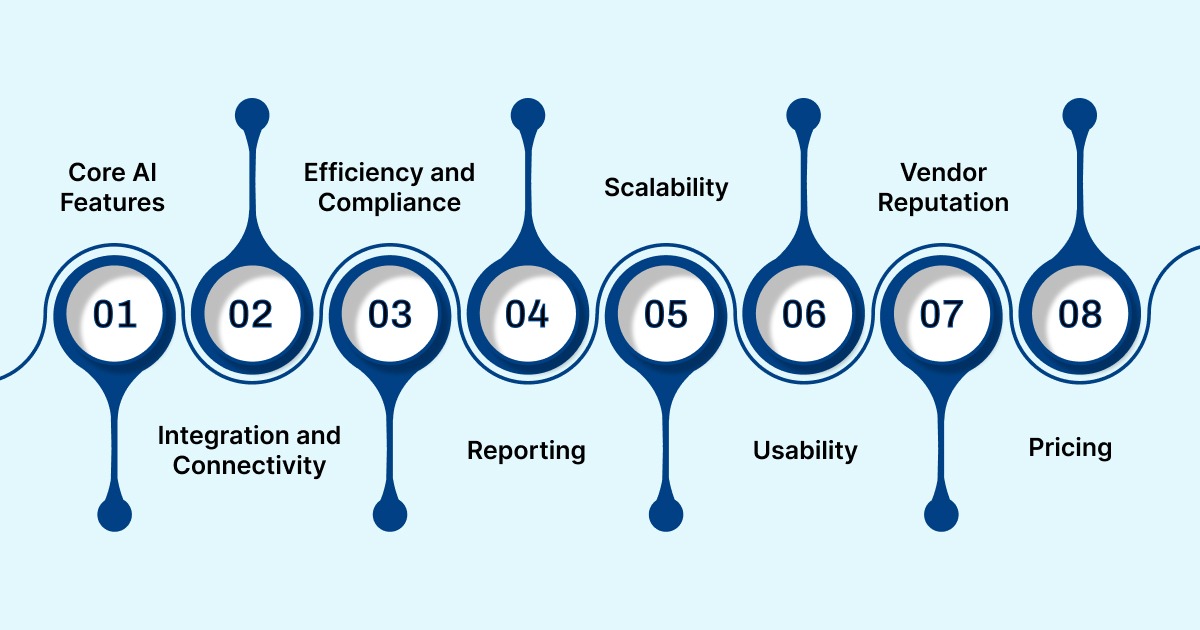
- Core AI Features: Look for systems that offer automated, real-time code suggestions directly from clinical notes, coupled with instant error detection. This immediately flags inconsistencies or missing data, ensuring higher accuracy before the chart moves to the biller.
- Integration and Connectivity: The software must ensure smooth, two-way integration with your existing Electronic Health Record (EHR) and Practice Management systems. Successful integration is crucial for avoiding manual data entry and preventing workflow bottlenecks.
- Efficiency and Compliance: The platform should dramatically accelerate turnaround time by handling high-volume charts autonomously, while also ensuring continuous, automatic compliance with the latest coding rules. This dual focus reduces rework and minimizes audit risk.
- Reporting: The system should provide robust, actionable reporting on key revenue cycle metrics, such as first-pass clean claim rates, denial trends by payer, and coder productivity. Clear data enables your team to identify and address systemic bottlenecks.
- Scalability: Choose a solution that can effortlessly manage significant increases in chart volume, whether from growth or peak seasons, without requiring proportional increases in your administrative or IT budget. This future-proofs your operations against expanding patient volumes.
- Usability: The interface must be intuitive and designed to work collaboratively with your human coding team. Easy navigation and minimal clicks are essential for reducing the learning curve and maximizing the daily productivity of your expert staff.
- Vendor Reputation: Prioritize vendors with a proven track record, positive testimonials from similar-sized healthcare organizations, and strong third-party validation. A reliable vendor ensures stability, ongoing innovation, and dependable client support.
- Pricing: Understand the overall cost structure, including implementation, subscription fees, and per-claim charges, focusing on the total cost of ownership (TCO) versus the expected Return on Investment (ROI). The goal is a clear value proposition that ties directly to increased collections and reduced operational expense.
Now that you know which essential capabilities to prioritize in your search, let's explore the leading vendors who deliver these features.
5 Best AI Medical Coding Software Solutions
Organizations that achieve financial stability rely on platforms proven to deliver high-velocity coding, effortless integration with existing EHRs, and guaranteed denial prevention.
Here’s a list of five top-tier solutions that drive real revenue cycle performance:
1. RapidClaims
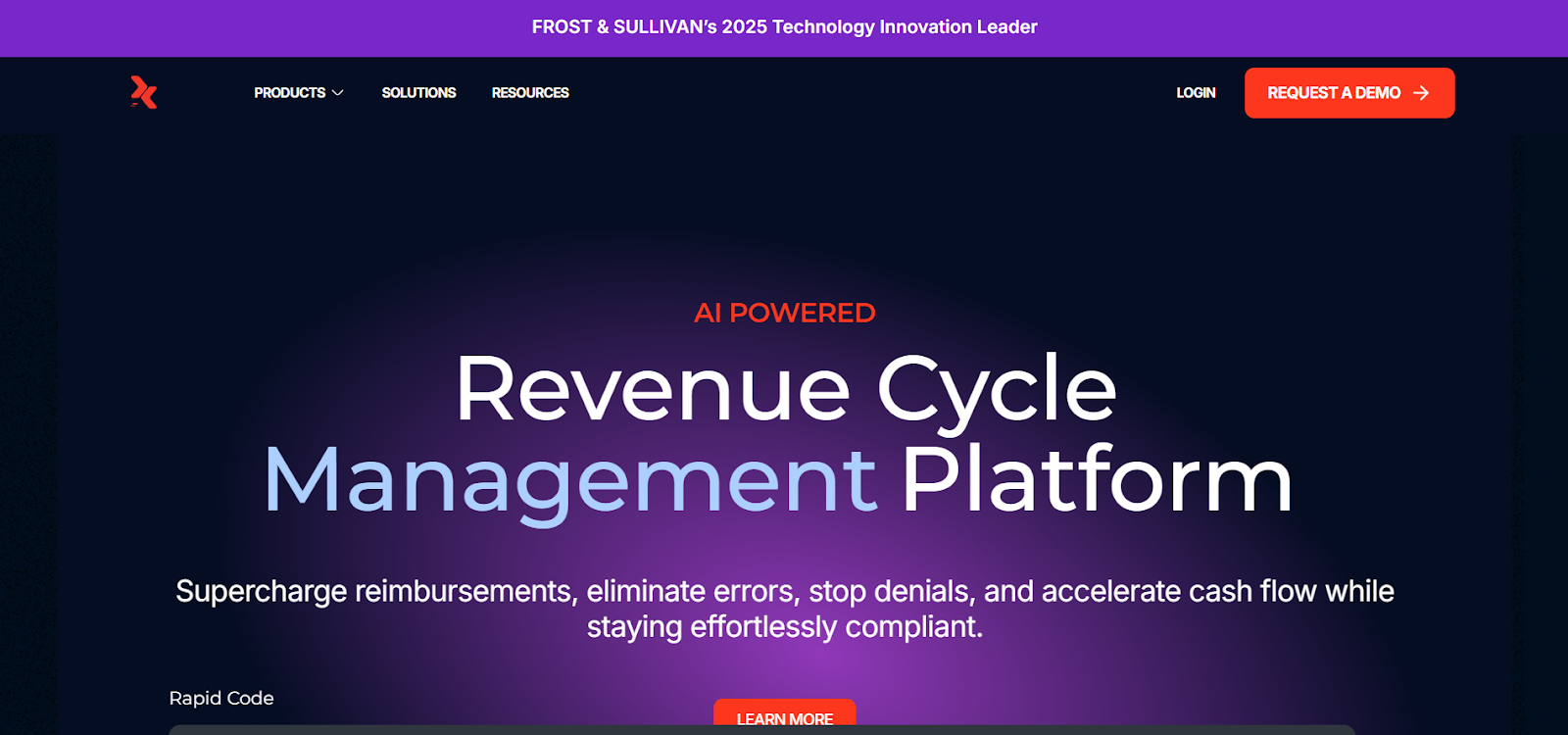
RapidClaims is an AI-powered Revenue Cycle Intelligence Platform engineered to drive financial health and compliance. The platform offers autonomous AI agents (RapidCode, RapidScrub, RapidCDI) that work alongside your team to ensure high-velocity processing and maximum revenue capture.
- Rapid Deployment & Fast ROI: The system needs minimal data (only 500 charts) for training, allowing your organization to go live and see measurable return on investment within the first month.
- Human+AI Collaboration: AI manages high-volume, repetitive coding autonomously, saving your expert human coders 2+ hours of manual work daily while keeping them in full control.
- 100% Chart and Policy Coverage: Advanced AI ensures every chart is coded accurately across all specialties, with continuous, automatic policy updates to maximize reimbursement and minimize audit risk.
- Frictionless EHR Integration: The platform integrates effortlessly with all major Electronic Health Record (EHR) systems, guaranteeing a smooth transformation without disrupting your existing clinical or IT infrastructure.
2. Fathom
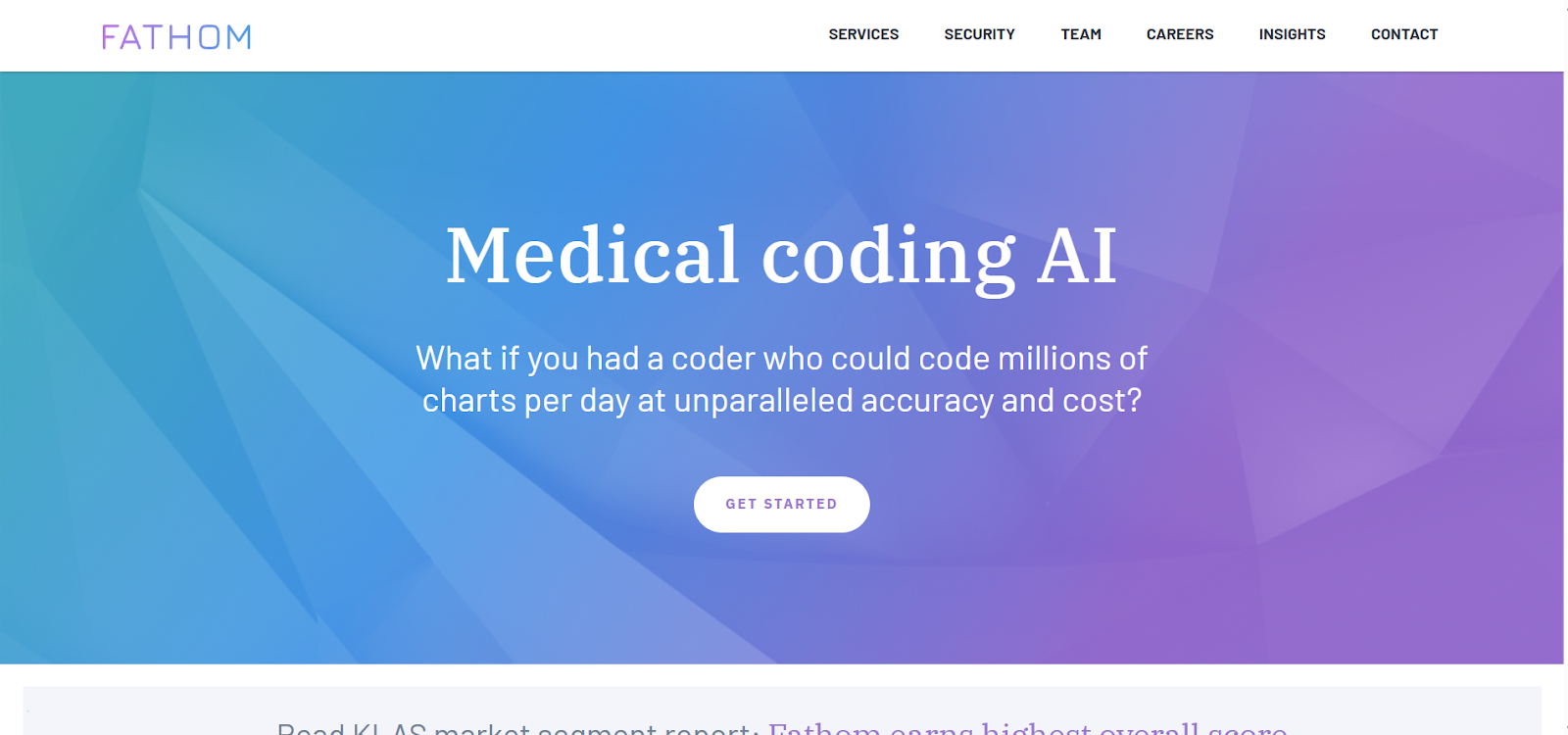
Fathom is a leading autonomous medical coding platform known for its ability to handle high coding volumes with minimal human intervention. It focuses on using AI to reduce the total cost of coding operations while maintaining superior scale and reliability.
- Maximum Autonomous Coding: The platform achieves high automation rates, fully automating the vast majority of routine coding volumes and sending claims directly to the biller without human review.
- Cost Efficiency and Scale: Fathom's design is intended to deliver significant reductions in your total coding costs. It offers massive scalability to effortlessly manage high-growth periods, backlogs, or seasonal volume spikes.
- Comprehensive Service Offerings: Beyond core coding, services include on-demand backlog processing and a real-time audit feature to systematically review and correct work done by your human coding staff.
- Reliability and Accuracy: The system is engineered for stability, ensuring your coding operations never slow down. This consistency mitigates audit risk and helps to reduce potential claim denials instantly.
3. Nym
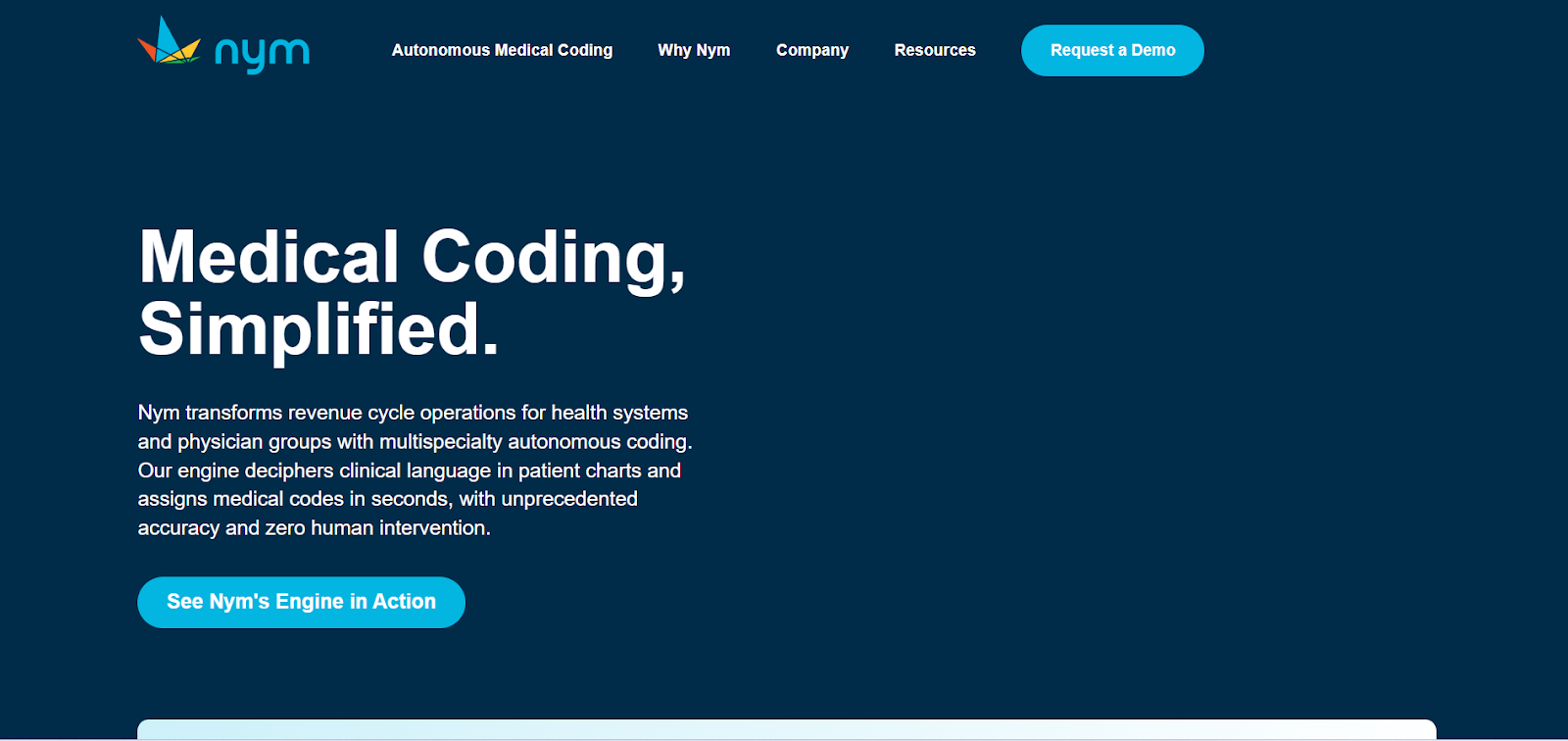
Nym offers an autonomous medical coding engine that focuses on simplifying complexity for health systems and physician groups, particularly for multi-specialty coding. Its core technology is designed to decipher complex clinical language and assign codes with maximum efficiency.
- Clinical Language Understanding (CLU): Proprietary CLU technology accurately interprets nuanced clinical documentation, allowing the engine to assign codes in seconds and accelerate your time-to-bill.
- Zero-Intervention Autonomy: Nym takes the first and final pass at coding encounters, running in the background to route successfully coded charts straight to billing with zero administrative burden.
- Fully Transparent Audit Trails: The platform ensures revenue integrity by providing a complete, verifiable audit trail for every single code assigned, guaranteeing compliant and defensible coding decisions.
- Real-Time Guideline Updates: The CLU engine automatically updates immediately when new coding guidelines (such as AMA/CMS changes) are released, ensuring continuous, effortless compliance.
4. CodaMetrix
CodaMetrix is an AI-Powered Contextual Coding Automation Platform built specifically to serve large health systems and improve coding quality and performance across the enterprise. It focuses on utilizing the full patient context for complete and precise coding.
- Contextual Coding Automation: The platform achieves precision by reading and understanding the full patient context across the continuum of care, resulting in more complete and accurate clinical data capture than simple keyword matching.
- One Platform for Every Code: CodaMetrix automatically applies codes across all service lines and complex specialties (like Radiology and ED), eliminating the need for fragmented, specialty-specific workflows.
- Longitudinal Patient View: The system codes at the first opportunity by creating a continuous view of the patient record, ensuring no relevant clinical data is left behind to optimize revenue capture and quality scores.
- Precision-Coding for Payer Rules: The AI continuously audits assigned codes against the very latest payer-specific guidelines. This minimizes claim denials and maximizes your potential reimbursement.
5. Combine Health
Combine Health provides an entire AI workforce for revenue cycle management, with specialized agents focusing on different segments like coding, billing, and denial management. The platform is designed to provide end-to-end automation and eliminate revenue leakage.
- Modular AI Agent Architecture: Dedicated AI agents (like Amy the Coder and Rachel the Appeals Manager) manage every RCM step, delivering specialized, high-accuracy automation across complex financial workflows.
- Explainable and Auditable Decisions: The technology offers full transparency, providing clear, line-by-line rationale and evidence behind every decision, making the AI output trustworthy and auditable.
- Comprehensive Denial and Appeals: The system excels in post-submission workflows by automating the entire denial process, including drafting clear, payer-specific appeals and proactively managing payer portals for status checks.
- Adaptable and Compliant Learning: The AI workforce continuously adapts to your unique preferences and evolving payer policies, ensuring that generated codes are 100% compliant with the latest regulatory changes.
Selecting the optimal platform ensures your organization gains a reliable, future-proof partner committed to maximizing both accuracy and financial returns.
Conclusion
The evolution of medical coding is no longer a slow transition; it is a rapid shift toward intelligent automation. The choice of platform determines whether your organization simply cuts costs or strategically optimizes the entire revenue cycle for maximum financial health. By focusing on systems that guarantee high accuracy, offer complete transparency, and deliver deep financial control, you can confidently move past administrative backlogs and compliance concerns.
To achieve this next-level financial performance, RapidClaims offers a unique path. With minimal training data required for deployment and a focus on accelerating cash flow across coding and denial prevention, their platform is engineered to deliver a measurable return on investment in weeks, not months.
Ready to transform your revenue cycle with validated AI performance and next-generation compliance? Contact RapidClaims today.
FAQs
1. What is the key difference between Autonomous Coding and Computer-Assisted Coding (CAC)?
CAC is a tool that suggests codes based on clinical documentation, but it still requires a human coder to review, validate, and finalize every entry. Autonomous Coding uses advanced AI to assign codes end-to-end with high accuracy, often sending routine claims directly to billing with zero human intervention.
2. How long does it take to implement an AI medical coding solution?
The initial implementation, including integration with your EHR and model training, typically takes 3 to 6 months. Some solutions, like RapidClaims, are designed for a faster deployment timeline by requiring significantly less historical data to begin generating measurable ROI.
3. Is AI medical coding software compliant with HIPAA?
Yes. Any reputable AI medical coding platform is required to be a HIPAA-compliant Business Associate (BA) and will sign a Business Associate Agreement (BAA) with your organization. This ensures the protection and privacy of all Protected Health Information (PHI) processed by the system.
4. Which medical specialties benefit the most from AI coding automation?
AI is highly effective in high-volume, repetitive specialties such as Radiology, Anatomic Pathology, and Emergency Department (ED) professional fees. However, modern solutions are increasingly mastering complex and multi-specialty coding for surgery, hospitalist, and general E/M services.


