

With the rapid digital transformation in healthcare, a critical question arises: How secure is your medical data? According to a 2024 report by 24By7Security, 588 healthcare data breaches affected over 179 million individuals in a single year, emphasizing the urgent need for stronger cybersecurity measures.
Healthcare Cybersecurity AI utilizes machine learning, anomaly detection, and predictive analytics to monitor networks, detect threats early, and respond in real-time. It also supports clinical audits, medical coding, and revenue cycle management, enabling healthcare organizations to maintain compliance and optimize workflow efficiency.
In this blog, you will learn how Healthcare Cybersecurity AI enhances security, optimizes medical coding, and improves revenue cycle management for healthcare organizations.
TL;DR (Key Takeaways)
- Cybersecurity Enhancement: AI utilizes machine learning and predictive analytics to detect, prevent, and respond to cyber threats in real-time.
- Clinical Audit Automation: AI streamlines audits by reviewing records, identifying discrepancies, and flagging high-risk cases for human evaluation.
- Medical Coding Efficiency: NLP-driven AI reduces coding errors, optimizes CPT/ICD-10 assignments, and accelerates claim processing.
- Revenue Cycle Optimization: AI automates claims, forecasts payments, detects fraud, and optimizes workflows, improving cash flow and compliance.
- AI Practices: Ensuring privacy, mitigating bias, maintaining transparency, and continuous monitoring preserves compliance and patient trust.
Table of Contents:
- What is Healthcare Cybersecurity AI?
- Why Cybercriminals Target the Healthcare Sector?
- 5 Major Cybersecurity Threats in Healthcare
- Role of AI in Strengthening Healthcare Cybersecurity
- Operational Applications of AI in Healthcare Cybersecurity
- Best Practices for Securing Healthcare Data in the Age of AI
- Conclusion
- Frequently Asked Questions (FAQs)
What is Healthcare Cybersecurity AI?
Healthcare Cybersecurity AI utilizes artificial intelligence to safeguard healthcare organizations against cyber threats and protect patient data. It applies machine learning and predictive analytics to monitor networks, EHRs, and connected devices, detecting anomalies and potential breaches in real time.
It also integrates with clinical and administrative workflows, supporting medical coding, revenue cycle management, and compliance monitoring. Continuously analyzing system behavior helps healthcare organizations maintain HIPAA, HITECH, and CMS compliance while reducing data breaches and operational risks.
Now, let’s examine why protecting sensitive healthcare data is critical, given its high value to cybercriminals.
Why Cybercriminals Target the Healthcare Sector?
Healthcare data is highly sensitive and monetizable, making the sector a top target for cyberattacks. Attackers exploit fragmented IT infrastructures and overworked staff to access patient records or disrupt operations.

Alt text:Why Cybercriminals Target the Healthcare Sector?
Below are key areas where cybercriminals commonly exploit healthcare vulnerabilities:
- High-Value Data: Patient health records, insurance details, and payment information command premium prices on black markets.
- Legacy Systems: Many hospitals still rely on outdated software and hardware that lack modern security protocols.
- Complex Interconnectivity: Multiple platforms, including EHRs, laboratory systems, and IoT devices, create numerous attack vectors.
- Operational Pressure: Clinical staff often prioritize patient care over cybersecurity vigilance, increasing susceptibility to social engineering attacks.
Also Read: From Chaos to Clarity: How AI in Medical Coding Enhances Accuracy
Next, let’s explore the key areas where healthcare systems are most susceptible to cyberattacks.
5 Major Cybersecurity Threats in Healthcare
Healthcare organizations face complex cybersecurity challenges that require both technical defenses and operational vigilance. The increasing reliance on digital systems, interconnected devices, and remote access has expanded the attack surface, making hospitals and clinics attractive targets for cybercriminals.
Below are the five major cybersecurity threats affecting healthcare today:
1. IoT Vulnerabilities
Connected medical devices, such as infusion pumps, pacemakers, and imaging systems, often run on outdated software or lack proper security configurations. Cybercriminals can exploit these vulnerabilities to gain unauthorized access to hospital networks.
Example: In 2023, the FDA issued a safety alert for the Medtronic MiniMed 600 Series Insulin Pump System due to a potential cybersecurity risk that could allow unauthorized access to the pump system.
2. Ransomware Attacks
Healthcare providers are frequent targets of ransomware because of the urgency of patient care and the high value of hospital data. Attackers encrypt critical systems and demand payment to restore access, often causing treatment delays and operational disruptions.
Example: In 2025, a ransomware attack on the dialysis provider DaVita affected approximately 2.7 million individuals, resulting in encrypted network elements and unauthorized access to sensitive patient information.
3. Phishing and Human-Targeted Attacks
Cybercriminals often exploit human error to gain unauthorized access to systems. Emails, phone calls, or fake alerts can trick staff into revealing credentials or downloading malware. Despite technical safeguards, human behavior remains a major vulnerability.
Example: In 2024, UC San Diego Health experienced a phishing attack when two employees disclosed their credentials in response to fraudulent emails. This breach allowed unauthorized access to their email accounts, potentially exposing sensitive patient data.
4. Data Privacy Breaches
Misconfigured systems, unencrypted data, or insider threats can expose sensitive patient information, resulting in financial penalties and a loss of patient trust. These breaches can involve EHRs, billing data, or lab results.
Example: In 2023, a misconfigured cloud storage environment exposed the data of a pharmacy client's customers on the internet for six years.
5. Regulatory Gaps
HIPAA, HITECH, and state-specific regulations govern the healthcare sector. Rapid technology adoption and evolving threat landscapes make compliance challenging. Organizations that fail to meet standards risk penalties and legal liability.
Example: In 2024, the U.S. Department of Health and Human Services (HHS) imposed a $548,265 penalty against Children’s Hospital Colorado for HIPAA Privacy and Security Rules violations.
To address these compliance challenges and operational risks, healthcare organizations are increasingly turning to AI-driven solutions. RapidClaims uses AI to streamline operations and reduce financial and compliance risks. Its platform automates coding, clinical documentation, and denial management, achieving a 98% clean-claim rate and 30-day time-to-value.
Role of AI in Strengthening Healthcare Cybersecurity
AI is increasingly adopted in healthcare to detect cyber threats more quickly and anticipate potential vulnerabilities. It also automates responses, working alongside human cybersecurity teams to strengthen overall defenses.

Alt text:Role of AI in Strengthening Healthcare Cybersecurity
Below are a few key applications of AI in healthcare cybersecurity:
- Real-Time Threat Detection: Machine learning models continuously monitor network traffic, EHRs, and connected devices for anomalies that indicate malware, ransomware, or unauthorized access.
- Predictive Risk Analytics: AI identifies abnormal patterns and predicts potential breaches before they escalate, allowing proactive mitigation.
- Automated Responses: AI systems can isolate affected devices, revoke suspicious access, or alert IT teams immediately, reducing response times and limiting operational disruption.
- Behavioral Analysis: AI tracks user and device behavior to detect insider threats, compromised credentials, or unusual system interactions.
Also Read: AI and Automation in Denial Management for Healthcare
Beyond threat detection, AI enhances operational workflows by improving clinical audits, medical coding, and revenue cycle management. This creates a unified approach to both security and efficiency in healthcare organizations.
Operational Applications of AI in Healthcare Cybersecurity
AI in healthcare improves operational workflows, ensures regulatory compliance, and optimizes financial performance. Using machine learning, natural language processing (NLP), and predictive analytics, AI enhances audits, coding accuracy, and revenue cycle management.
Below are the key operational applications of AI in healthcare cybersecurity:
1. Intelligent Automation in Medical Coding
Accurate coding is crucial for accurate billing, regulatory compliance, and revenue capture. AI enhances coding processes through NLP and intelligent automation.
- Automated Code Assignment: NLP interprets physician notes and maps them to CPT, ICD-10, and HCPCS codes with high accuracy.
- Error Detection: Flags deviations from coding standards, reducing the likelihood of claim denials.
- Trend Analysis: Identifies frequently miscoded procedures, enabling workflow refinement and staff training.
- Faster Turnaround: Accelerates claims submission and reimbursement cycles, enhancing cash flow.
- Seamless EHR Integration: AI continuously updates coding rules within existing healthcare IT infrastructure to maintain compliance.
2. Streamlining Revenue Cycle Management (RCM) through AI
Revenue cycle management is a complex process that involves scheduling, claims processing, payment posting, and denial management. AI streamlines these processes while reducing administrative overhead and financial leakage.
- Automated Claims Processing: Detects errors and predicts potential denials before submission.
- Payment Forecasting: Predicts patient and payer payment timelines for better cash flow planning.
- Workflow Automation: Handles routine tasks, including eligibility verification, claim status tracking, and follow-ups.
- Fraud Detection: Monitors billing patterns to flag unusual activity or potential fraud.
- Data-Driven Decision Making: Provides actionable insights for optimizing staffing, resource allocation, and revenue performance.
3. Ensuring Ethical AI Use and Data Privacy in Healthcare
Implementing AI in healthcare necessitates robust governance to ensure patient trust and maintain regulatory compliance.
- Data Privacy Compliance: AI systems must meet HIPAA, HITECH, and state-level privacy standards.
- Bias Mitigation: Regular algorithm audits prevent discriminatory outcomes in coding, billing, or predictive analytics.
- Transparency: Decision-making processes are documented to support internal review and external audits.
- Accountability: Clear governance structures define responsibilities for AI oversight and incident response, ensuring effective management of these critical areas.
- Continuous Evaluation: AI models are updated continuously to address emerging cyber threats, regulatory changes, and evolving clinical practices.
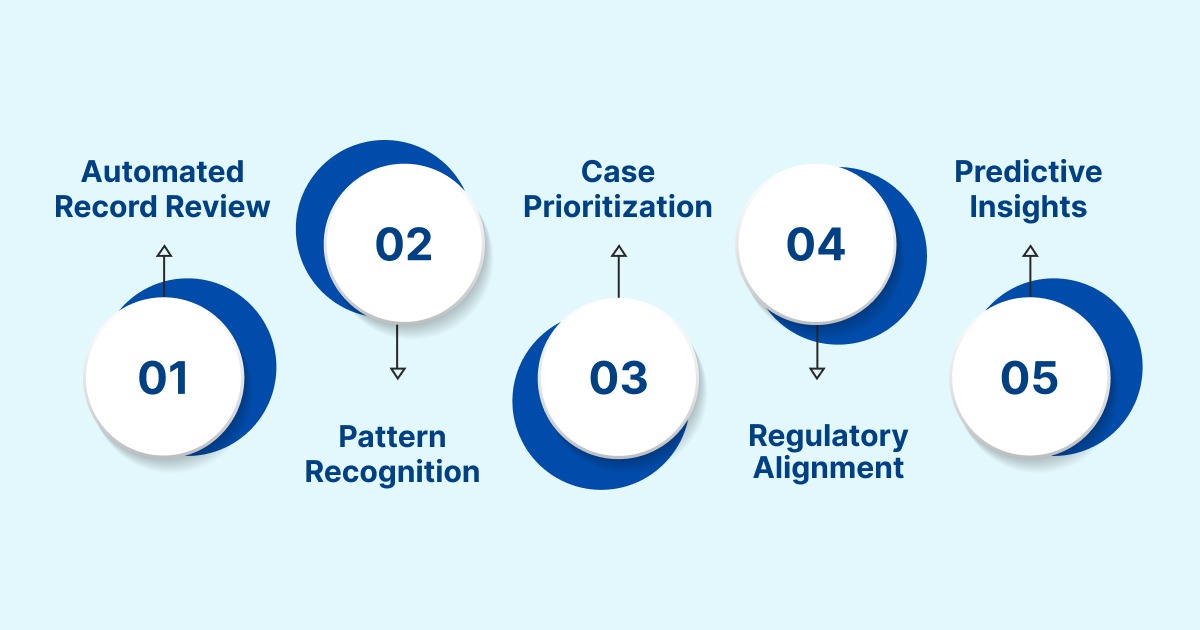
4. Automating and Optimizing Clinical Audits with AI
Clinical audits are crucial for ensuring compliance and quality assurance; however, manual audits are time-consuming and prone to errors. AI automates and prioritizes these processes to increase accuracy and efficiency.
Alt text:Automating and Optimizing Clinical Audits with AI
- Automated Record Review: Scans EHRs and clinical workflows to flag missing documentation, inconsistent entries, and potential coding errors.
- Pattern Recognition: Detects recurring discrepancies or high-risk practices across patient records to inform corrective actions.
- Case Prioritization: Focuses human auditors on critical or high-risk records, optimizing resource allocation.
- Regulatory Alignment: Ensures audit protocols comply with HIPAA, CMS, and state-level regulations.
- Predictive Insights: Forecasts areas prone to non-compliance, helping prevent future errors and reduce audit findings.
Platforms like RapidClaims enhance audit efficiency with Turbo Throughput, processing over 1,000 charts per minute with an audited accuracy rate of 96% or higher. Its Explainable AI provides line-level rationales and code-context hover cards, while RapidCDI ensures AHIMA/CMS-compliant templates and full audit trails, enabling both high accuracy and regulatory compliance.
Now, let’s examine practical strategies healthcare organizations can implement to safeguard patient data in an AI-driven environment.
Best Practices for Securing Healthcare Data in the Age of AI
Healthcare organizations must adopt a multi-layered approach to safeguard patient information in AI-driven environments. Implementing these strategies ensures both operational efficiency and regulatory compliance:
- Integrated AI Security Platforms: Centralize real-time threat detection, predictive analytics, and automated response systems. These platforms can simultaneously monitor network traffic, EHR access, and connected medical devices, flagging anomalies before they escalate into breaches.
- Staff Training & Awareness: Human error remains a leading cause of security incidents. Regular training on phishing, social engineering, credential hygiene, and secure handling of patient data reduces vulnerabilities and strengthens the organization’s first line of defense.
- Continuous Compliance Monitoring: AI systems should continuously evaluate workflows against relevant regulations, including HIPAA, HITECH, and state-level laws. Automated alerts and compliance dashboards help track deviations, ensuring organizations stay audit-ready and avoid costly penalties.
- Incident Response Planning: Develop structured, rapid-response protocols for security events. Simulated breach exercises and pre-defined containment workflows allow IT teams to act decisively, minimizing downtime and protecting sensitive patient data.
- Regular Audits & Penetration Testing: Conduct frequent audits and controlled penetration tests to identify vulnerabilities in EHR systems, cloud storage, and IoT devices. Proactive remediation strengthens defenses, reduces exposure, and ensures resilience against evolving cyber threats.
AI-driven cybersecurity, combined with staff training and continuous audits, enables healthcare organizations to protect patient data and maintain compliance efficiently.
Conclusion
Healthcare cybersecurity AI mitigates the growing risk of cyberattacks by safeguarding patient data, ensuring regulatory compliance, and streamlining operational workflows. AI-driven threat detection, predictive analytics, and automated responses enable healthcare organizations to prevent breaches, reduce risk, and maintain trust proactively.
For healthcare teams seeking to implement advanced, reliable AI solutions, RapidClaims provides tools that streamline claims processing, optimize revenue cycle management, and enhance audit readiness. Their AI solutions ensure accurate coding, faster reimbursements, and real-time compliance, enabling efficient, fully compliant operations.
Take control of your healthcare operations today. Visit RapidClaims to explore AI-powered solutions and request a free demo to see how your organization can enhance cybersecurity, compliance, and revenue efficiency with minimal manual effort.
Frequently Asked Questions (FAQs)
1. Can small clinics adopt AI cybersecurity without a dedicated IT team?
A. Small healthcare practices can implement AI cybersecurity using cloud-based solutions that require minimal IT support. These platforms provide automated threat detection, real-time alerts, and compliance monitoring. They are scalable and cost-effective. Clinics can protect patient data without maintaining a large IT department.
2. How does AI protect patient data on mobile health apps?
A. AI continuously monitors mobile app activity to detect unusual access patterns or suspicious behavior. It encrypts sensitive health information and prevents unauthorized logins. Any anomalies trigger automated alerts to security teams. This approach helps secure patient data on personal devices.
3. What methods does AI use to detect insider threats in hospitals?
A. AI analyzes user behavior, access patterns, and system interactions to identify anomalies that indicate insider risks. It flags suspicious logins, unusual data downloads, or repeated access to sensitive records. Alerts allow IT teams to investigate proactively. This reduces potential internal security breaches.
4. Can AI prevent ransomware attacks on telemedicine platforms?
A. AI identifies ransomware signatures and unusual file activity in real time. It can isolate affected systems, block malicious processes, and alert administrators. This ensures telemedicine sessions remain operational. Patient records are protected from encryption-based attacks.
5. How can AI help healthcare organizations stay audit-ready?
A. AI continuously tracks system access, modifications, and data transfers to ensure compliance. It generates reports aligned with HIPAA and CMS standards. Automated monitoring highlights potential gaps before audits. This reduces manual review effort and keeps organizations prepared for regulatory inspections.


