
Hospital margins are under pressure, and DRG accuracy sits directly at the center of that pressure. Rising labor costs, persistent staffing shortages, and tighter payer scrutiny have made even minor coding errors financially and operationally significant.
For many hospitals, DRG errors don't show up immediately. They surface weeks or months later as payer denials, audit requests, or unexpected recoupments. By the time those issues are identified, the cost isn't limited to lost reimbursement. It includes staff rework, compliance risk, and disruption to already strained revenue cycle teams.
This is why DRG validation has taken on new urgency. Hospitals are being audited more aggressively, especially on high-dollar and short-stay DRGs, while simultaneously being expected to code faster with fewer experienced resources. Traditional spot checks and retrospective audits are no longer sufficient to manage that risk at scale.
This guide explains what DRG validation really means in 2026, why it has become essential for hospitals, and how modern approaches help revenue, HIM, and compliance teams stay ahead of payer scrutiny without slowing down operations.
Key Takeaways
- DRG validation directly protects hospital revenue in 2026. Inaccurate DRGs now lead to denials, downgrades, audits, and costly rework.
- DRG risk starts before billing, not after payment. Pre-bill validation is the process by which hospitals prevent revenue loss and audit exposure.
- Audits fail DRGs for weak clinical support, not missing codes. Unsupported severity, principal diagnosis errors, and time-threshold gaps drive recoupments.
- Spot checks don't scale under today’s audit pressure. Rising denials and tighter MAC/RAC reviews require targeted, risk-based DRG validation.
- AI makes DRG validation defensible at scale. Solutions like RapidClaims help hospitals flag high-risk DRGs early, validate clinical support, and stay audit-ready without slowing billing.
Table of Contents:
- What Is DRG Validation and Why It Matters for Hospitals
- How DRG Validation Fits Into the Hospital Revenue Lifecycle
- Why DRG Validation Audits Are Increasing in 2026
- The Real Financial Impact of Poor DRG Validation
- DRG Validation Best Practices for Hospitals in 2026
- Conclusion
- FAQs
What Is DRG Validation and Why It Matters for Hospitals
At its simplest, DRG validation is the process of confirming that a patient's assigned Diagnosis-Related Group (DRG) accurately reflects the clinical reality of the encounter and complies with inpatient coding and billing rules. In practice, it sits at the intersection of documentation quality, coding accuracy, and reimbursement integrity.
For hospitals, DRG validation answers three critical questions before a claim ever reaches a payer:
- Is the principal diagnosis clinically supported and correctly sequenced?
- Do the documented conditions and procedures justify the assigned DRG, including CC/MCCs?
- Would this DRG withstand external audit scrutiny if reviewed?
That distinction matters because DRG validation is not the same as coding or a retrospective audit.
Coding focuses on translating documentation into code. Audits look backward, often after payment, to identify overpayments or compliance risk.
DRG validation looks at the entire clinical picture in context and verifies that the final DRG assignment is defensible before billing or early enough to correct risk.
Why DRG Validation Has Become More Important in 2026
Hospitals are operating in a reimbursement environment where DRG accuracy is under constant review. Payers and auditors increasingly target:
- Short-stay inpatient admissions
- High-severity DRGs with CC/MCC impact
- Cases where documentation and length of stay appear misaligned
Even a single DRG shift can mean thousands of dollars in variance on a case-by-case basis. At scale, those variances compound. Small, repeated DRG inaccuracies can quietly erode:
- Case Mix Index (CMI)
- Net patient revenue
- Confidence during payer, RAC, or MAC audits
Why Hospitals Can't Rely on Spot Checks Alone
Many hospitals still rely on limited post-bill reviews or periodic audits to manage DRG risk. In 2026, that approach leaves gaps. Coding volumes are higher, documentation patterns are changing with EHR workflows, and experienced inpatient coders remain in short supply.
Without consistent DRG validation, hospitals often don't discover issues until:
- A payer requests records
- An audit flags a DRG downgrade
- Finance sees an unexplained revenue variance
By then, the cost is no longer just reimbursement. It includes appeal effort, staff time, compliance exposure, and operational distraction.
So, in 2026 and beyond, DRG validation is a core revenue and compliance safeguard, not an optional quality step.
How DRG Validation Fits Into the Hospital Revenue Lifecycle
DRG validation is most effective when it's treated as a control point inside the revenue lifecycle, not a disconnected quality exercise. Where and when validation happens determines whether it protects revenue or simply documents risk after the fact.
For hospitals, DRG validation typically intersects the lifecycle at three moments:
- Pre-bill (preferred): Validation occurs after coding and CDI review but before the claim is submitted. This is where hospitals can correct DRG risk with minimal downstream impact.
- Early post-bill: Validation flags high-risk cases shortly after submission, allowing rapid correction before payer adjudication or during early follow-up.
- Audit-driven (least effective): Validation happens only after a payer, RAC, or MAC review. At this point, hospitals are defending decisions rather than preventing exposure.
Even small DRG shifts can have an outsized impact. A single DRG downgrade on a complex inpatient case can result in a four- or five-figure reimbursement variance, and those losses compound quickly across service lines.
So, DRG validation works best when it's positioned as an early safeguard in the hospital revenue lifecycle. Validating DRGs before claims reach payers protects CMI, reduces audit exposure, and improves financial predictability without slowing down operations.
Why DRG Validation Audits Are Increasing in 2026
Hospitals aren't imagining the uptick. In 2026, DRG scrutiny is rising because payers and auditors have more incentive, better tooling, and more precise targets than they did a few years ago.
That's why proactive DRG validation is becoming a core hospital protection layer, not a "nice-to-have.”
- Short-stay reviews are getting tighter, especially under Medicare
One concrete shift: Medicare Administrative Contractors (MACs) assumed responsibility for patient status reviews of short-stay inpatient claims starting September 1, 2025, a change that directly increases review activity around inpatient appropriateness.
Short stays are one of the most common entry points for DRG disputes because the clinical story, status decision, and DRG weight can be challenged together.
- Auditors focus on where the DRG variance is easiest to prove
Specific DRG patterns are consistently attractive to auditors because they're high-dollar and reviewable from the chart:
- CC/MCC-supported severity
- Principal diagnosis logic ("condition after study")
- Time-threshold procedures (like ventilation duration)
- Short stays with high severity/weight
OIG and other oversight programs continue to flag inpatient documentation and coding as recurring audit areas, keeping DRG validation squarely in the spotlight.
- Denials are up, and hospitals are feeling it across payers
DRG issues don't always show up as “DRG denials” on a dashboard. They often show up as medical necessity denials, requests for records, downgrades, and takebacks.
HFMA-linked industry reporting (May 2024) notes that 89% of hospitals have seen a significant increase in denied claims, and 15% of hospital claims are initially denied. It's a sign that payers are pushing harder on claim defensibility overall.
- Documentation and coding remain the top error drivers in improper payments
CMS's FY 2024 Medicare Fee-for-Service improper payment reporting still shows meaningful error rates tied to documentation, medical necessity, and incorrect coding, exactly the categories
DRG validation is designed to catch before billing. When oversight programs see persistent error drivers, they don't relax audits; they sharpen them.
In short, audit pressure isn't slowing down. Hospitals need to defend DRGs with clinical evidence, consistency, and speed.
RapidClaims supports audit readiness by:
- Flagging DRGs likely to be challenged
- Providing an explainable rationale tied to the clinical record
- Creating a defensible validation trail before payers ask
Prepare for DRG audits with validation built for real payer scrutiny. Request a RapidClaims overview.
The Real Financial Impact of Poor DRG Validation
For hospitals, weak DRG validation creates three kinds of loss at once: reimbursement variance, audit exposure, and expensive rework.
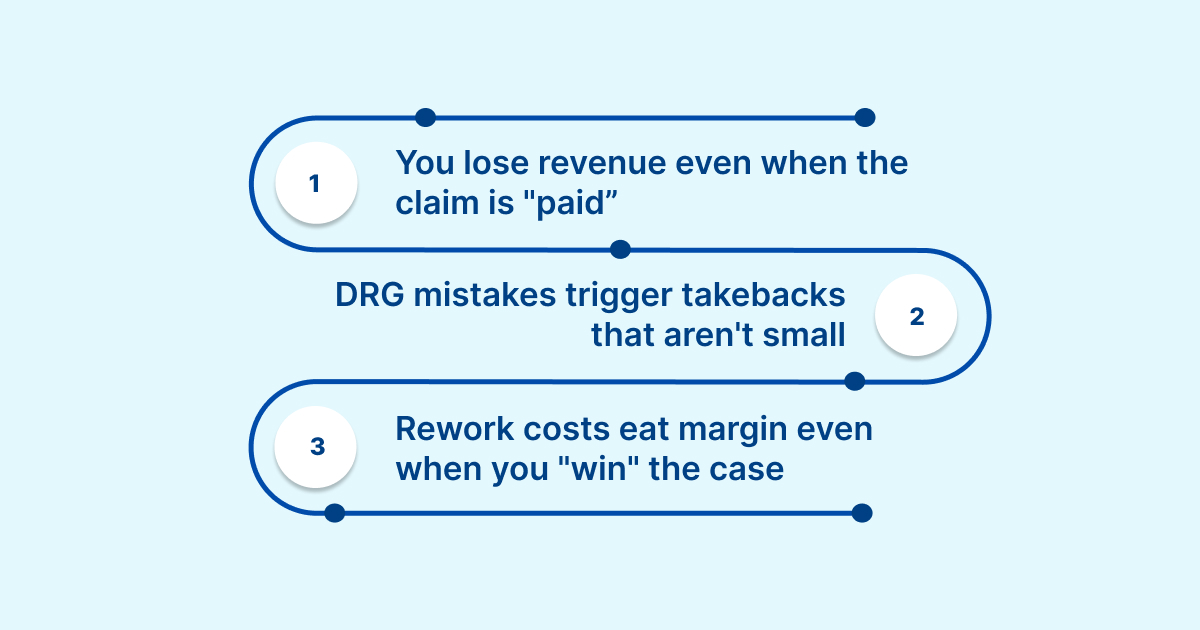
The problem is that most of it doesn't hit as a single obvious "event." It shows up as gradual CMI drift, recurring downgrades, and denials that take weeks to unwind.
1) You lose revenue even when the claim is "paid.”
A DRG can be wrong in both directions.
- Under-supported severity can lead to downcoding and lower reimbursement. Overstated severity can lead to recoupments later.
- Either way, hospitals take the hit because inpatient reimbursement is already under pressure.
2) DRG mistakes trigger takebacks that aren't small
DRG-related errors can result in meaningful repayment demands because auditors often target high-dollar, reviewable scenarios.
- For example, the HHS Office of Inspector General estimated Medicare improperly paid hospitals $79.4 million for certain MS-DRGs that need 96+ hours of mechanical ventilation, with errors tied to incorrect code selection and ventilation-hour counting.
That’s the kind of exposure DRG validation is meant to prevent: claims that look reasonable operationally but don’t hold up under documentation review.
3) Rework costs eat margin even when you "win" the case
Hospitals don't just lose dollars on denied or downgraded claims. They lose time.
- HFMA-linked conference materials summarize industry estimates showing the national average cost to rework a denied claim is about $103 per claim, compared to roughly $6.50 to submit a clean claim in the first place.
So every DRG-driven denial or downgrade doesn't just reduce reimbursement. It adds administrative drag that compounds across hundreds or thousands of claims.
Poor DRG validation creates margin leakage, audit vulnerability, and measurable labor waste, precisely the areas hospitals can least afford to absorb in 2026.
DRG Validation Best Practices for Hospitals in 2026
In 2026, the goal of DRG validation isn't to review every chart the same way. It's to catch cases most likely to trigger DRG shifts, denials, or takebacks before they reach a payer. That means designing validation around risk, not routine.
Here are the best practices to protect reimbursement and reduce audit exposure without slowing discharge-to-bill.
1. Make DRG validation a pre-bill control, not a post-payment cleanup
Post-bill findings are expensive because they force rework, rebills, and appeals. Pre-bill DRG validation reduces that downstream drag by correcting risk before the claim is finalized.
Practical move: Set a pre-bill review window for high-risk DRGs (even 24–48 hours) to prevent validation from stalling billing cycles.
2. Validate "defensibility," not just code presence
Many DRG disputes aren't about whether a diagnosis was documented. They're about whether the record shows clinical indicators, provider linkage, and treatment/monitoring consistent with that diagnosis.
Practical move: Require validators to confirm the diagnosis is supported by indicators, assessment, and actions, not just a problem list entry.
3. Hard-check time-threshold and "objective" DRG drivers
Some DRG drivers look straightforward but still fail audits because timestamps or source documentation don't fully support the requirement.
Practical move: Build a mandatory validation step for time-threshold DRGs (vent duration, ICU-level criteria, procedure timing) using primary source documentation, not inferred timelines.
4. Standardize principal diagnosis logic so validation is consistent
Hospitals are exposed when two reviewers select different principal diagnoses for the same case. That inconsistency is exactly what payers exploit during disputes.
Practical move: Adopt a single, shared standard for "condition after study" selection across coding, CDI, and validation. Then enforce it through peer review and feedback loops.
5. Treat DRG validation as a learning loop, not a one-off gate
If the same DRG mistakes recur, validation becomes a permanent cost center rather than a control. Use findings to improve upstream behavior: templates, query patterns, coder education, and documentation habits.
And remember: denials are already high. Reducing repeat DRG-driven denials is one of the fastest ways to regain capacity.
Practical move: Track validation "root causes" monthly (not just overturn rates) and push fixes upstream to CDI and coding workflows.
Conclusion
In 2026, DRG validation sits at the center of hospital revenue integrity. When DRGs accurately reflect the clinical story and withstand audit scrutiny, hospitals protect reimbursement, reduce rework, and stabilize cash flow. When they don't, the impact shows up as downgrades, denials, and time-consuming appeals.
The shift is clear: DRG validation must happen early, consistently, and with clinical context, not after payment, and not as a manual spot check.
If your hospital is evaluating how to strengthen DRG defensibility without slowing billing, RapidClaims helps teams validate DRGs with clinical context, prioritize high-risk cases, and support audit-ready decisions at scale.
Request a personalized RapidClaims demo to see how AI can support DRG validation, coding accuracy, and audit preparedness before payers raise questions.
FAQs
Q. How often should hospitals perform DRG validation?
A. High-risk inpatient DRGs should be validated continuously rather than quarterly. Many hospitals apply pre-bill DRG validation for targeted cases and ongoing review for audit-sensitive service lines to keep pace with payer scrutiny.
Q. Is DRG validation required for all inpatient claims?
A. No. Most hospitals use a risk-based approach, validating DRGs with the highest audit and revenue exposure rather than reviewing every case. This keeps billing moving while still protecting reimbursement.
Q. What triggers a DRG validation audit by payers or CMS contractors?
A. Audits are often triggered by short stays, high-severity DRGs, single CC/MCC cases, or patterns that differ from peer benchmarks. Repeated DRG shifts or inconsistencies also increase the likelihood of an audit.
Q. Can DRG validation reduce both underpayments and overpayments?
A. Yes. Adequate DRG validation catches missed severity, leading to underpayment and unsupported DRGs, which in turn result in recoupments. This dual protection is why hospitals use validation as a revenue safeguard, not just a compliance check.
Q. How is DRG validation different from a standard coding audit?
A. Coding audits review code accuracy in isolation. DRG validation evaluates whether the entire clinical record supports the final DRG, making it more effective for audit defense and reimbursement stability.


.jpg)