Building Your Annual Revenue Cycle Playbook: A Pathway to Growth
In this blog, you’ll learn what a revenue cycle playbook is, its key components, and how to integrate auditing, compliance, and metrics for lasting efficiency.
Ayeesha Siddiqua
Lead Coder · RapidClaims
Published February 26, 2026Updated June 5, 2026
Did you know that in 2024, the number of external audits in healthcare more than doubled compared to 2023? Total at-risk dollars also rose fivefold to $11.2 million, putting provider organizations’ cash flow at risk and increasing potential denial exposure.
At the same time, auditor productivity increased by 35% due to stronger investments in data analytics and automation. These trends show that reactive revenue cycle practices are no longer sufficient. Denial management, compliance, and revenue optimization must now be proactive, standardized, and data-driven.
In this blog, you’ll learn what a revenue cycle playbook is, its key components, and how to integrate auditing, compliance, and metrics for lasting efficiency.
TL;DR (Key Takeaway)
Standardized Playbook: A revenue cycle playbook aligns front-end, mid-cycle, and back-end processes to minimize errors and prevent revenue leakage.
Critical Metrics: Denial rate, days in accounts receivable (A/R), and clean claim rate enable proactive monitoring and continuous improvement.
Integrated Audits: Preventive, routine, specialty, and recovery audits ensure compliance, optimize revenue, and reduce risk.
Staff Enablement: Training, clear escalation paths, and cross-functional collaboration are essential for successful playbook adoption.
AI-Driven Automation: Platforms like RapidClaims automate coding, documentation, and denial prevention, enhancing efficiency, accuracy, and audit readiness.
Table of Contents:
What is a Revenue Cycle Playbook?
Core Components of the Revenue Cycle Playbook
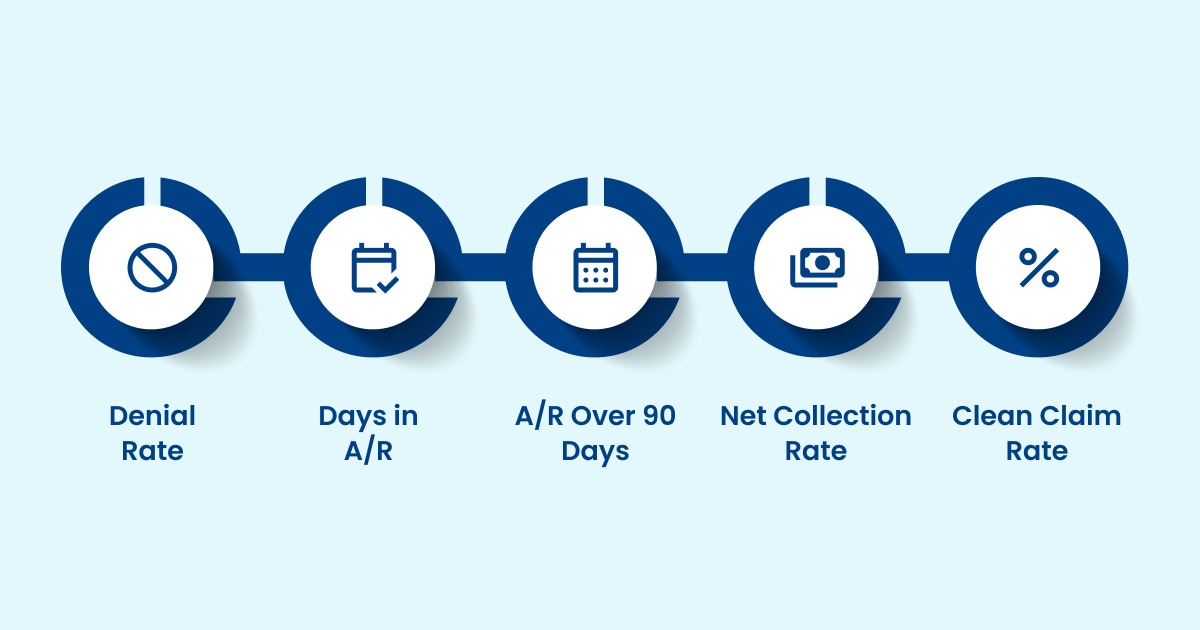
Top 5 Revenue Cycle Management Metrics to Monitor in 2025
How a Revenue Cycle Playbook Uses Key Metrics?
Overcoming Revenue Cycle Challenges with Best Practices
How Do Healthcare Audits Strengthen Your Revenue Cycle?
Conclusion
Frequently Asked Questions (FAQs)
What is a Revenue Cycle Playbook?
A revenue cycle playbook is a structured, documented set of procedures, policies, governance, workflows, escalation paths, and performance targets that guide how your organization executes revenue cycle operations. Think of it as the “operating manual” for your entire revenue management engine.
It’s not just a procedural manual or policy document; it’s a living guide that:
Aligns all stakeholders (patient access, coding, billing, denials, compliance) around consistent protocols.
Defines roles, responsibilities, and handoffs
Embeds audit, compliance, and quality checks throughout
Builds in feedback loops, metrics, and continuous improvement
Helps scale consistency across locations, service lines, or referrers
From a clinical practice to a large hospital system, the playbook ensures that when a claim flows from registration to reimbursement, there is predictability, traceability, and accountability at each stage.
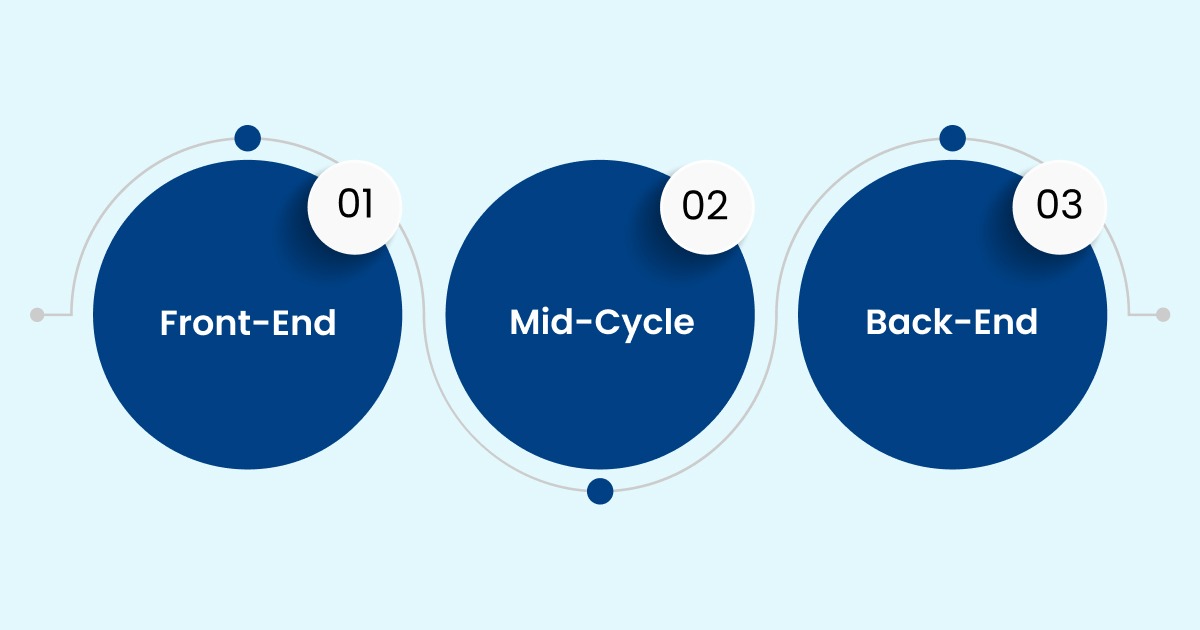
To understand how granular your playbook should be, it helps to break the revenue cycle into its traditional phases: front-end, mid-cycle, and back-end. That’s what we’ll cover next.
Core Components of the Revenue Cycle Playbook
A revenue cycle playbook is most effective when it clearly defines processes and responsibilities at every stage of the revenue cycle. Breaking it into front-end, mid-cycle, and back-end components helps healthcare organizations standardize workflows, reduce errors, and optimize cash flow.
Alt text:Core Components of the Revenue Cycle Playbook
Errors and inefficiencies at the front end create downstream leakage (denials, rework, uncollectibles). You want to “get it right first” as often as possible.
Key Functions:
Pre-registration & Eligibility Verification: Collect complete patient demographics, insurance, and payer details before the service. Perform real-time eligibility checks and benefits verification, and identify if prior authorization is needed.
Financial Counseling & Upfront Collections: Estimate patient responsibility, including copays, deductibles, and coinsurance. Offer payment plans or point-of-service collections and provide Good Faith Estimates as required by the No Surprises Act.
Check-In / Check-Out Workflows: Capture any updates to coverage or patient status. Confirm co-pay or deposit collection and verify that all documentation, including consents and authorizations, is accurate.
Common Pitfalls: Incomplete or incorrect insurance data, delayed or missing prior authorizations, poor patient education, and fragmented handoffs between front desk and billing.
Audit & Compliance Controls: Conduct random audits of registration accuracy and quarterly reviews of eligibility and authorization denials. Track upfront collection and registration error rates to maintain compliance.
With the front-end set well, the next stage involves managing charges, coding, and claims submission, where mid-cycle processes ensure clean claims and minimize rework.
2. Mid-Cycle - Claims Preparation & Submission
Mid-cycle processes focus on coding, charge capture, claim validation, and payer rules compliance. Errors here are a significant cause of delayed or denied reimbursements.
Key Functions:
Charge Capture / Encounter Documentation: Ensure all services, supplies, and diagnostics are accurately documented. Utilize templates, prompts, or billing logic to minimize errors and omissions.
Coding & Compliance Review: Assign appropriate CPT, HCPCS, and ICD codes. Apply modifiers correctly and validate medical necessity, bundling logic, and payer rules to ensure accurate claims processing.
Claim Scrubbing / Edits / Validation: Perform automated or manual edits to check for missing fields, policy mismatches, and payer-specific rules. Resolve errors in real time before submission.
Claim Submission & Tracking: Submit claims via electronic interfaces or clearinghouses. Maintain claim status tracking and reconcile remittances promptly.
Common Pitfalls: Under-coding or over-coding, improper modifiers, omitted charges, payer rule incompatibility, and delayed submissions.
Audit & Compliance Controls: Conduct coding audits through sample chart reviews and peer comparisons. Review pre-submission edit failures and perform root cause analysis of scrubbing errors.
With mid-cycle processes optimized, remaining revenue friction shifts to the back end, where claims are reconciled, denials are managed, and patient collections are handled.
The back-end stage converts claims into cash and addresses denials, underpayments, or patient collections. Effective management here protects revenue and reduces losses.
Key Functions:
Payment Posting & Reconciliation: Match payer remittances to submitted claims. Identify underpayments, short payments, and adjustments. Post patient payments and bill secondary payers as needed.
Denial Management & Appeals: Prioritize denials by value and reason. Categorize root causes such as coding, eligibility, or medical necessity. Develop appeal templates, escalation rules, and tracking procedures.
Patient Billing & Collections: Generate timely patient statements. Follow up through reminders, calls, or digital portals. Address disputes, payment challenges, and collection processes efficiently.
Reporting, Analysis & Continuous Improvement: Monitor key metrics, including denial rate, days in A/R, and write-off trends. Analyze trends by service line or provider and feed insights back into front-end and mid-cycle processes.
Common Pitfalls: Insufficient follow-up on denials, repeating appeals without addressing root causes, delayed or unclear patient statements, and unclear escalation paths.
Audit & Compliance Controls: Perform periodic denial audits, underpayment reviews, patient finance audits, and revenue recovery sampling to ensure consistency and minimize losses.
With front-end, mid-cycle, and back-end processes in place, AI-powered tools can improve accuracy and efficiency. Solutions like RapidClaims automate coding, documentation, denial prevention, and recovery.
Its modules, including RapidCode, RapidScrub, and RapidRecovery, handle repetitive tasks, provide insights for complex decisions, optimize ICD-10, CPT, and E/M coding. They also support real-time HCC and RAF updates and recover denials with AI-driven, success-based recovery while maintaining compliance.
At this point, you have defined your playbook structure across the revenue cycle. But a playbook only works if you embed metrics and compliance oversight. Let’s take a closer look.
Top 5 Revenue Cycle Management Metrics to Monitor in 2025
Data-driven monitoring has become the backbone of sustainable revenue integrity. Tracking the right KPIs helps healthcare organizations detect inefficiencies early, reduce denials, and optimize financial performance across every revenue stage.
Alt text:Top 5 Revenue Cycle Management Metrics to Monitor in 2025
To build a performance-focused revenue cycle playbook, organizations should track the following five key metrics in 2025:
1. Denial Rate
This measures the percentage of claims denied on the first submission. A rising denial rate often signals issues in registration, coding accuracy, or claims processing.
This tracks the average number of days it takes to collect payments after services are billed. Higher A/R averages indicate payer delays or inefficiencies in follow-up.
Formula: Days in A/R = Total Accounts Receivable ÷ (Average Daily Charges)
3. A/R Over 90 Days (Aged Receivables Over 90 Days)
This measures the share or value of receivables pending for more than 90 days. A high ratio indicates revenue is at risk due to aging claims.
Formula: A/R > 90 Days = (Aged Receivables Over 90 Days ÷ Total Receivables) × 100
4. Net Collection Rate (NCR)
This illustrates the percentage of collectible revenue that is actually collected after adjustments are made. A declining NCR indicates lost revenue due to underpayments or write-offs.
Formula: Net Collection Rate = (Payments Received ÷ Adjusted Charges) × 100
5. Clean Claim Rate
This represents the percentage of claims accepted without errors or rework. A high clean claim rate drives faster reimbursements and reduces administrative burden.
Formula: Clean Claim Rate = (Number of Clean Claims ÷ Total Claims Submitted) × 100
Beyond these top five KPIs, healthcare organizations should also monitor a broader set of metrics to gain a comprehensive view of revenue cycle performance. The table below highlights additional key metrics, their definitions, and formulas.
Metric
Definition / Why It Matters
Formula
Claim Rejection Rate
Percentage of claims rejected up front (not accepted by payer/clearinghouse) due to errors, formatting, or missing data.
(Rejected Claims ÷ Total Claims Submitted) × 100
Authorization Approval Rate
Proportion of services requiring pre-authorization that payers approve.
(Approved Authorizations ÷ Total Authorization Requests) × 100
Eligibility Verification Rate
Percentage of patients whose insurance coverage is verified before or at the time of service.
(Verified Patients ÷ Total Scheduled Patients) × 100
Coding Accuracy Rate
The correctness of coding in audits—high accuracy means fewer coding-related denials.
(Accurate Codes ÷ Total Codes Audited) × 100
Patient Collection Rate
Portion of patient-responsible amounts actually collected (post-insurance).
(Patient Payments ÷ Patient Responsibility) × 100
Cost per Claim Processed
Total cost to process a claim from start to finish.
Total RCM Costs ÷ Number of Claims Processed
Bad Debt Rate
Percentage of billed revenue written off as uncollectible.
(Bad Debt ÷ Gross Patient Revenue) × 100
Charge Lag Days
Days between the date of service and the date charge is entered (or the claim is submitted).
Date of Charge Entry – Date of Service
First Pass Resolution Rate (FPRR)
Percentage of claims paid on first submission without edits or appeals.
(Clean Paid Claims ÷ Total Claims) × 100
Point-of-Service Collection Rate
Percentage of patient-responsible balances collected at the time of service.
(POS Collections ÷ Total Patient Payments) × 100
No-Touch Claim Rate
Share of claims processed end-to-end without human intervention.
(No-Touch Claims ÷ Total Claims) × 100
Compliance Audit Pass Rate
Percentage of audited records that pass compliance review without issues.
(Passes ÷ Total Audits) × 100
DNFB (Discharged Not Final Billed) Days
Days that claims remain unbilled after patient discharge (i.e., backlog)
Days from Discharge → Final Bill
Late Charge Rate
Proportion of charges added after the initial claim submission.
Next, let’s examine how a revenue cycle playbook utilizes these metrics to enhance compliance, auditing precision, and informed operational decision-making.
How a Revenue Cycle Playbook Uses Key Metrics?
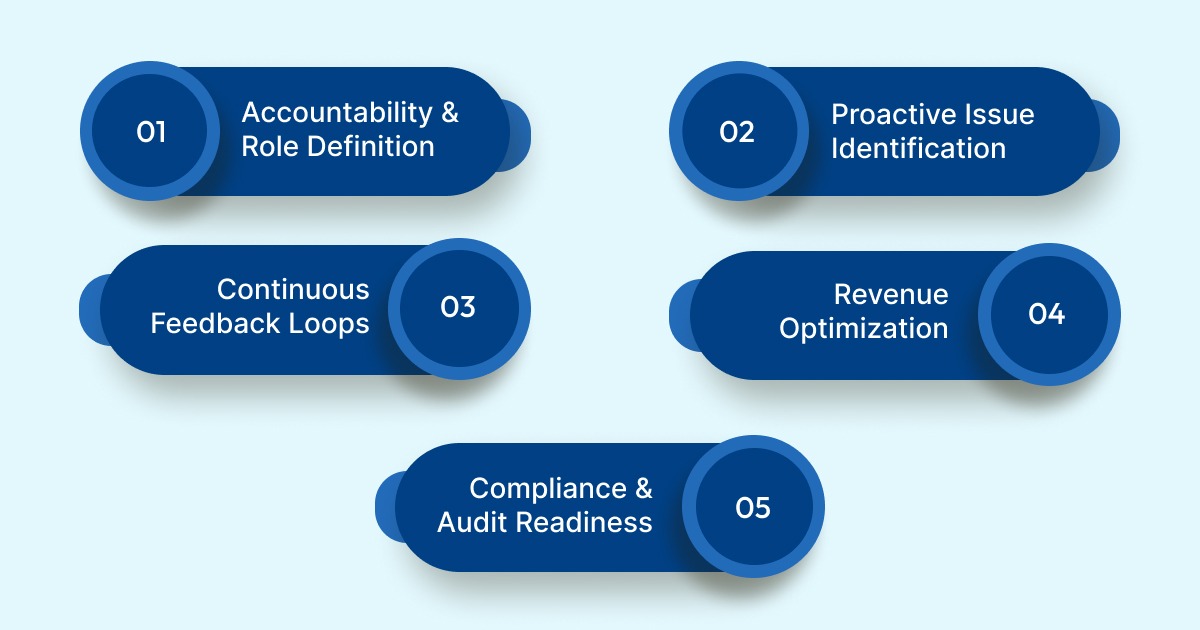
Integrating key revenue cycle metrics into a structured playbook ensures that data drives actionable improvements across the organization. Instead of tracking KPIs in isolation, a playbook connects metrics to workflows, responsibilities, and decision-making.
Alt text:How a Revenue Cycle Playbook Uses Key Metrics?
Accountability and Role Definition: Assign each metric to a specific team, such as registration, coding, or collections. Clear escalation paths ensure issues are resolved quickly.
Proactive Issue Identification: Metrics highlight potential problems early. Rising denial rates may indicate registration or coding errors, while A/R over 90 days signals delayed follow-ups.
Revenue Optimization: Monitoring KPIs reduces revenue leakage, prevents cash flow delays, and improves net collection rates.
Compliance and Audit Readiness: Embed audit and documentation controls into daily operations. Metrics-driven processes strengthen compliance and audit preparedness.
By connecting metrics to accountability, processes, and continuous feedback, a revenue cycle playbook turns raw data into actionable intelligence. This approach enables healthcare organizations to operate proactively, optimize revenue, and consistently maintain compliance.
Even with a well-defined playbook, proactively addressing common challenges is essential to ensure lasting efficiency and compliance.
Overcoming Revenue Cycle Challenges with Best Practices
A revenue cycle playbook only delivers results when it is actively adopted, maintained, and integrated into daily operations. Organizations often face challenges that reduce efficiency, increase compliance risk, or create revenue leakage.
Below are the most common challenges and actionable best practices to address them:
1. Overly Complex Playbooks That Overwhelm Staff
Playbooks that are excessively detailed or bureaucratic can confuse staff, slow workflows, and reduce compliance. When employees have to search through dense documentation to complete routine tasks, efficiency suffers and errors increase.
Best Practices:
Start small and iterate: Implement the playbook in a pilot department or unit first, gather feedback, and refine workflows before scaling organization-wide.
Prioritize critical workflows: Focus on high-impact areas such as claims submission, denial management, and collections before adding low-priority details.
Simplify communication: Use flowcharts, checklists, and step-by-step guides to make instructions actionable.
2. Rigid Policies That Don’t Allow Judgment for Exceptions
Healthcare operations often face unique patient, payer, or clinical scenarios. Overly rigid processes fail when rare cases arise, resulting in workflow disruptions, delayed payments, or compliance issues.
Best Practices:
Design for exceptions: Include clear guidance on how to handle uncommon cases, such as changes to patient insurance mid-treatment.
Provide flexibility within boundaries: Allow experienced staff to make judgment calls without violating compliance or policy.
Document exceptions: Track edge cases to identify patterns and adjust workflows over time.
3. Lack of Compliance & Auditing Integration
Many organizations add auditing and compliance checks after the fact, creating gaps in documentation, coding, and regulatory adherence. This increases the risk of payer penalties or failed audits.
Best Practices:
Embed Compliance from Day One: Integrate coding, documentation, and regulatory checks into every workflow stage.
Utilize Real-time Auditing Tools: Automated audits of claims or coding errors help identify issues before submission.
Align KPIs with Compliance Goals: Monitor denial rates, clean claim rates, and payer feedback to maintain adherence.
4. Undefined Escalation Paths
When roles and responsibilities are unclear, minor issues escalate into significant delays. Claims may linger, denials go unresolved, and accountability is lost.
Best Practices:
Define escalation clearly: Map each process step to a responsible individual or team.
Establish time-bound triggers: For example, unresolved denials over 7 days escalate automatically to a manager.
Train staff on escalation: Ensure all employees understand protocols for reporting and resolution.
5. Poor Cross-Functional Buy-In
Playbooks fail when they are developed in silos—finance, coding, operations, and IT must all be involved. Without input from each function, critical gaps appear, and adoption suffers.
Best Practices:
Engage all stakeholders: Include representatives from clinical, operations, IT, and finance in the design and rollout process to ensure a comprehensive approach.
Conduct joint workshops: Identify pain points and solutions collectively.
Incorporate frontline feedback: Staff performing day-to-day tasks provide insights into practical usability and workflow efficiency.
Automation and analytics reduce errors and improve revenue cycle performance. RapidClaims, designed for healthcare revenue cycles, uses SMART-on-FHIR integration and payer-driven learning to ensure compliance.
Its modules deliver measurable results: 96% audited coding accuracy with RapidCode, a 25% improvement in RAF accuracy with RapidCDI, and a 70% reduction in claim denials withRapidScrub. These outcomes enhance audit readiness, protect margins, and reduce repetitive documentation.
Now, let’s explore how healthcare audits fit into a revenue cycle playbook and strengthen revenue, compliance, and risk management.
How Do Healthcare Audits Strengthen Your Revenue Cycle?
Healthcare audits are essential in a revenue cycle playbook, providing oversight and driving improvements. When used strategically, audits support revenue growth, compliance, and effective risk management.
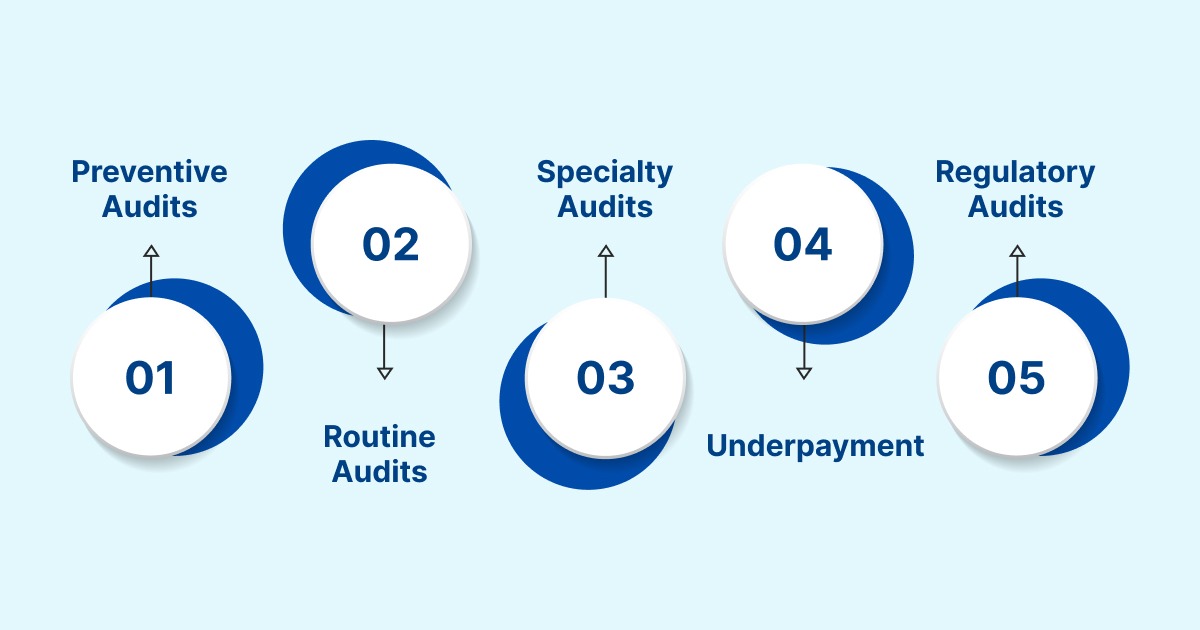
Alt text:How Do Healthcare Audits Strengthen Your Revenue Cycle?
Below are the key types of healthcare audits that achieve these goals:
Preventive Audits / Prospective Auditing: Before submitting high-risk claims, such as new codes or high-dollar items, sample chart reviews identify errors early. Sampling focuses on risk-prone providers or service lines to prevent denials and revenue loss.
Routine Audits (Retrospective): Periodic reviews across registration, medical billing, coding, and appeals reveal historical error rates, root causes, and financial impact, enabling teams to adjust their workflows and prevent repeat mistakes.
Specialty Audits: Targeted reviews in HCC coding, risk adjustment, medical necessity, and modifier usage ensure accuracy, optimize reimbursement, and reduce compliance risk.
Underpayment / Recovery Audits: Comparing allowed versus paid amounts identifies underpayments. Organizations can initiate appeals or recoupments to recover lost revenue.
Compliance & Regulatory Audits: Internal audits prepare organizations for CMS, RAC, or OIG reviews. This includes documentation readiness, audit trails, and version control to minimize penalties and ensure compliance.
By embedding audits at every stage, including registration, coding, appeals, and underpayment recovery, healthcare organizations turn auditing into a proactive tool for revenue and risk management.
Conclusion
A well-defined revenue cycle playbook is crucial for healthcare organizations to minimize errors, prevent denials, and maximize cash flow. By standardizing workflows, embedding auditing, and utilizing key metrics, teams can operate proactively and consistently maintain compliance.
AI-powered solutions, such asRapidClaims, complement a revenue cycle playbook by automating coding, denial prevention, and documentation review. Healthcare organizations can process claims more efficiently, enhance accuracy, and enhance audit readiness, all while reducing manual effort and operational risk.
Take the next step in optimizing your healthcare revenue cycle playbook.Request a Free Demo and see how RapidClaims’ AI-powered RPA can transform your healthcare operations and make your team more efficient, accurate, and audit-ready.
Frequently Asked Questions
1. How can I ensure my revenue cycle playbook remains adaptable to regulatory changes?
A. Establish a regular review schedule aligned with industry updates. Assign a compliance team to monitor healthcare regulations and payer policies to ensure adherence. Utilize version control to track changes and train staff on new procedures promptly, thereby maintaining compliance and reducing denials.
2. What role does staff training play in the success of a revenue cycle playbook?
A. Training ensures all team members understand their responsibilities. Regular sessions reinforce best practices and keep staff updated. Scenario-based training enhances problem-solving skills, resulting in more efficient claim processing and fewer errors.
3. How can I track the effectiveness of my revenue cycle playbook?
A. Monitor key performance metrics like denial rates, days in A/R, and clean claim rates. Track trends over time to identify bottlenecks or recurring issues. Regular reviews and audits reveal areas that need updates or process improvements.
4. Can a revenue cycle playbook be customized for different specialties?
A. Yes. Tailor the playbook to specific specialties by including specialized codes, procedures, and payer requirements. This ensures accurate billing and coding practices, which improve reimbursement rates and maintain compliance.
5. What are common pitfalls to avoid when implementing a revenue cycle playbook?
A. Avoid a lack of staff engagement, insufficient training, and outdated procedures. Integrate the playbook with EHR systems and maintain regular updates to ensure seamless integration. Clear communication and system alignment enhance overall effectiveness.
Get the next analysis in your inbox
The Revenue Cycle Briefing — operator-grade research, every other Wednesday. 12,400+ subscribers.
About the author
Ayeesha Siddiqua
Lead Coder · RapidClaims
Ayeesha Siddiqua is a highly experienced medical coding professional with 22 years of expertise in E/M Outpatient, Radiology, and Interventional Radiology (IVR), ensuring coding accuracy, regulatory compliance, and optimized reimbursements at RapidClaims.